AP Syllabus focus:
‘Exclusive national authority also includes implied powers not explicitly listed; they are inferred from the Necessary and Proper Clause to carry out enumerated powers.’
Implied powers explain how the national government can act beyond the Constitution’s written list of powers. The Necessary and Proper Clause is the key constitutional basis for creating laws that implement Congress’s specific, enumerated responsibilities.
Core Idea: From Enumerated to Implied Powers
The Constitution grants Congress enumerated powers—specific powers that are explicitly written (mainly in Article I). In practice, carrying out those powers often requires additional authority that is not spelled out word-for-word.
Implied powers: Powers not expressly written in the Constitution but reasonably inferred as necessary to carry out enumerated powers.
Implied powers matter because modern governance requires flexibility: a short list of written powers must be applied to new problems, institutions, and technologies.
The Necessary and Proper Clause as the Source
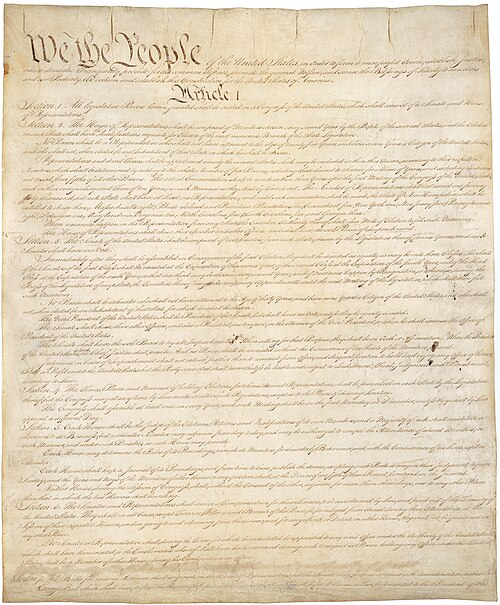
This image is a high-resolution primary-source scan of the U.S. Constitution’s first page, showing the Preamble and the start of Article I. Seeing the original document reinforces that Congress’s powers are textually grounded in Article I and helps students situate the Necessary and Proper Clause within the broader structure of enumerated legislative authority. Source
Necessary and Proper Clause (Elastic Clause): Constitutional provision that permits Congress to pass laws needed to carry out its enumerated powers and other constitutional responsibilities.
This clause is not a stand-alone grant to do anything; it is a tool for implementing powers the Constitution already gives to the national government.
How Implied Powers Work (Conceptual Steps)
When Congress considers whether it can legislate in an area not explicitly mentioned, the logic typically follows this chain:
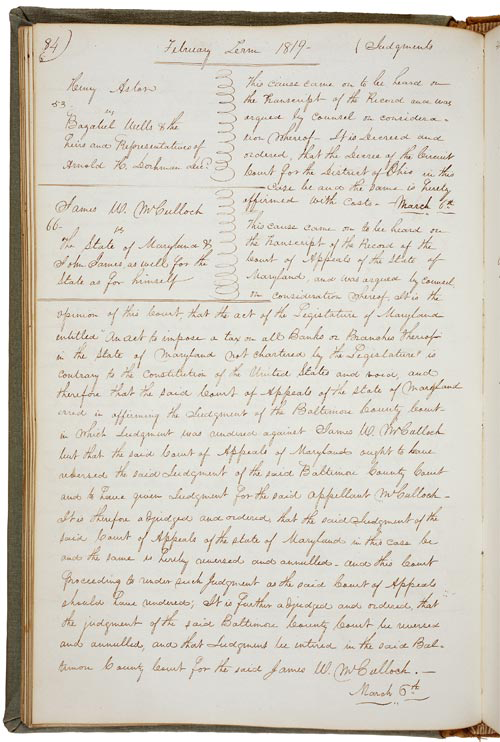
This image reproduces a page from the Supreme Court’s documentation of McCulloch v. Maryland (1819), the foundational case interpreting implied powers through the Necessary and Proper Clause. It supports the “ends–means” reasoning in constitutional analysis: if Congress pursues a legitimate enumerated end, it may choose appropriate means not expressly listed in the Constitution. Source
Identify an enumerated power (e.g., taxation, spending, regulating interstate commerce, raising armed forces).
Determine the legitimate constitutional objective tied to that power.
Choose a means that helps achieve that objective.
Justify the law as necessary and proper to carry out the enumerated power.
The key dispute is often over what counts as “necessary” and how closely the means must connect to the listed power.
Why This Expands Exclusive National Authority
The syllabus emphasis is that exclusive national authority is not limited to the enumerated list; it also includes implied powers inferred from the Necessary and Proper Clause. This makes national power more workable because Congress can:
Create structures and procedures needed to administer national policy
Adapt existing powers to new circumstances (without needing constant amendments)
Fill in operational details that the Constitution intentionally leaves open-ended
At the same time, implied powers are still constrained: they must be connected to a constitutional responsibility, and they remain subject to constitutional limits (for example, protections for rights and the broader structure of divided power).
Common Areas Where Implied Powers Appear
Implied powers are most visible when Congress needs mechanisms to execute its listed powers. Typical categories include:
Administrative capacity: setting up offices, rules, and enforcement systems to implement laws
Financial and fiscal tools: designing practical methods to collect revenue, manage funds, or support national priorities
National problem-solving: choosing policy instruments that help carry out enumerated goals even when the instrument itself is not named in the Constitution
Limits and Ongoing Disagreement
Even though implied powers are constitutionally grounded, disagreement persists over their scope:
Broad view: “Necessary” can mean useful or appropriate for carrying out an enumerated power.
Narrow view: “Necessary” should mean strictly essential, limiting Congress to only the most direct methods.
These competing interpretations shape debates over whether particular federal laws are valid uses of implied powers or improper expansions of national authority.
Practice Questions
(1–3 marks) Define implied powers and explain how the Necessary and Proper Clause is used to justify them.
1 mark: Correct definition of implied powers (not written but inferred).
1 mark: Identifies Necessary and Proper Clause as constitutional basis/authority.
1 mark: Explains link: clause allows laws to carry out enumerated powers.
(4–6 marks) Explain how implied powers derived from the Necessary and Proper Clause can expand exclusive national authority while still being limited by the Constitution.
1 mark: States implied powers expand federal action beyond enumerated list.
1 mark: Connects expansion specifically to Necessary and Proper Clause implementation function.
1 mark: Explains “means to an enumerated end” logic (law must relate to a listed power).
1 mark: Gives a clear way expansion occurs (e.g., creating mechanisms/structures/tools).
1 mark: Identifies at least one constitutional constraint (must tie to enumerated power; cannot violate constitutional limits).
1 mark: Describes broad vs narrow disagreement over what “necessary” means.
FAQ
The text is ambiguous, so “necessary” can be argued either way.
A narrow reading treats it as “indispensable”.
A broad reading treats it as “useful” or “convenient” for implementing enumerated powers.
Not on its own. It operates as an implementing clause.
A valid argument normally links a law to a separate enumerated power and then claims the law is a reasonable means to execute that power.
Implied powers come from the Constitution by inference (especially the Necessary and Proper Clause).
“Inherent” powers are claimed to stem from national sovereignty and statehood rather than specific constitutional text, making them more controversial.
Because it allows Congress to stretch its capacity to implement enumerated powers as conditions change.
That “elasticity” is about selecting methods, not creating entirely new constitutional goals.
Challenges often focus on the closeness of fit between the law and the enumerated power.
Common approaches include:
Claiming the law is too remote from the listed power
Arguing it invades areas better left to states
Arguing it conflicts with another constitutional limit