

AP Syllabus focus: ‘Muslim scholars preserved and commented on Greek philosophy, fostered learning in Baghdad’s House of Wisdom, and promoted transfers in Muslim and Christian Spain.’
Knowledge moved across Afro-Eurasia through conquest, trade, and scholarship. From Baghdad to Iberia, Muslim intellectual centres preserved Greek philosophy, expanded it through commentary, and helped transmit it into Latin Christian Europe.
Core Idea: Preservation, Synthesis, Transmission
Why Greek philosophy mattered in the Islamic world
Greek works (especially Aristotle and Plato) were valued for logic, ethics, metaphysics, and natural philosophy. Muslim scholars engaged them to:
Support administration and education through training in logic and rhetoric
Address theological questions in dialogue with revelation (e.g., reason and faith)
Build a shared scholarly language across diverse regions and peoples
“Preserved and commented on” as intellectual practice
Preservation was not passive copying. Scholars often:
Produced Arabic translations from Greek or Syriac intermediaries
Wrote commentaries explaining arguments, resolving contradictions, and clarifying terminology
Created syntheses that blended Greek philosophy with Islamic thought, shaping later debates
Baghdad and the House of Wisdom
Baghdad as a hub of learning
Under the Abbasids, Baghdad became a magnet for scholars and texts, connecting older learning traditions from the eastern Mediterranean, Persia, and beyond.
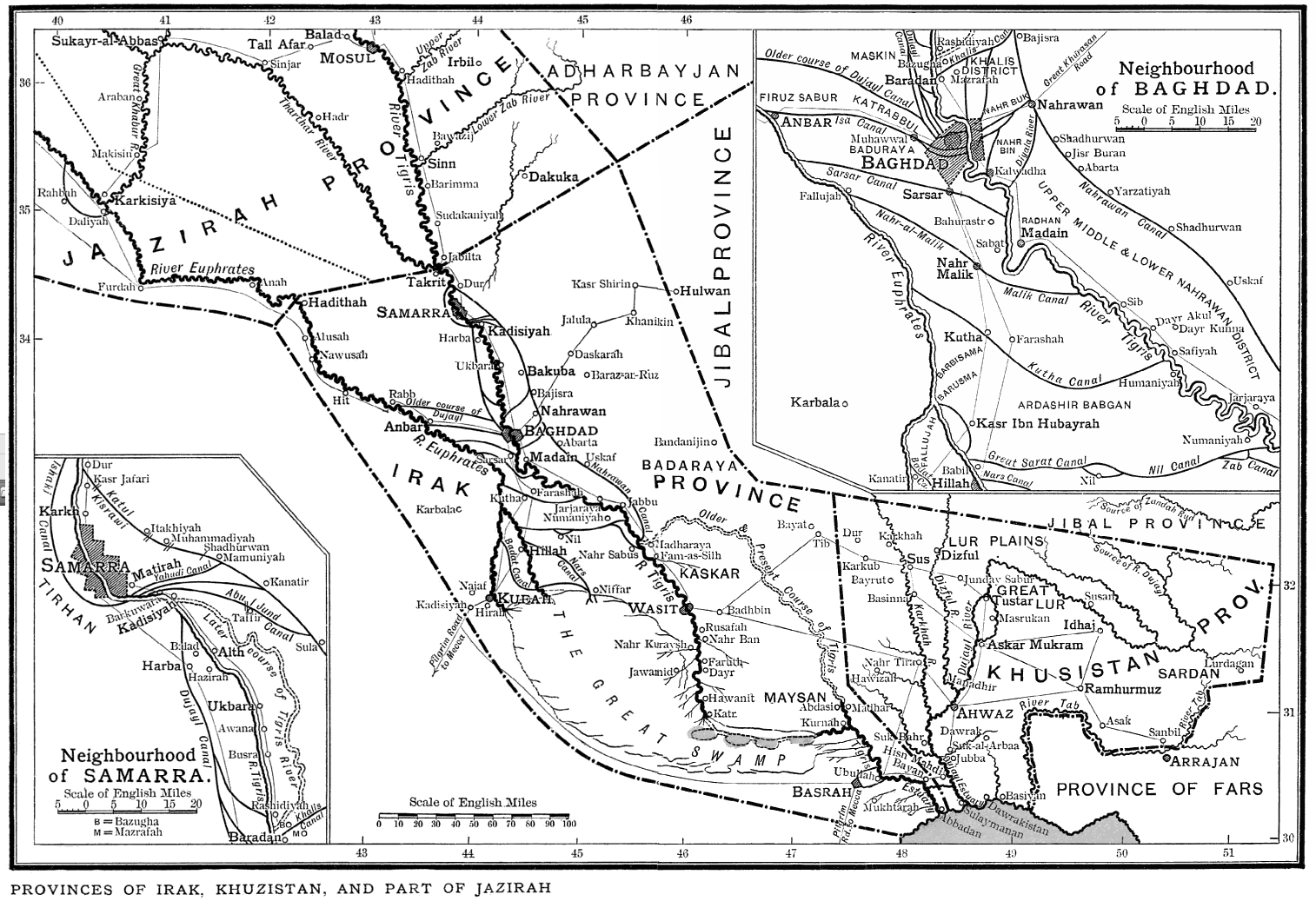
Map of Abbasid-era Iraq and nearby Khuzestan with inset maps highlighting the vicinity of Baghdad (and Samarra). By locating Baghdad within major river systems and regional connections, it helps explain the city’s strategic advantages for attracting texts, people, and scholarly networks. Source
House of Wisdom (Bayt al-Hikma): An Abbasid-era scholarly centre in Baghdad associated with translation, study, and production of works in philosophy and related fields.
The translation-and-scholarship “pipeline”
A typical process that linked Greek philosophy to new audiences included:
Collection of manuscripts through diplomacy, purchase, and scholarly travel
Translation into Arabic (often via Syriac Christian scholarly networks)
Editing and standardising key texts for teaching and copying
Commentary-writing that adapted Greek ideas to new questions and audiences
Translation activity helped make Arabic a major language of philosophy, while commentaries made difficult works usable for students, jurists, and court intellectuals.
Philosophers and commentators as transmitters
Muslim thinkers became authoritative interpreters of the Greek tradition. Their writings mattered because later readers in multiple regions encountered Greek ideas through these commentaries.
Ibn Sina (Avicenna): developed influential philosophical syntheses that shaped later intellectual debates
Ibn Rushd (Averroes): produced extensive commentaries on Aristotle that became central to later Latin European study of Aristotelian philosophy
Knowledge Transfer in Muslim and Christian Spain
Al-Andalus as a crossroads
In Muslim Spain (al-Andalus), diverse communities interacted in cities that supported scholarship, libraries, and elite patronage.
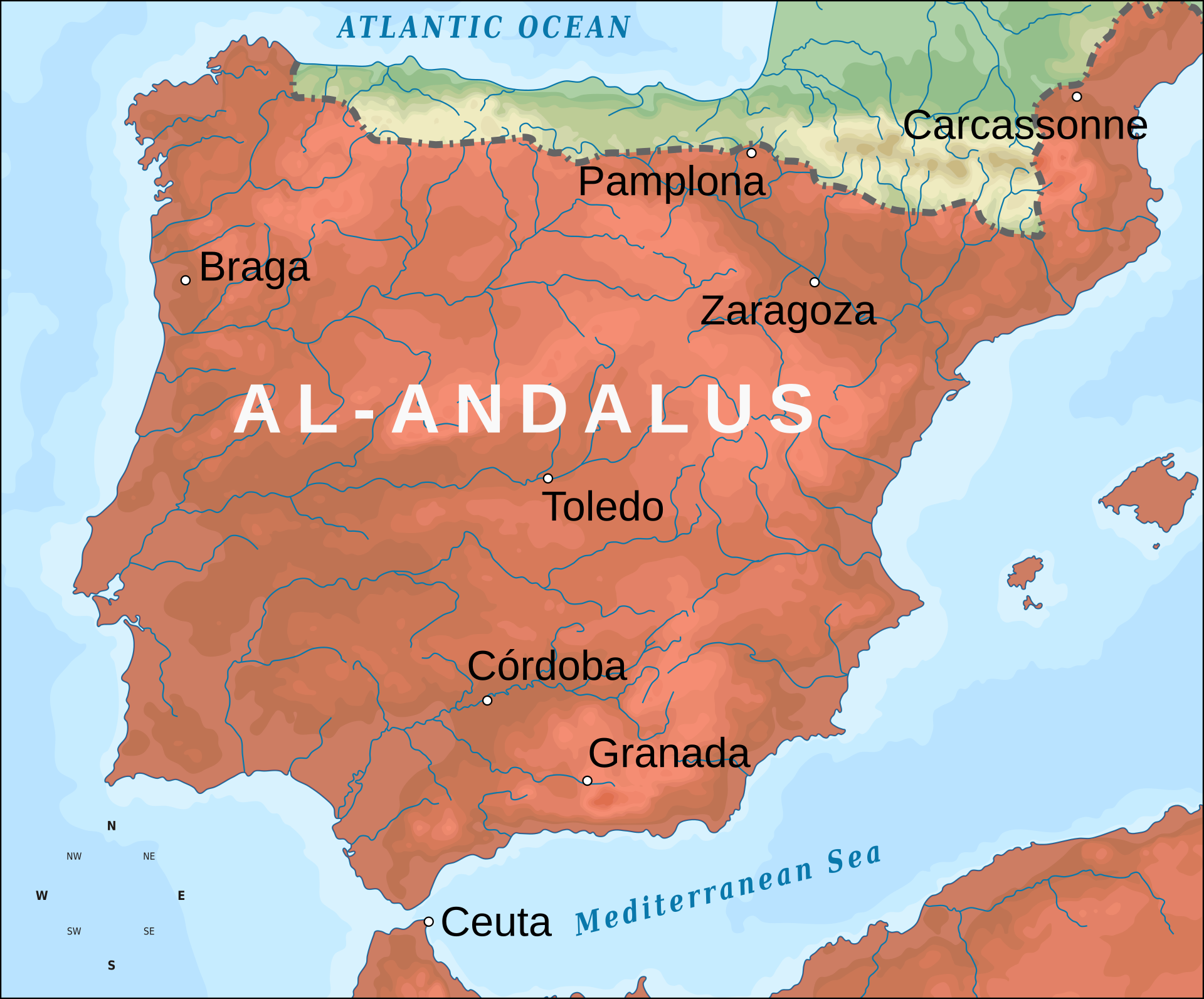
Labeled map showing the territory of al-Andalus in 732, highlighting Iberia’s early integration into the Islamic world. Even though your notes focus more on later translation into Latin, the map still supports the ‘crossroads’ idea by visually framing Iberia’s position between the western Mediterranean and Latin Christian kingdoms. Source
The region’s importance lay in access and connectivity:
Proximity to the western Mediterranean and Latin Christian kingdoms
Multilingual environments (Arabic, Hebrew, Latin, Romance vernaculars)
Scholarly networks that linked Iberia to North Africa and the broader Islamic world
Transmission into Latin Christendom
In Muslim and Christian Spain, translators and scholars helped move philosophical works into Latin, often using Arabic versions and commentaries as the bridge.
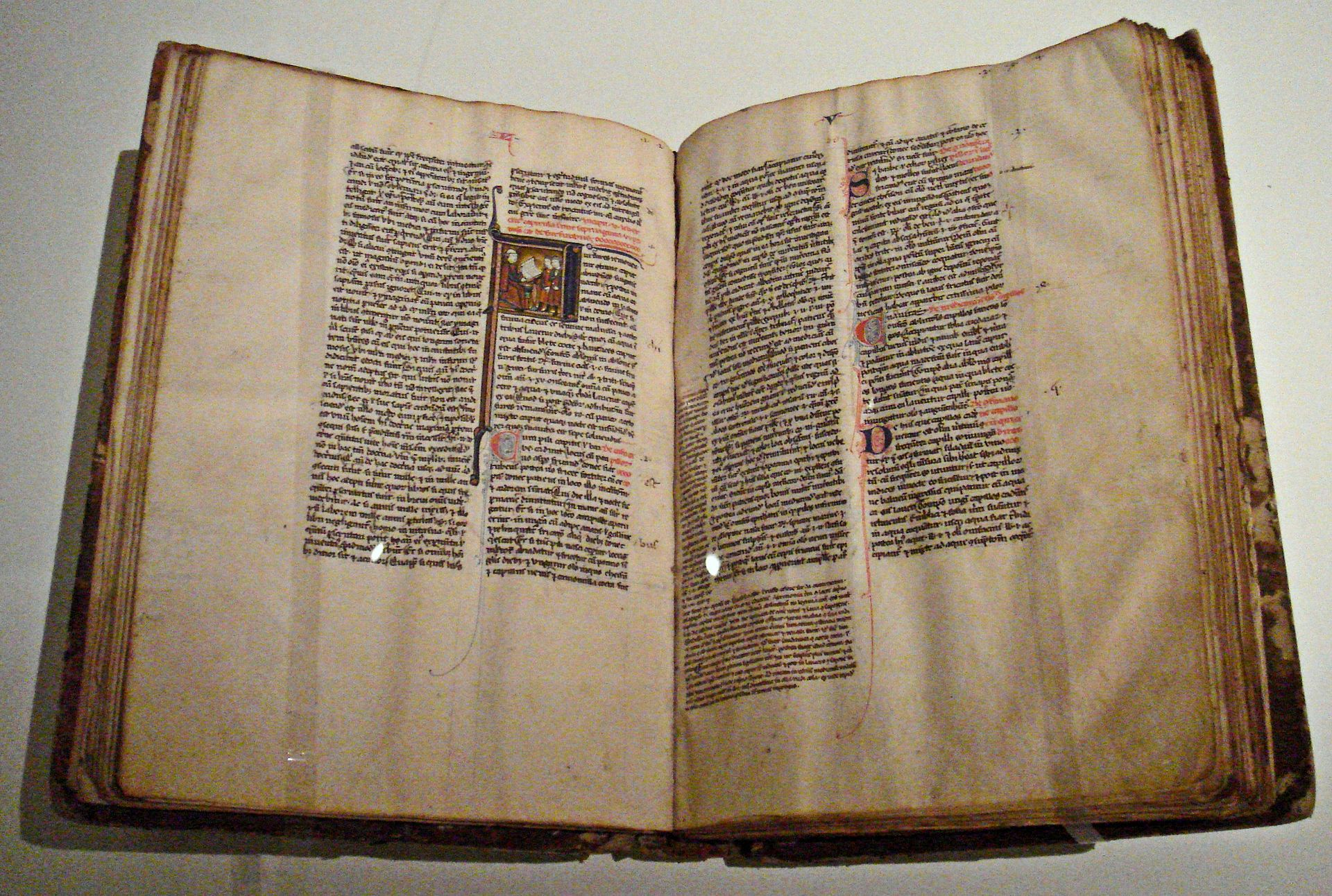
Photograph of a medieval manuscript tradition connected to Latin translation from Arabic, credited here to Gerard of Cremona (active in Toledo’s translation environment). This kind of manuscript evidence makes the Iberian “bridge” tangible by showing how Arabic scholarship was materially recopied, translated, and circulated for new Latin-reading audiences. Source
Key features of this transfer included:
Translation of philosophical texts from Arabic into Latin
Use of commentaries (especially on Aristotle) as teaching tools
Circulation of these works into European schools and universities, where they informed scholastic methods of reasoning and disputation
This Iberian conduit mattered because many Latin readers gained access to Aristotelian logic and natural philosophy alongside the interpretive frameworks developed by Muslim commentators.
What “transfers” changed in practice
As texts crossed linguistic and religious boundaries, they were often:
Reorganised into curricula (logic first, then natural philosophy and metaphysics)
Read through layers of commentary that shaped interpretation
Debated for compatibility with Christian theology, increasing the demand for precise definitions and logical argument
Practice Questions
Identify one way Muslim scholars contributed to the transmission of Greek philosophy. (2 marks)
1 mark: Identifies a valid contribution (e.g., translating Greek works into Arabic; writing commentaries on Aristotle; organising study in Baghdad).
1 mark: Provides a specific example or brief elaboration (e.g., House of Wisdom; Ibn Rushd’s commentaries).
Explain how Baghdad and Spain each facilitated knowledge transfer of Greek philosophy in the period c. 1200 to c. 1450. (5 marks)
1 mark: Explains Baghdad’s role as a scholarly hub (translation/study networks).
1 mark: Links Baghdad to the House of Wisdom and/or translation activity.
1 mark: Explains Spain’s role as a crossroads enabling Arabic-to-Latin transmission.
1 mark: Describes mechanisms in Spain (translation, multilingual communities, circulation to schools).
1 mark: Uses at least one accurate piece of supporting evidence (e.g., Ibn Rushd/Averroes; Aristotle; al-Andalus).
FAQ
Syriac scholars often had long-standing access to Greek learning and educational traditions.
They could act as intermediaries by translating Greek texts into Syriac and supporting later Arabic translations, helping preserve specialised philosophical vocabulary across languages.
Commentaries did more than restate ideas; they shaped how readers understood them.
They clarified difficult passages, proposed interpretations, and connected arguments to new questions—so later Latin readers often encountered Greek philosophy through an interpretive lens rather than a “neutral” text.
Translators had to map technical terms across languages with different intellectual histories.
Small choices (e.g., how to render “substance” or “intellect”) could steer debate, standardise certain interpretations, and make some arguments seem more compatible—or less compatible—with religious doctrine.
Iberia combined geographic proximity with multilingual scholarly settings.
In some areas, scholars could collaborate across Arabic and Latin, accelerating translation and making it easier for texts and teaching materials to circulate into European educational networks.
Both mattered, but in different ways:
States and elites funded libraries, schools, and patronage
Individuals (translators, teachers, commentators) did the specialised work that made texts readable and teachable across languages


.svg)
