CIE Syllabus focus:
'Candidates should understand the differing information needs of owners, managers, employees, investors, lenders, suppliers, customers, government and public bodies.'
Accounting information is useful only when it meets the needs of the people who rely on it. Different users focus on different figures because their decisions, risks, and priorities are not the same.
Understanding the users
Every business produces accounting information such as statements of profit or loss, statements of financial position, and supporting records.
These are used by different people to judge performance, financial strength, and future prospects.
When these people are considered together, they are often called stakeholders.
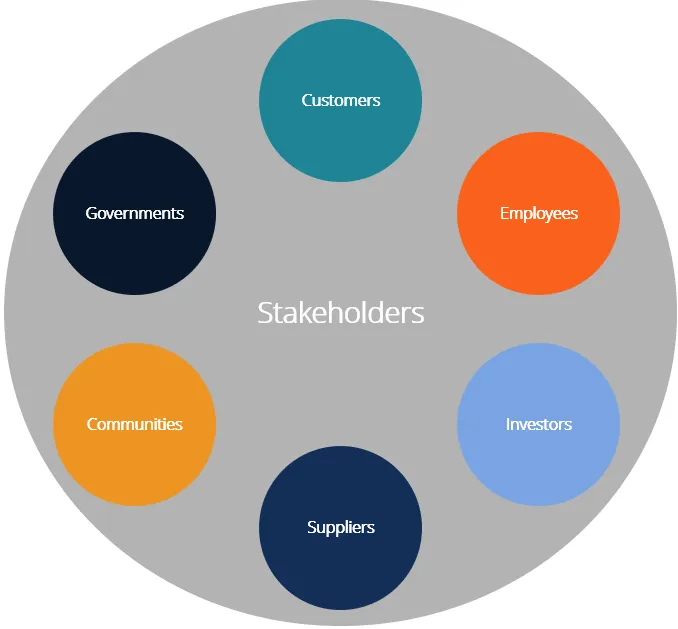
A stakeholder diagram showing key internal and external groups (e.g., employees, investors, suppliers, customers, and government) arranged around the central concept of the business. It supports the idea that accounting information is designed for multiple audiences, each with different decisions and risks. Source
Stakeholder: Any person or organization with an interest in the performance, financial position, or future of a business.
Some users are closely involved with the business, while others are outside parties who must judge it mainly from published information. Not all users want the same detail. Some need regular internal reports, while others depend mainly on financial statements. Their needs depend on the decisions they must make and the risks they face.
Owners and managers
Owners
Owners want to know whether the business is successful and whether their investment is being protected. They are interested in:
profitability
growth in capital
the ability of the business to provide drawings or future returns
the overall financial position of the business
For a sole trader or partners, accounting information also helps judge whether the business can support their personal income and long-term goals. Owners are concerned with both present performance and the future strength of the business.
Managers
Managers need accounting information for day-to-day control and long-term planning. Their information is usually more detailed and more frequent than that of most other users. They focus on:
revenue and expense trends
cash available for operations
asset usage
areas of weak performance
whether business plans are being achieved
Managers use this information to make decisions about pricing, spending, staffing, and expansion. Their main concern is effective decision-making and control. Because they are responsible for running the business, they often need accounting information quickly and in a form that supports action.
Employees and investors
Employees
Employees are interested in the stability and continuing success of the business because it affects their jobs and income. They may look for information about:
the ability of the business to pay wages and salaries
job security
whether the business is growing or declining
whether there is enough profit to support future employment
Employees are less concerned with owner returns than with the business’s ability to continue operating successfully. If the business appears weak financially, employees may worry about redundancies, delayed wages, or reduced benefits.
Investors
Investors are people who may buy, or have bought, shares in a company. They use accounting information to assess:
potential return from dividends
likely growth in the value of their investment
the level of risk involved
whether the company appears financially strong
Potential investors compare businesses before deciding where to place funds. Existing investors use the information to decide whether to hold or sell their shares. They are usually concerned with both present performance and future prospects.
Lenders, suppliers, and customers
Lenders
Lenders, such as banks and other loan providers, are mainly concerned with whether the business can repay borrowed money and interest. They examine:

A formula diagram for liquidity measures, showing how the current ratio and quick ratio are calculated from current assets and current liabilities. This connects to lenders’ focus on short-term repayment capacity and the security provided by readily available assets. Source
liquidity
cash flow
existing level of borrowings
the strength of assets and capital
Their interest is not mainly in high profits, but in security and the ability to meet repayment obligations on time. A lender may accept lower profits if cash is strong and repayment appears safe.
Suppliers
Suppliers provide goods or services, often on credit. They want accounting information that helps them decide whether to continue supplying and how much credit to allow. They are interested in:
short-term ability to pay
past payment performance
stability of trading results
whether the business is likely to remain a reliable customer
A supplier is usually more concerned with near-term payment than with long-term expansion plans. If accounts suggest slow payment or financial weakness, a supplier may reduce credit or demand cash terms.
Customers
Customers may need accounting information when they rely on a business for regular supply, after-sales service, or long-term contracts. They may be interested in:
whether the business is likely to continue operating
whether it has the resources to maintain supply
whether it appears financially stable enough to honor guarantees or service agreements
This is especially important where customers depend heavily on one business. Large customers may also review accounting information before entering major contracts with a supplier.
Government and public bodies
Government
The government uses accounting information for several purposes, including:
assessing taxation
checking compliance with legal and reporting requirements
gathering data about business activity in the economy
informing economic policy and regulation
Government departments are interested in accurate and reliable figures, not just profit alone. Accounting information helps them assess what is owed and whether laws have been followed.
Public bodies
Public bodies include organizations such as regulators, local authorities, and agencies involved in oversight or planning. They may use accounting information to:
monitor the financial health of important businesses
support decisions about licenses, grants, or contracts
assess economic impact on employment and communities
protect public interests
Why information needs differ
Different users do not read accounts in the same way because they ask different questions.
Owners ask whether the business is rewarding their commitment.
Managers ask what action should be taken next.
Employees ask whether their jobs are secure.
Investors ask whether risk and return are acceptable.
Lenders ask whether money will be repaid.
Suppliers ask whether credit can be given safely.
Customers ask whether the business can continue serving them.
Government and public bodies ask whether legal, tax, and wider economic responsibilities are being met.
This means the same set of accounts can be useful to many groups, but each group will focus on different figures and disclosures.
Practice Questions
State one information need of an owner and one information need of a lender. [2]
1 mark for a valid owner information need, such as profitability, growth in capital, financial position, or ability to provide returns.
1 mark for a valid lender information need, such as ability to repay a loan, liquidity, cash flow, or security of assets.
Explain the accounting information needs of managers, suppliers, and government. [6]
Managers:
1 mark for identifying a valid need, such as detailed information on revenue, expenses, cash, or performance.
1 mark for explaining that this is used for planning, control, and decision-making.
Suppliers:
1 mark for identifying a valid need, such as short-term liquidity, payment ability, or creditworthiness.
1 mark for explaining that this helps decide whether to allow credit or continue supplying goods.
Government:
1 mark for identifying a valid need, such as profit, revenue, or records for taxation and compliance.
1 mark for explaining that this is used to assess tax liabilities and ensure legal requirements are met.
Accept any other relevant valid points.
FAQ
Small business owners are often directly involved in daily operations, so they may want very specific information about cash availability, personal drawings, and short-term survival.
Shareholders in large companies are usually less involved in management. They are more likely to focus on overall return, dividend potential, and long-term growth in share value.
Different users need information at different speeds.
Managers may need it daily or monthly.
Lenders may need it before approving a loan.
Tax authorities may rely on annual reporting periods.
Information that arrives too late may still be accurate, but it may no longer be useful for decision-making.
A supplier may want more current or more detailed evidence than annual accounts can provide.
They might request:
recent management figures
bank references
trade references
information about current payment patterns
This helps the supplier judge immediate payment risk rather than relying only on older published data.
Yes. Public bodies may still have an interest in a business because of its wider effect on society.
They may look at accounting information to assess:
local employment impact
continuity of essential services
compliance with regulations
market behavior in regulated industries
Their concern is often public interest rather than private return.
Businesses cannot always share all accounting information with every user.
Reasons include:
protection of commercial secrets
legal restrictions
privacy concerns
competitive risk
As a result, internal users often receive much more detailed information than external users. This can affect the quality of decisions made by outside parties.