

CIE Syllabus focus:
'Candidates should calculate profitability ratios, including gross profit margin, mark-up, profit margin, return on capital employed and expenses to revenue ratio.'
Profitability ratios show how effectively a business turns sales, costs, and invested funds into profit. For CIE A-Level Accounting, success depends on choosing the correct figures and expressing each answer clearly as a percentage.
Understanding profitability ratios
Profitability ratios measure the earning performance of a business. They link profit to another accounting figure, such as revenue, cost of sales, expenses, or capital employed. Because they focus on relationships rather than absolute amounts, they make accounting data more meaningful.
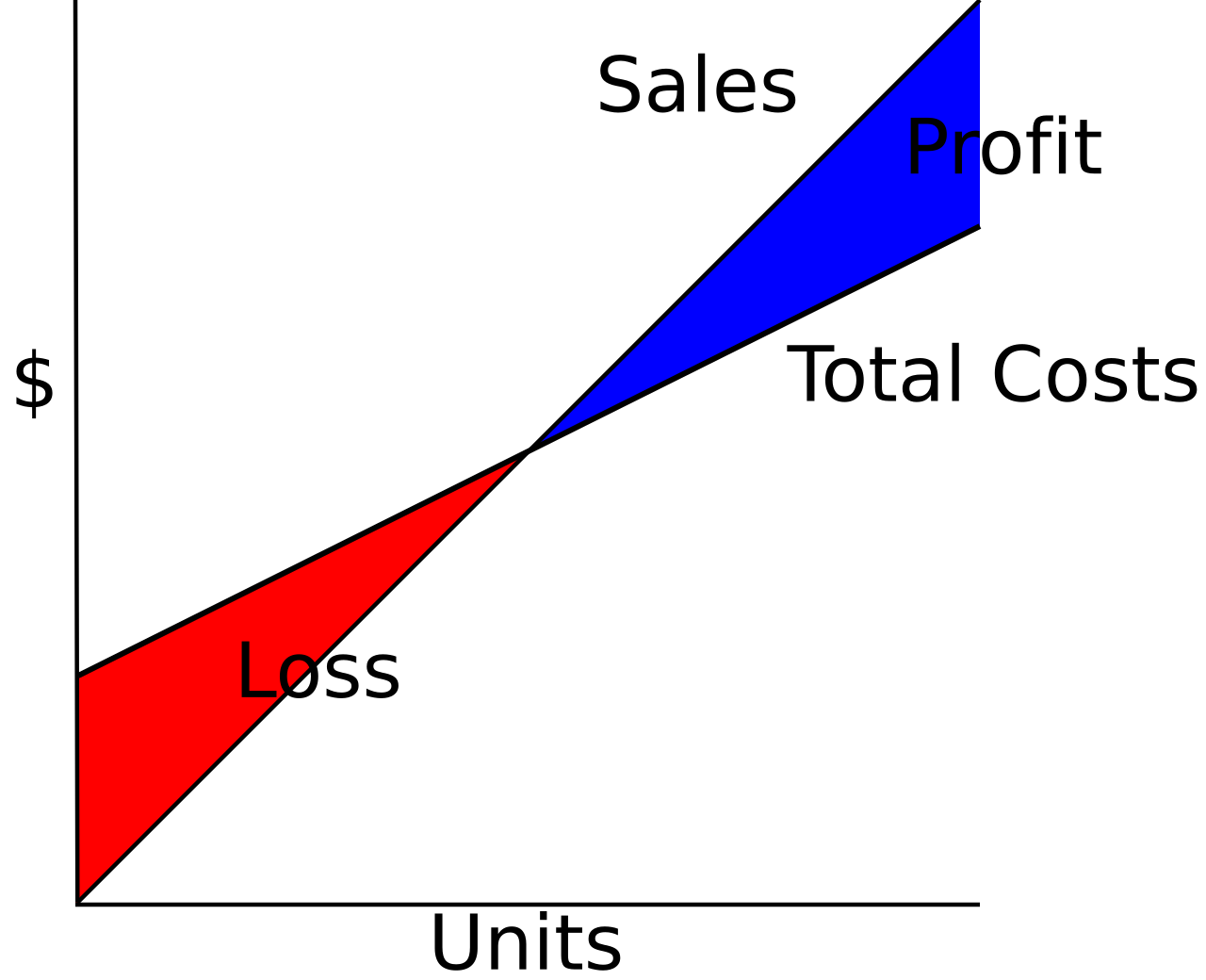
A cost–volume–profit style diagram plotting sales (revenue) and total costs against output/volume, with profit and loss regions clearly indicated. It builds intuition for why profitability metrics depend on relationships (e.g., how changes in revenue or costs change profit), even before converting those relationships into ratios. Source
In examination questions, the figures used usually come from the statement of profit or loss and the statement of financial position. Before calculating any ratio, identify the correct profit figure. Gross profit is not the same as profit from operations, and using the wrong one gives an incorrect ratio even if the arithmetic is accurate.
When source figures are listed separately, use the final adjusted totals needed for the ratio. For example, revenue should reflect any returns already deducted, and expense figures should match the period being measured. Profitability ratios are only as reliable as the accounting figures used.
Most profitability ratios are expressed as a percentage, so the final figure is normally multiplied by 100. A ratio of 25% shows that the business earns 25 cents of profit for every 1 of the relevant base figure.</p><h2 class="editor-heading" id="gross-profit-measures"><strong>Gross profit measures</strong></h2><h3 class="editor-heading"><strong>Gross profit margin</strong></h3><p><strong>Gross profit margin</strong> measures gross profit as a percentage of revenue.</p><img src="https://tutorchase-production.s3.eu-west-2.amazonaws.com/db7d24a9-4929-4f42-a43e-df5cdfd159c8-file.png" alt="Pasted image" style="width: 820px; height: 172px; cursor: pointer;" width="820" height="172" draggable="true"><p><em>An equation-style visual showing gross profit margin as a percentage of revenue, with cost of goods sold (COGS) subtracted to obtain gross profit. This helps students see the structure “profit figure ÷ base figure × 100” and why the denominator must be revenue for gross profit margin. </em><a rel="noopener noreferrer nofollow" href="https://www.xero.com/us/guides/what-is-gross-profit-margin/"><span style="color: #001A96"><em>Source</em></span></a></p><p>It shows how much of sales income remains after deducting the <strong>cost of sales</strong>.</p><div class="example-section"><p>Gross\ Profit\ Margin=\dfrac{Gross\ Profit}{Revenue}\times 100Gross\ ProfitRevenueMarkup=\dfrac{Gross\ Profit}{Cost\ of\ Sales}\times 100Gross\ ProfitCost\ of\ SalesProfit\ Margin=\dfrac{Profit\ from\ Operations}{Revenue}\times 100Profit\ from\ OperationsRevenueExpenses\ to\ Revenue\ Ratio=\dfrac{Expenses}{Revenue}\times 100ExpensesRevenueROCE=\dfrac{Operating\ Profit}{Capital\ Employed}\times 100. </em><a rel="noopener noreferrer nofollow" href="https://corporatefinanceinstitute.com/resources/accounting/return-on-capital-employed-roce/"><span style="color: #001A96"><em>Source</em></span></a></p><div class="takeaways-section"><p><strong>Capital employed:</strong> The long-term finance used in a business, commonly measured as total assets less current liabilities or as equity plus non-current liabilities.</p></div><p>The exact method of finding capital employed must match the information given in the question and the approach expected by your course.</p><div class="example-section"><p>Return\ on\ Capital\ Employed=\dfrac{Profit\ from\ Operations}{Capital\ Employed}\times 100Profit\ from\ OperationsCapital\ Employed$ = Long-term funds invested in the business, monetary amount
ROCE is useful because it connects profit with the resources used to generate that profit. In calculation questions, check whether non-current liabilities form part of capital employed, because they are often included with equity as long-term finance.
Accuracy in examination answers
Careful presentation is important when calculating profitability ratios. Examiners often award credit for method as well as the final answer, so write the formula clearly before substituting figures when required.
Common points to remember include:
use figures from the same accounting period
make sure revenue is not confused with cash received
distinguish between gross profit and profit from operations
use cost of sales for mark-up, not revenue
express final answers as percentages
apply any instruction on rounding consistently
check that the ratio name matches the formula used
If a ratio answer seems unreasonable, recheck the denominator first. Many profitability ratio errors arise not from arithmetic, but from selecting the wrong accounting figure.
Practice Questions
A business has revenue of 50 000.
Calculate the gross profit margin. [2]
Gross profit = Gross\ Profit\ Margin=\dfrac{30000}{80000}\times 100=37.5%$ (1)
A business has the following figures for the year ended 31 December:
Revenue 180 000
Distribution expenses 36 000
Profit from operations 210 000
Long-term bank loan $40 000
Calculate: (a) mark-up [1] (b) profit margin [1] (c) total operating expenses to revenue ratio [2] (d) return on capital employed [2]
(a) (1)
(b) (1)
(c) Total operating expenses = Expenses\ to\ Revenue\ Ratio=\dfrac{60000}{300000}\times 100=20%250 000 (1)
(d) (1)
FAQ
Both ratios use the same gross profit figure, but they divide by different amounts.
Gross profit margin uses revenue as the denominator.
Mark-up uses cost of sales as the denominator.
Because revenue is larger than cost of sales whenever gross profit exists, dividing by cost of sales produces the larger percentage. If a student gets a lower mark-up than gross profit margin from the same figures, the denominators have probably been mixed up.
They affect the underlying figures before the ratio is calculated.
Sales returns reduce revenue, so they can change gross profit margin, profit margin, and expenses to revenue ratios.
Trade discounts are usually deducted before the transaction is recorded, so revenue and purchases are entered at the net amount. This means the discount does not appear separately in the ratio calculation.
Always use the final recorded figures, not the original invoice amounts.
Older assets may have a low carrying amount because of accumulated depreciation. That reduces capital employed in the denominator.
If profit from operations remains steady while capital employed falls, ROCE increases. This can make a business appear more efficient even when its actual trading performance has not improved much.
That is why ROCE should be read carefully when a business has:
heavily depreciated assets
outdated equipment still in use
a very low book value for long-term assets
Yes. ROCE can rise if capital employed falls while operating profit stays the same.
This might happen if a business:
repays a long-term loan
sells underused non-current assets
reduces working capital tied up in the business
A higher ROCE is not always caused by better profit generation. Sometimes it results from using a smaller long-term investment base.
The two ratios answer different questions.
Gross profit margin focuses on the share of revenue kept as gross profit. Mark-up focuses on how much profit is added to the cost of goods.
Using both helps retailers judge:
pricing policy
purchasing costs
product profitability
whether selling prices are high enough relative to cost
A business might set prices by adding a mark-up to cost, but managers may still prefer gross profit margin when reviewing sales performance.

