

CIE Syllabus focus:
'Candidates should understand how to communicate and analyse accounting information required by different stakeholders.'
Accounting information is only useful when it is presented clearly and interpreted correctly. Different stakeholders need different forms of explanation so they can make informed business and financial decisions.
Purpose of communicating accounting information
Accounting information becomes useful only when it is presented in a form that the user can understand and apply. Effective communication links financial data to the decision being made by the stakeholder.
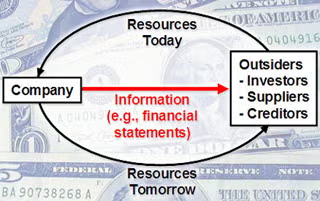
This diagram illustrates the role of financial accounting as an information bridge between a company and external parties who provide resources (for example, capital or credit). It reinforces the idea that accounting communication is not just reporting numbers—it supports real decisions and transactions. Use it to connect “stakeholder decisions” to the need for understandable, decision-relevant reporting. Source
Stakeholder: Any person or group with an interest in the financial performance, financial position, or future of a business.
A stakeholder is not simply given figures; the figures must be selected, organized, and explained. Communication therefore includes both the content and the presentation of accounting information. Analysis adds meaning by showing what the numbers suggest about performance, financial position, or financial risk.
Why communication matters
It supports decisions, such as whether to invest, lend, extend credit, or continue dealing with the business.
It reduces misunderstanding by explaining significant changes rather than presenting totals alone.
It improves accountability because users can judge whether management has used resources effectively.
It allows comparisons over time when information is presented consistently.
It helps the stakeholder focus on the items that are most relevant to their decision.
Matching information to stakeholder needs
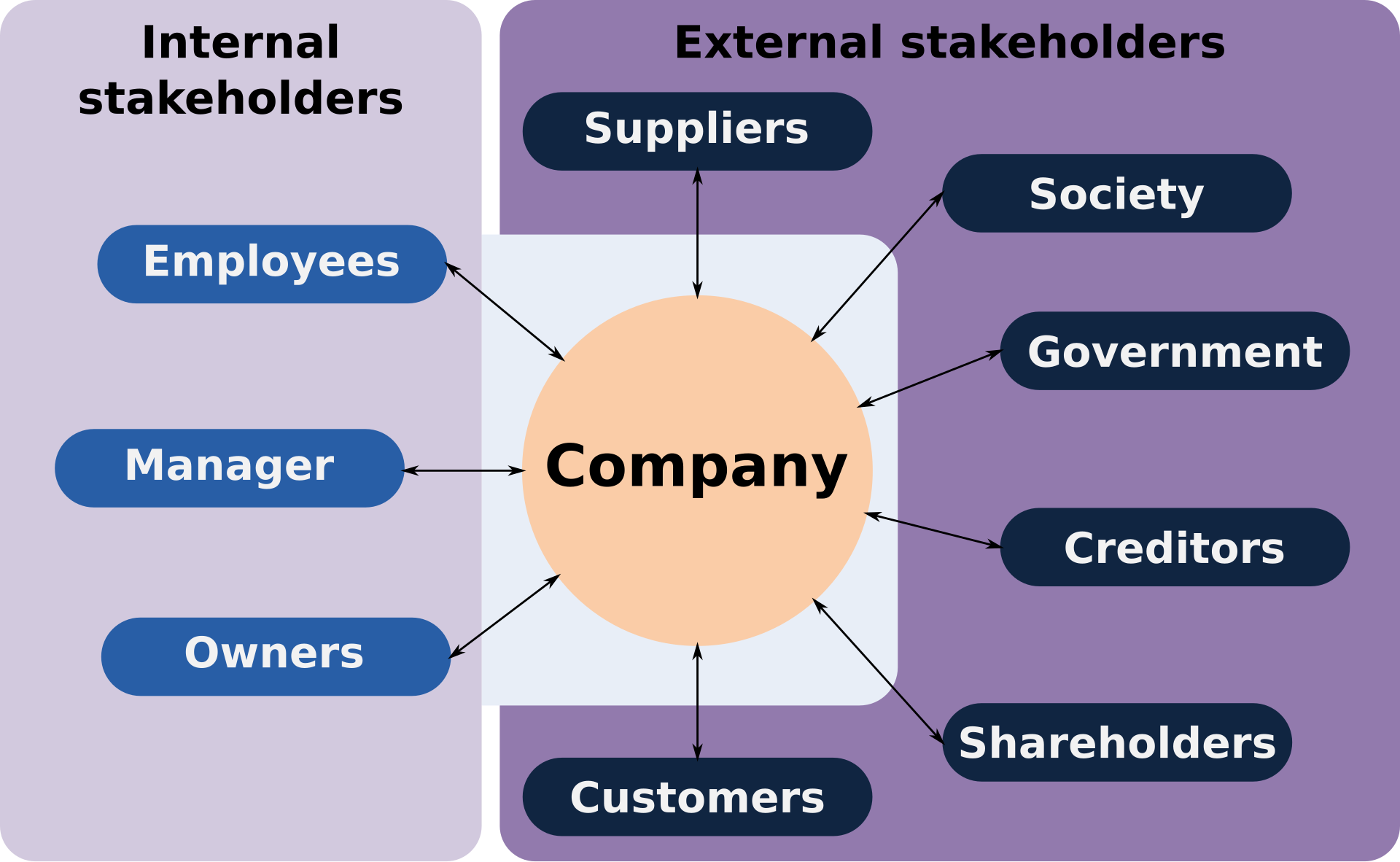
This stakeholder map shows a business at the center with key stakeholder groups arranged around it and classified as internal versus external. It helps explain why the same underlying accounting figures may need different presentation and emphasis depending on who is using the information. The diagram is especially useful for linking stakeholder identity to communication style and decision needs. Source
The first step is to identify who the stakeholder is and what decision they are trying to make. The same financial statements may be communicated differently depending on whether the audience is internal or external.
Internal stakeholders
Managers usually need detailed and frequent information. Monthly or quarterly reports are often more useful to them than a year-end summary. Their analysis may focus on changes in revenue, expenses, cash balances, receivables, payables, and overall financial position so that they can plan, control, and respond quickly.
Owners and directors usually need broader information about the business as a whole. They may want to know whether profit is improving, whether liquidity is strong enough, and whether the financial position supports future growth. Communication should therefore combine the main financial statements with concise commentary explaining important movements and trends.
External stakeholders
Investors and potential investors need information that helps them assess return and risk. A clear annual report, supported by comparative figures and explanation of major changes, is more useful than raw totals alone. They need the numbers to be interpreted in a way that shows whether performance is stable, improving, or weakening.
Lenders want evidence that the business can meet interest and repay capital. Communication should emphasize profitability, liquidity, cash generation, and the level of existing obligations. Analysis should be directed toward the business’s ability to service debt, not just the amount of profit earned in one period.
Suppliers are mainly interested in whether they will be paid on time. A concise analysis of short-term financial strength and payment record is usually more relevant to them than highly detailed long-term information.
Employees, trade unions, and employee representatives may need information about stability, profitability, and the ability of the business to continue operating. This is often communicated in summarized reports or meetings rather than in highly technical form.
Government and public bodies usually require formal, accurate, and timely information. Communication here must be precise, standardized, and supported by proper accounting records.
Analyzing accounting information
Analysis means interpreting the significance of the figures, not merely repeating them. Good analysis asks what has changed, why it has changed, and why that change matters to the stakeholder. A stakeholder should be able to see both the direction and the importance of change.
Useful approaches to analysis
Trend analysis compares current figures with previous periods to identify improvement, decline, or instability.
Comparative analysis compares performance with targets, expectations, or similar businesses when relevant information is available.
Component analysis breaks totals into parts, such as revenue, cost of sales, operating expenses, current assets, and current liabilities, to identify the main cause of change.
Contextual analysis relates figures to business events such as expansion, price changes, rising costs, or altered credit terms.
Decision-focused analysis selects only the points most relevant to the user’s purpose.
Strong analysis avoids isolated figures. For example, an increase in profit may appear favorable, but a stakeholder may also need to know whether cash balances weakened, liabilities increased, or the change resulted from a one-off item. Numbers should therefore be linked to explanation, not presented without context.
Presenting information effectively
Good communication techniques
Use a format suitable for the audience, such as full financial statements, summary reports, briefing notes, presentations, or charts.
Use clear language and avoid unnecessary accounting jargon when communicating with non-specialist users.
Include comparative figures so changes can be seen clearly.
State the accounting period, units, and currency to avoid ambiguity.
Highlight significant items and explain their effect on performance or financial position.
Separate factual reporting from opinion or forecast.
Keep the level of detail appropriate: too much detail hides important points, while too little detail weakens analysis.
Visual presentation can improve understanding, but charts and summaries should support the accounting figures, not replace them. Internal users can usually receive more detailed information because they are involved in running the business. External users often need more formal and concise communication.
Common weaknesses to avoid
A common error is sending the same report to all stakeholders without adapting it to their needs. Another is emphasizing favorable information while ignoring equally important matters, such as worsening liquidity or rising obligations.
Poor communication also occurs when figures are presented without explanation, when major changes are not compared with previous periods, or when analysis does not lead to a clear decision point. Effective communication of accounting information should always be relevant, clear, balanced, and directly linked to the stakeholder’s purpose.
Practice Questions
State two qualities of effective communication of accounting information to stakeholders. (2 marks)
1 mark for each valid quality stated, up to 2 marks.
Valid answers include:
relevance
clarity
timeliness
comparability
appropriate level of detail
balanced presentation
Explain how accounting information should be communicated and analyzed differently for:
(a) managers
(b) suppliers
(6 marks)
Award up to 3 marks for each stakeholder.
(a) Managers:
detailed and frequent internal reports needed (1)
information should include changes in revenue, expenses, cash, receivables, payables, or overall position (1)
analysis should help planning, control, and operational decision-making, with explanations of causes of change (1)
(b) Suppliers:
information should focus on short-term ability to pay and payment reliability (1)
communication is usually more concise and formal than for managers (1)
analysis should help the supplier decide whether to give credit or continue supplying goods (1)
FAQ
The main financial statements give totals, but the notes explain what those totals include and how they were prepared.
They can show:
accounting policies
breakdowns of major balances
unusual items
commitments or contingent matters
Without the notes, a stakeholder may misunderstand the significance of the figures or compare them unfairly with another business.
An audit can increase stakeholder confidence because an independent party has examined the financial statements and supporting evidence.
This does not guarantee that every figure is perfect, but it does make the information more credible for users such as:
investors
lenders
suppliers
regulators
That extra credibility can affect decisions about investment, lending, and credit.
Some businesses earn much more revenue in certain months than in others. If a stakeholder looks at only one reporting date, the figures may give a distorted impression.
For example:
inventory may be unusually high before a busy season
cash may be unusually low after a large purchase
profit at an interim date may not represent the full year
Stakeholders should therefore compare like periods and consider the business cycle.
The business should not change the underlying facts, but it can change the level and style of presentation.
A practical approach is to:
prepare a full set of formal financial statements
give detailed internal reports to managers
provide summarized external reports where appropriate
protect confidential information that is not necessary for outside users
The aim is to keep communication relevant without becoming misleading or incomplete.
A restatement changes previously reported figures, usually because of an error or a change in accounting treatment. This matters because stakeholders often rely on year-to-year comparison.
If prior figures are restated:
trend analysis may change
earlier conclusions may no longer be valid
confidence in reporting quality may be affected
Stakeholders should read the explanation carefully and make sure they compare revised figures with current figures on a like-for-like basis.

.svg)