CIE Syllabus focus:
'Understand the difference between cost centres and cost units, and allocate and apportion overhead expenditure between production and service departments.'
Accurate departmental costing depends on knowing where costs are collected, what output they relate to, and how shared overheads are divided fairly across departments within the business.
Cost centers and cost units
A business first groups costs by cost center so that costs can be monitored and controlled.
Cost center: A location, function, person, or item of equipment for which costs are collected and analyzed.
A cost center is about where costs are incurred. It may be a department, a machine group, a branch, or an administrative section. In manufacturing, departments such as machining, assembly, and maintenance are often treated as separate cost centers.
Once costs have been gathered, they are related to a cost unit.
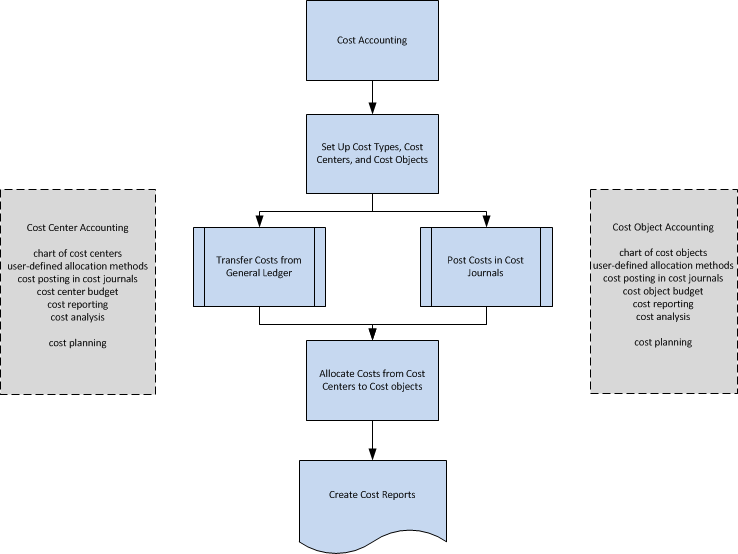
Workflow diagram illustrating a typical cost-accounting process: costs are recorded, collected in cost centres, and then allocated onward to the outputs that bear costs (cost objects). This visual reinforces the logic that costs are first gathered by responsibility/location and only later attached to the final item being costed. Source
Cost unit: A unit of product or service to which costs are charged.
A cost unit is about what is being costed. Examples include one chair, one repair, one passenger mile, or one meal served. The same business may have many cost centers but usually only one or a few suitable cost units for each type of output.
Why the distinction matters
The distinction is important because:
a cost center collects costs for control and analysis
a cost unit is the final unit that carries cost
cost centers help management identify responsibility for spending
cost units help measure the cost of producing goods or providing services
Overhead expenditure and departments
Many costs cannot be traced directly to a single cost unit. These are overhead expenditures.
Overhead expenditure: Indirect cost incurred in operating a business that cannot be directly identified with one specific cost unit.
Overheads include items such as factory rent, lighting, supervision, depreciation of shared equipment, and cleaning. They are incurred to support production, but they are not direct materials or direct labor for one unit of output.
Production and service departments
For departmental costing, businesses often separate production departments from service departments. A production department works directly on the goods or services being provided to customers. A service department supports other departments. Typical service departments include maintenance, stores, canteen, quality control, and factory administration.
This distinction matters because overheads are first collected within departments. A production department is part of the process that creates output, while a service department exists to assist that process. Both types may receive a share of overhead expenditure during the initial departmental analysis.
Allocation and apportionment
When overheads are assigned to departments, two different methods are used. Some overheads can be linked wholly to one department. This is allocation.
Allocation: The direct charging of an entire item of overhead expenditure to one cost center.
If a supervisor works only in Assembly, or if insurance relates only to a machine used in one department, the whole cost can be allocated to that department.
Other overheads are shared by several departments, so they must be divided on a fair basis.
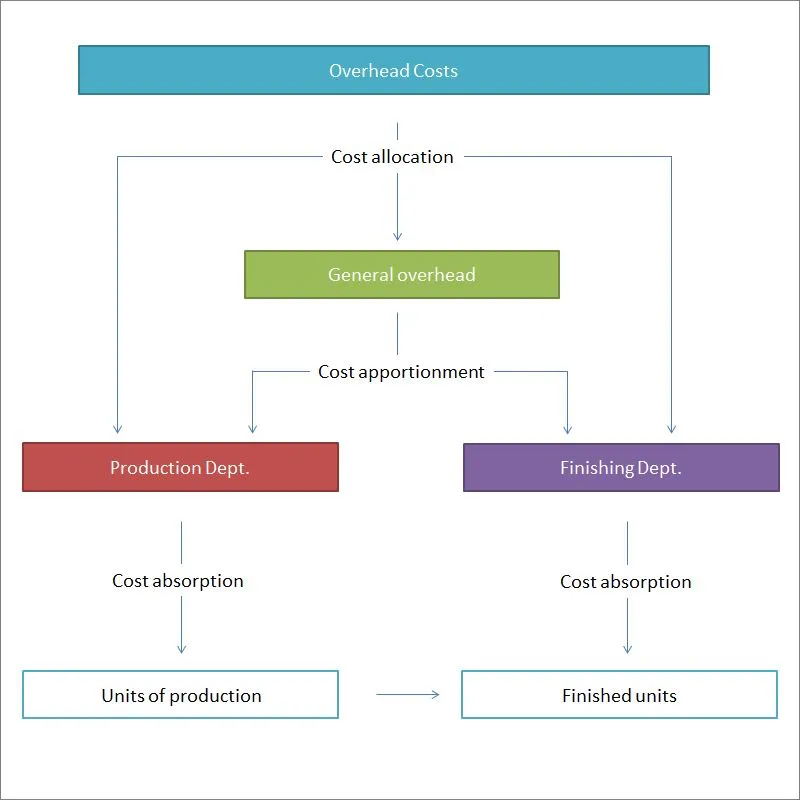
Flow diagram summarizing how overheads move through a costing system: some overheads are allocated directly, while general overheads are apportioned between departments. It then shows how departmental overheads are absorbed into units of production, linking departmental analysis to unit costs. Source
This is apportionment.
Apportionment: The sharing of an item of overhead expenditure between cost centers on a reasonable basis.
Apportionment is used when an overhead benefits more than one department. The basis chosen should reflect how the cost is caused or used.
= overhead assigned to one department
= common overhead to be apportioned
= the department's measure, such as floor area or number of employees
= total of that measure for all relevant departments
This approach avoids arbitrary division. A sensible apportionment basis increases the reliability of departmental cost information and supports better management decisions.
Choosing an apportionment basis
The basis selected should match the nature of the overhead:
Rent, rates, heating, lighting, and building insurance are often apportioned by floor area or cubic space.
Power may be apportioned by machine hours, units consumed, or equipment usage.
Canteen costs may be apportioned by number of employees.
Supervision and welfare costs may be apportioned by number of employees or time supervised.
Depreciation of machinery may be apportioned by asset value or machine usage.
Stores handling costs may be apportioned by the number or value of requisitions.
A good basis is measurable, logical, and consistent. It does not need to be perfect, but it must be justifiable. In exam questions, use the basis provided. If asked to comment, explain why the basis is suitable for that type of cost.
A practical approach to departmental overheads
A clear method is to:
identify each item of overhead expenditure
decide whether it can be allocated directly to one department
if not, choose a suitable basis to apportion it across departments
include both production and service departments in the departmental analysis
total the overheads for each department after all items have been assigned
Common mistakes include confusing cost centers with cost units, allocating a shared cost instead of apportioning it, and using an unsuitable basis simply because it is easy. Another frequent error is to ignore service departments. Even though they do not produce saleable output directly, they still consume resources and must receive their share of overheads in the first stage of departmental costing.
Practice Questions
State two differences between a cost center and a cost unit. (2 marks)
A cost center is a location, function, person, or item of equipment where costs are collected. (1)
A cost unit is a unit of product or service to which costs are charged. (1)
A factory has two production departments, P1 and P2, and one service department, S.
The following overheads are to be assigned:
Rent 10,000, apportioned by floor area
Supervision 8,000, apportioned by number of employees
Machine insurance 5,000, of which 3,000 relates to P1 and 2,000 relates to P2 only
Additional data:
Floor area: P1 6,000 sq. ft., P2 3,000 sq. ft., S 1,000 sq. ft.
Employees: P1 12, P2 6, S 2
Required: (a) Distinguish between the treatment of machine insurance and the treatment of rent. (2 marks)
(b) Calculate the total overhead assigned to each department after allocation and apportionment. (4 marks)
(6 marks)
(a)
Machine insurance is allocated because specific amounts relate directly to named departments. (1)
Rent is apportioned because it is shared between departments on the basis of floor area. (1)
(b)
Rent: P1 6,000; P2 3,000; S 1,000. (1)
Supervision: P1 4,800; P2 2,400; S 800. (1)
Machine insurance: P1 3,000; P2 2,000; S 0. (1)
Totals: P1 13,800; P2 7,400; S 1,800. (1)
FAQ
Yes. In practice, some departments perform mixed roles.
If a department mainly works on customer output, it is usually treated as a production department. If it mainly supports other departments, it is treated as a service department.
Where both roles are significant, a business may:
split the department into two cost centers, or
classify it by its main activity
This improves the fairness of overhead assignment.
Use the most reasonable available basis and apply it consistently.
A good fallback choice should:
have a clear link to how the cost is used
be based on reliable data
be simple enough to apply regularly
Management should also review the basis over time. If the business changes its layout, staffing, or production methods, the old basis may no longer be suitable.
A change may be needed when operations change.
Examples include:
moving to a larger factory
installing more machinery
increasing automation
reorganizing departments
collecting better cost data than before
The aim is not to manipulate costs, but to make departmental overheads more realistic. Any change should be justified and used consistently once adopted.
Sometimes one service department supports another. For example, maintenance may service the canteen, and the canteen may provide meals for maintenance staff.
In that case, a simple one-way split may be less accurate. Businesses may use:
a repeated distribution method, or
a reciprocal approach
These methods recognize mutual support between service departments before costs are finalized for production departments.
Departmental overhead totals can affect how efficiently a manager appears to be operating.
If overheads are assigned on a poor basis:
one manager may seem inefficient unfairly
another may appear better than they really are
comparisons between departments become less reliable
Fair allocation and apportionment improve responsibility accounting and make internal performance reports more useful.