CIE Syllabus focus:
'Prepare costing and profit statements using marginal costing, and reconcile reported profits under marginal costing and absorption costing.'
Marginal costing is a key technique for measuring profit and understanding how inventory affects reported results. It focuses attention on variable cost behavior and explains why profit can differ from absorption costing.
Marginal costing and profit measurement
In marginal costing, only variable production costs are included in the cost of inventory and the cost of goods sold. Fixed production overheads are treated as a cost of the accounting period in which they arise, not as part of inventory valuation.
Marginal costing: A costing method in which units produced are charged only with variable production costs, while fixed production overhead is written off in full to the income statement of the period.
This means profit depends mainly on sales volume, because fixed production overhead does not move into or out of inventory. If units are produced but not sold, their variable production cost remains in closing inventory, but fixed production overhead still reduces profit immediately.
The key figure in a marginal costing statement is contribution.
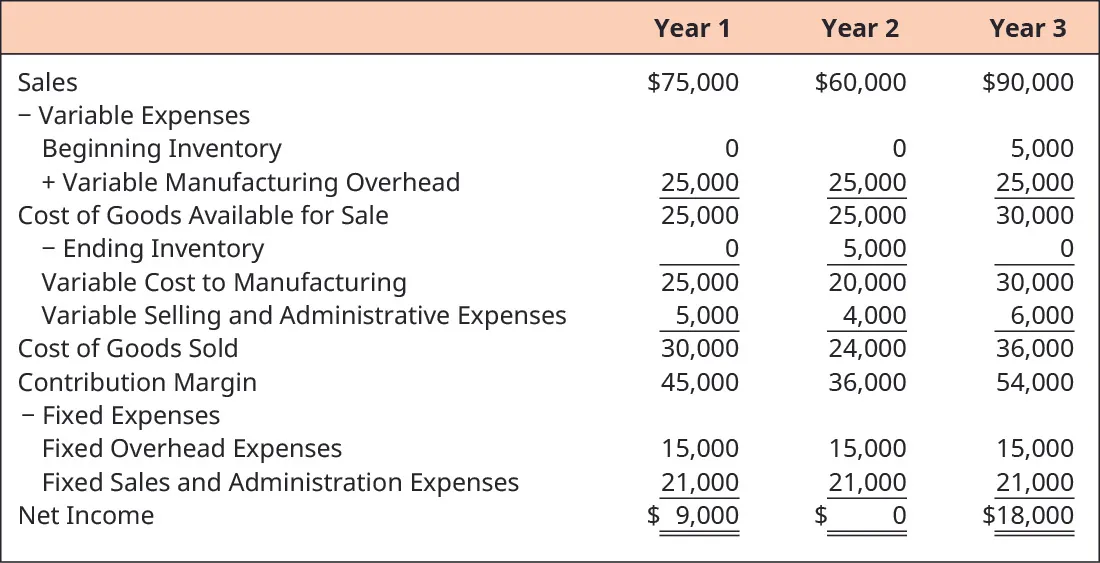
Example of a marginal (variable) costing income statement where variable expenses are deducted from sales to obtain contribution margin, and then fixed costs are deducted to arrive at net income. The layout reinforces that contribution is the central subtotal for decision-making and CVP-style analysis. It also highlights that fixed manufacturing overhead is treated as a period cost under marginal costing. Source
Contribution: Sales revenue less all variable costs.
Contribution shows how much revenue is available to cover fixed costs and then provide profit. A higher contribution improves the ability of a business to cover its fixed costs.
= amount remaining after all variable costs, in monetary units
= revenue from units sold, in monetary units
= total variable cost of sales and other variable expenses, in monetary units
Once contribution has been found, all fixed costs are deducted to arrive at profit.
Structure of a marginal costing statement
A marginal costing profit statement may be presented in slightly different layouts, but the logic is always the same:
Sales
less variable cost of sales
less other variable costs, such as variable selling or distribution costs if given
equals contribution
less fixed costs
equals profit
When inventory figures are included, opening and closing inventory are valued at variable production cost only. This is a central feature of marginal costing and must be applied consistently throughout the statement.
A common examination layout for variable cost of sales is:
opening inventory at variable cost
plus variable production cost of current period
less closing inventory at variable cost
equals variable cost of goods sold
After that, any variable non-production costs are deducted before contribution is shown. Fixed costs are then deducted in total.
Students should be careful to classify costs correctly:
variable production costs go into inventory valuation
fixed production overhead does not go into inventory valuation
fixed selling and administration costs are always period costs
variable selling and administration costs are deducted before contribution is found
Absorption costing and the source of profit differences
To reconcile profits, you must understand how absorption costing differs from marginal costing.
Absorption costing: A costing method in which units produced are charged with both variable production cost and fixed production overhead.
Under absorption costing, part of the fixed production overhead can be included in closing inventory if some output remains unsold. Under marginal costing, that same fixed production overhead is charged fully against the current period’s profit.
This difference in the treatment of fixed production overhead is the only reason why profits differ between the two methods, assuming the same sales revenue and the same cost data are used.
The effect depends on inventory levels:
if closing inventory is greater than opening inventory, absorption costing profit is higher
if closing inventory is lower than opening inventory, absorption costing profit is lower
if inventory levels are unchanged, the profits are the same
The reason is timing. Absorption costing can defer part of fixed production overhead in inventory, while marginal costing charges it immediately.
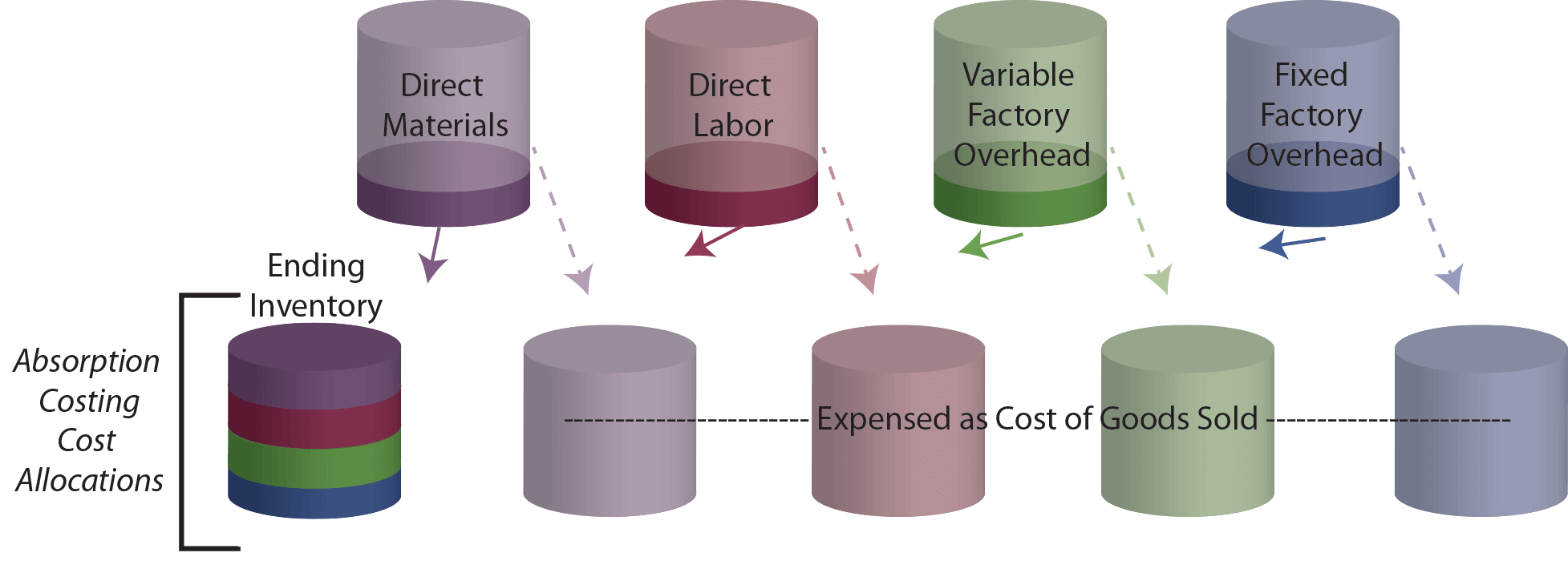
Diagram illustrating how manufacturing costs ‘flow’ into cost of goods sold versus ending inventory under absorption costing. The key visual point is that fixed factory overhead can be included in the ending inventory ‘cup’ under absorption costing, which defers some fixed overhead to a future period. This directly explains why profit can be higher when inventory increases under absorption costing. Source
Profit reconciliation
Profit reconciliation is the process of moving from the profit shown by one method to the profit shown by the other method by adjusting for the fixed production overhead contained in inventory.
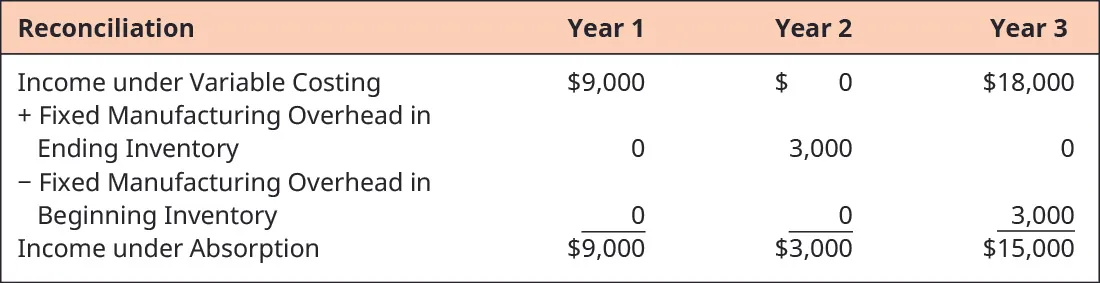
Reconciliation format showing how to bridge from marginal (variable) costing profit to absorption costing profit by adjusting for fixed manufacturing overhead in opening and closing inventories. It makes the timing effect explicit: fixed overhead is deferred into closing inventory under absorption costing and released from opening inventory when those units are sold. This is the practical layout behind the reconciliation logic in exam questions. Source
= absorption costing profit minus marginal costing profit, in monetary units
= closing inventory units minus opening inventory units
= absorbed fixed production overhead for one unit, in monetary units
This formula gives the amount of fixed production overhead transferred into or out of inventory. The sign must then be interpreted correctly.
A practical reconciliation approach is:
start with the profit under one method
find the increase or decrease in inventory units
multiply by the fixed production overhead absorption rate per unit
add the amount if inventory increased and you are moving from marginal costing profit to absorption costing profit
subtract the amount if inventory decreased and you are moving from marginal costing profit to absorption costing profit
If starting with absorption costing profit and reconciling to marginal costing profit, the adjustment is reversed.
Common points that examiners expect
Students often lose marks through avoidable mistakes. Important points include:
do not include fixed production overhead in closing inventory under marginal costing
do not confuse production with sales; profit under marginal costing is more closely linked to sales
use the inventory change, not the production change, in a reconciliation
make sure the fixed overhead rate used is per unit
show clearly whether the reconciliation is from marginal to absorption or from absorption to marginal
Careful presentation is important. Labels such as contribution, fixed costs, and profit should be shown clearly, and the treatment of inventory should match the chosen costing method throughout the statement.
Practice Questions
State two reasons why profit reported under absorption costing may differ from profit reported under marginal costing in the same accounting period. (2 marks)
1 mark: Fixed production overhead is treated differently under the two methods.
1 mark: Inventory changes cause some fixed production overhead to be carried forward in or released from inventory under absorption costing.
A business reported profit of 48 000 under marginal costing. Opening inventory was 3 200 units and closing inventory was 4 000 units. The fixed production overhead absorption rate was 6 per unit.
Calculate the profit under absorption costing and state the reason for the difference. (5 marks)
1 mark: Inventory increase identified as units.
1 mark: Difference in profit calculated as .
1 mark: Correct treatment that absorption costing profit is higher because inventory increased.
1 mark: Profit under absorption costing correctly calculated as 52 800.
1 mark: Reason stated: fixed production overhead has been included in closing inventory under absorption costing but charged in full in marginal costing.
FAQ
Over a number of periods, all units produced are eventually sold, so all fixed production overhead that was deferred in inventory under absorption costing is eventually released.
This means the timing differs between the methods, but the total fixed production overhead charged over the full period is the same. As a result, cumulative profit is the same if there are no inventory losses or valuation changes.
The reconciliation adjustment depends on how much fixed production overhead is included in each unit under absorption costing.
If the rate is wrong, the entire profit adjustment will be wrong, even if the inventory change is correct. In exam questions, always check whether the rate given is:
per unit
based on normal activity
already calculated for you
Yes. If extra units are produced and not sold, closing inventory rises. Under absorption costing, part of the fixed production overhead is carried into closing inventory instead of being charged immediately.
This can make current-period profit appear higher, even though sales have not increased. That is one reason managers should interpret absorption costing profit carefully.
If there is no opening inventory, the reconciliation depends only on the fixed production overhead included in closing inventory.
If closing inventory exists, absorption costing profit will exceed marginal costing profit by the amount of fixed production overhead contained in that closing inventory. If there is also no closing inventory, the profits will be identical because no fixed production overhead is deferred.
Contribution highlights the relationship between sales, variable costs, and fixed costs. It shows how much each period’s sales are contributing toward covering fixed costs.
This is useful because marginal costing separates:
costs that vary with output or sales
costs that are fixed for the period
That structure makes the statement easier to interpret when managers want to see how changes in sales affect profit.