

CIE Syllabus focus:
'Calculate overhead absorption rates using appropriate bases, and calculate under absorption and over absorption of overheads.'
Overhead absorption is used to charge indirect production costs to units of output, jobs, or services. A clear understanding of rates, bases, and adjustments is essential for accurate costing and effective management control.
Understanding overhead absorption rates
A business cannot trace production overheads directly to one unit in the same way as direct materials or direct labor. Instead, it uses an overhead absorption rate to share these indirect costs across production in a systematic way.
Overhead absorption rate. A rate used to charge production overheads to cost units based on an appropriate activity measure.
The rate is usually set in advance for a period, using budgeted overheads and a budgeted level of activity.

This diagram summarizes the predetermined overhead absorption rate as a ratio of estimated (budgeted) overhead cost to an estimated activity base. It visually reinforces that the rate is set using budget data before production takes place, so it can be applied consistently during the period. Source
This creates a predetermined rate that can be applied throughout the accounting period.
= estimated indirect production overheads for the period
= estimated total amount of the chosen absorption base
Using a predetermined rate allows a business to cost production without waiting until the end of the period, when actual overhead figures become available.
Choosing an appropriate absorption base
The absorption base is the activity measure used to absorb overheads. The most appropriate base depends on how overheads are driven in the business.
Common bases include:
Direct labor hours
suitable where production depends mainly on labor time
often used in labor-intensive businesses
Machine hours
suitable where machinery is the main factor in production
often used in automated or capital-intensive manufacturing
Direct labor cost
may be used where wage cost is closely linked to production effort
less suitable if workers are paid at very different rates for similar output
Units of output
suitable only where products are uniform and each unit uses similar overhead resources
A good absorption base should:
reflect the main cause of overhead cost
be easy to measure reliably
produce fair and consistent product costs
If the wrong base is chosen, the cost of production may be distorted. This can affect pricing, inventory valuation, and performance assessment.
Applying the overhead absorption rate
Once the rate has been calculated, it is applied to the actual level of activity achieved during the period. This gives the amount of overhead absorbed into production.
= overheads charged to production
= actual units of the chosen absorption base used in the period
For example, if machine hours are the base, the business multiplies the rate per machine hour by the actual machine hours worked. If labor hours are the base, it uses actual labor hours.
This absorbed amount is then included in the cost of units, jobs, or batches produced during the period.

This table demonstrates overhead assignment using an activity base (direct labour hours): total hours are multiplied by an overhead rate per hour to allocate overhead to products, then divided by units produced to obtain overhead per unit. It reinforces the mechanics of applying an absorption rate to activity measures to build up product costs. Source
Under absorption and over absorption
Because the absorption rate is based on budgeted figures, the overhead absorbed into production will often differ from the actual overhead incurred. This creates either under absorption or over absorption.
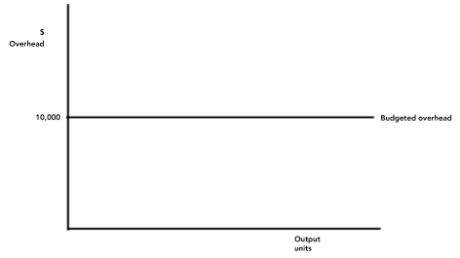
This graph illustrates fixed production overhead as a horizontal budget line and shows how applying a fixed overhead absorption rate converts that fixed amount into a cost per unit of activity. It supports the intuition behind over/under absorption: when actual output differs from budgeted output, absorbed overhead can end up above or below actual overhead. Source
Under absorption of overheads. A situation in which the overheads absorbed into production are less than the actual overheads incurred.
Under absorption means insufficient overhead has been charged to production during the period.
Over absorption of overheads. A situation in which the overheads absorbed into production are greater than the actual overheads incurred.
Over absorption means too much overhead has been charged to production during the period.
= overheads actually incurred in the period
= overheads charged to production in the period
If the answer is positive, overheads are under absorbed. If the answer is negative, overheads are over absorbed.
Why under or over absorption happens
Differences between actual and absorbed overheads commonly arise because:
actual overhead spending differs from the budget
actual activity is higher or lower than expected
seasonal patterns change production levels
the budget was unrealistic
the absorption base does not closely match how overheads are incurred
These differences do not necessarily mean that accounting is incorrect. They show that estimates used at the start of the period did not exactly match actual results.
Adjusting for under and over absorption
At the end of the period, the difference between actual overheads and absorbed overheads must be identified and adjusted.
If overheads are under absorbed:
production has been charged with too little overhead
costs are understated
profit will be overstated unless corrected
If overheads are over absorbed:
production has been charged with too much overhead
costs are overstated
profit will be understated unless corrected
In many exam questions, the adjustment is made by transferring the amount of under or over absorption to the income statement through cost of sales. The key principle is that the final accounts should reflect actual overhead incurred, not just the amount absorbed during the year.
Common exam points
Students should take care to:
use budgeted figures when calculating the overhead absorption rate
use actual activity when calculating absorbed overhead
compare actual overhead with absorbed overhead, not with the budgeted overhead
state clearly whether the difference is under absorption or over absorption
include the correct unit in the rate, such as per labor hour, per machine hour, or per unit
A strong answer shows both accurate calculation and correct interpretation of what the difference means for production cost and reported profit.
Practice Questions
A factory uses machine hours as the basis for absorbing production overheads. State the formula for the overhead absorption rate and give one reason why machine hours may be an appropriate base. [2]
1 mark: States formula: or equivalent.
1 mark: Explains that machine hours are appropriate where production is machine-intensive or overheads are mainly driven by machine use.
A business has budgeted production overheads of $96,000 and budgeted direct labor hours of . During the period, actual direct labor hours were and actual production overheads were $101,500.
Calculate: (a) the overhead absorption rate per direct labor hour [2]
(b) the overhead absorbed during the period [1]
(c) whether the overheads were under absorbed or over absorbed, and by how much [2]
(a) $96,000 \div 24,000=425,500 \times 102,000102,000=- so overheads were over absorbed by $500 = 2 marks
1 mark for correct difference
1 mark for correct identification as over absorption
FAQ
Actual overheads are usually not known until the end of the accounting period.
Using budgeted figures lets a business:
cost production immediately
set prices during the period
prepare regular management reports without delay
It also keeps the rate stable, which makes internal costing more consistent from month to month.
Yes. A business may use different rates for different production areas if their cost behavior is different.
For example:
one department may absorb overhead by machine hours
another may absorb overhead by labor hours
This often gives more realistic product costs than using one single rate for the whole factory.
It may suggest that the original budget was not realistic.
Possible reasons include:
actual activity was much higher than expected
overhead spending was controlled better than planned
the chosen base caused too much cost to be charged to production
Management should review whether the budget assumptions are still suitable.
No. It can be misleading if wage rates differ sharply between employees or departments.
A higher-paid worker does not always create more overhead cost than a lower-paid worker.
In automated businesses, direct labor cost may be especially weak as a base because machines, not wages, often drive overheads.
Seasonal businesses may have low activity in some months and high activity in others.
If a fixed predetermined rate is used:
low activity periods may show under absorption
high activity periods may show over absorption
This means a monthly figure may look unusual even when the annual result is reasonable. Managers should interpret short-term differences carefully.
