

CIE Syllabus focus:
'Evaluate marginal costing data for make-or-buy, special orders, closure, limiting factors and target profit decisions, including non-financial factors.'
Marginal costing supports short-term business decisions by focusing on how revenue and costs change between alternatives. The key idea is to compare relevant revenues, relevant costs, and the resulting contribution.
The basis of marginal costing decisions
Marginal costing separates variable costs from fixed costs and emphasizes the extra benefit of one option compared with another.
Marginal costing: A costing approach that treats variable costs as product costs and focuses on contribution when making short-term decisions.
This approach is useful only when the decision changes future cash flows. Past costs do not matter, and fixed costs matter only if they can be avoided or changed by the decision.
A relevant cost is the cost that should be included in the decision because it differs between alternatives.
Relevant cost: A future cost that arises as a direct result of a decision and differs between the available options.
The main measure used in marginal costing is contribution, because contribution first covers fixed costs and then creates profit.
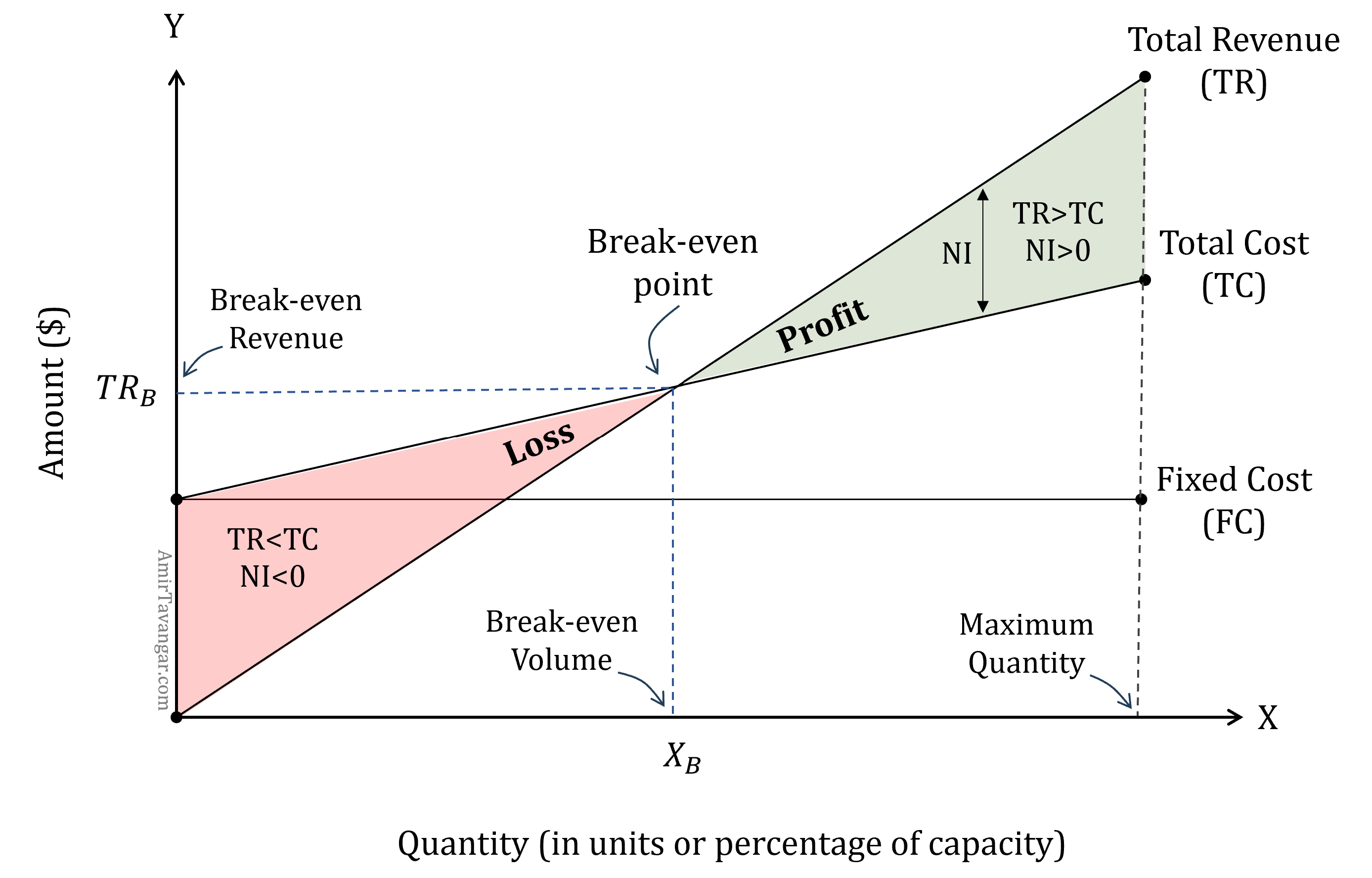
Break-even (CVP) chart showing Total Revenue, Total Cost, and a separate Fixed Cost line. The intersection of Total Revenue and Total Cost marks the break-even point, separating the loss region (below break-even) from the profit region (above break-even). This diagram makes it clear how contribution first recovers fixed costs before any profit is made. Source
= contribution earned from one unit sold, in dollars
= revenue from one unit sold, in dollars
= variable cost of one unit, in dollars
When evaluating options, managers should focus on:
additional revenue
additional variable costs
any avoidable fixed costs
any opportunity cost from using scarce resources
Make-or-buy decisions
A make-or-buy decision compares the relevant cost of producing internally with the relevant cost of purchasing from an outside supplier.
In a make decision, relevant costs may include:
direct materials
direct labor
variable production overhead
specific fixed costs that would be avoided if production stopped
opportunity cost if the resources could earn contribution elsewhere
If the buy option is chosen, the purchase price and any extra receiving, inspection, or transport costs are relevant. However, fixed costs that continue whichever option is chosen are not relevant.
A business should not choose only on the lowest cost.
Important non-financial factors include:
supplier reliability
quality standards
delivery speed
confidentiality of design or process
control over production
effect on employee morale and skills
Special orders
A special order is a one-off order, often at a lower price than the usual selling price. Under marginal costing, the order may be accepted if it adds positive contribution.
This usually means:
the selling price covers the variable cost of the order
any additional specific fixed cost is also covered
normal sales are not reduced
If there is spare capacity, a lower price may still be worthwhile because fixed costs are already being paid. If capacity is full, the business must consider the opportunity cost of lost regular sales.
Non-financial issues are especially important in special order decisions:
risk of upsetting regular customers
damage to brand image from discounting
likelihood that the special price becomes expected in the future
customer credit risk
after-sales service obligations
Closure decisions
A closure decision may involve stopping a product line, department, or outlet. Marginal costing helps by showing whether the activity is making a positive contribution toward fixed costs.
A product or department should not automatically be closed just because it makes a loss after fixed costs. If it still earns positive contribution, closure may reduce total profit unless enough fixed costs are saved.
The key comparison is:
contribution lost if the activity closes
fixed costs saved if the activity closes
If fixed costs saved are greater than contribution lost, closure may improve profit. If not, closure may worsen the result.
Managers must also consider non-financial factors such as:
effect on customer loyalty
loss of linked sales of other products
impact on staff retention
local community and reputation issues
long-term strategic importance
Limiting factors
A limiting factor is a scarce resource that restricts output, such as labor hours, machine hours, or materials.
Limiting factor: A resource in short supply that prevents a business from producing or selling as much as it would like.
When a limiting factor exists, products should be ranked by the contribution earned from each unit of the scarce resource, not by contribution per unit of output.
= contribution earned from one unit of the scarce resource, in dollars
= contribution earned from one unit of product, in dollars
= amount of scarce resource needed for one unit of product
The business should normally give priority to the product with the highest contribution per limiting factor unit, while still considering demand restrictions and contractual obligations.
Target profit decisions
Marginal costing can also be used to find the output needed to earn a chosen level of profit.
= number of units that must be sold
= total fixed costs for the period, in dollars
= desired profit for the period, in dollars
= contribution earned from one unit sold, in dollars
This helps management judge whether a profit goal is realistic. The decision must still be tested against:
expected demand
available capacity
pricing policy
workforce capability
likely reaction from competitors
Non-financial factors in final recommendations
Marginal costing gives a strong numerical basis, but the best decision is not always the one with the highest short-term contribution.
Managers should consider whether the option:
supports long-term strategy
protects quality and customer satisfaction
maintains reliable supply
preserves employee skills and morale
avoids legal, ethical, or reputational risk
In exam answers, the strongest recommendations use both financial evidence from marginal costing and relevant non-financial factors.
Practice Questions
State two non-financial factors a business should consider before choosing to buy a component from an outside supplier instead of making it internally. (2 marks)
1 mark for any valid non-financial factor, up to 2 marks.
Valid answers include: quality, supplier reliability, delivery speed, confidentiality, control over production, employee morale, continuity of supply.
A business makes Product A and Product B. Machine hours are limited to 1,200 hours per month.
Product A: Contribution per unit = $18 Machine hours per unit =
Product B: Contribution per unit = $14 Machine hours per unit =
Maximum demand per month: Product A = 200 units Product B = 400 units
Using marginal costing, advise which product should be prioritized and calculate the maximum total contribution. (6 marks)
Calculates contribution per machine hour for Product A: $18 \div 3=67400 \div 3=133400 \times 5,600133 \times 2,394\approx (1 mark)
Accept a clearly stated assumption about whole units if applied consistently.
FAQ
In the short term, many fixed costs continue whatever decision is taken, so they are irrelevant.
Over a longer period, more fixed costs may become avoidable, such as:
supervision salaries
factory rent on unused space
equipment lease costs
maintenance contracts
This means a buy decision that seems expensive in the short term may become cheaper in the long term once these fixed costs can be removed.
Even if wages are fixed in total, labor time may still be scarce.
If employees spend time on one product, they may be unable to work on another product that earns contribution. The lost contribution from the next best use of that labor time is the opportunity cost.
So the relevant issue is not always the wage payment itself. It is the value of what the business gives up by using the labor in a particular way.
Some products cannot be made one unit at a time in practice. They may require:
setup time
cleaning time
inspection time
minimum batch quantities
If these extra resource costs are ignored, contribution per limiting factor unit may be overstated.
A product with a high theoretical ranking may become less attractive once setup hours or unavoidable batch losses are included. This is why operational details can matter when applying marginal costing.
If the target is an after-tax profit, the business must first convert it into the equivalent before-tax profit.
The general approach is:
decide the desired after-tax profit
adjust for the tax rate
use the before-tax target in the marginal costing formula
For example, if tax is 20%, an after-tax target must be larger before tax to leave the required amount after tax is deducted.
A special order may add positive contribution but still strain cash resources if the customer pays late.
The business may need to pay for:
materials
extra packaging
shipping
temporary labor
before receiving the cash from the customer.
So a decision can look good in marginal costing terms but still be risky if working capital is tight. Managers should check payment terms and short-term financing capacity before accepting the order.
