

CIE Syllabus focus:
'Evaluate the advantages, limitations and usefulness of cost-volume-profit analysis, and make business decisions and recommendations using supporting data.'
Cost-volume-profit analysis helps managers relate sales volume, costs, and profit. At this level, the focus is not only on calculation, but on judging reliability and using the results to support sound recommendations.
Understanding cost-volume-profit analysis
Cost-volume-profit analysis examines how changes in sales volume, selling price, variable cost, and fixed cost affect profit. Managers use it to assess expected performance, compare alternatives, and judge the likely effect of changes before decisions are made.
Cost-volume-profit analysis: A technique that studies the relationship between costs, sales volume, and profit in order to support planning and decision-making.
It is useful because it turns accounting data into a planning tool.
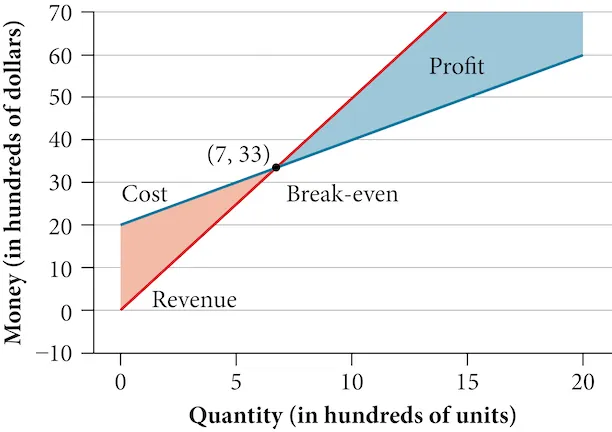
This break-even graph plots total Cost and total Revenue against output and marks the intersection as the break-even point where profit is zero. The shaded regions distinguish operating at a loss (left of break-even) from operating at a profit (right of break-even). This visual is helpful when discussing how CVP turns accounting data into a planning tool by linking volume changes to profit outcomes. Source
Rather than focusing only on past results, it helps management estimate future outcomes such as expected profit, break-even sales, and the margin between expected sales and loss.
A central idea in CVP analysis is that profit depends on contribution and on whether total contribution is enough to cover fixed costs.
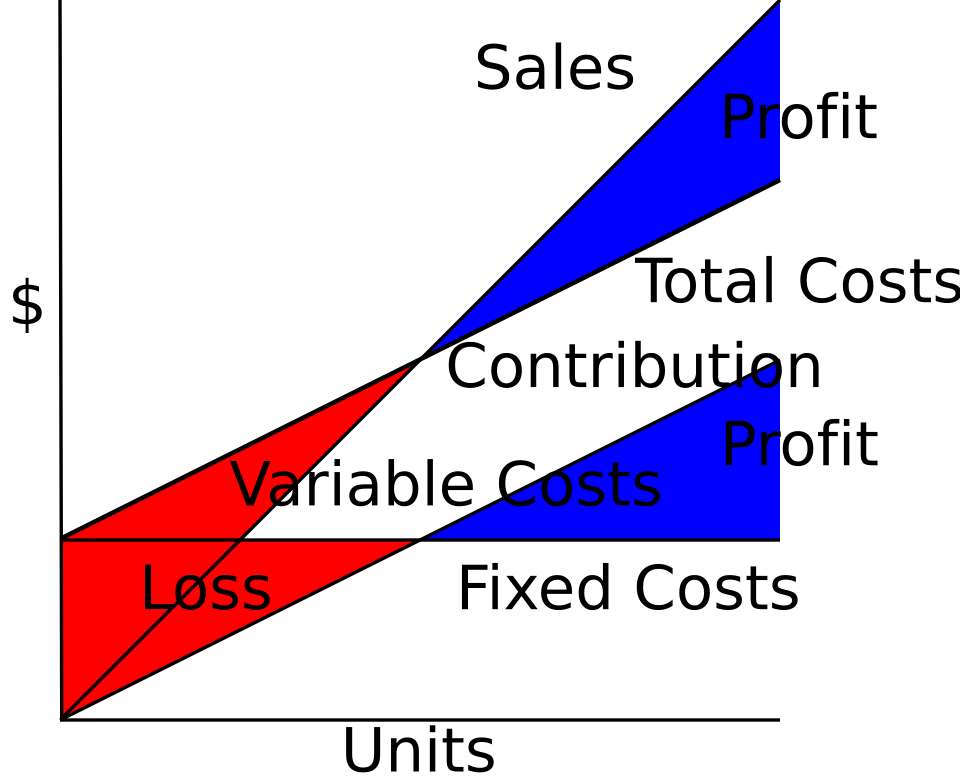
This CVP diagram shows how the break-even point can be viewed either as the intersection of Sales and Total Costs or, equivalently, as the point where Contribution exactly covers Fixed Costs. The profit and loss regions are clearly indicated, reinforcing that profit is the surplus of total contribution over fixed costs. It is especially useful for explaining why contribution is the key driver in short-run decision-making. Source
= operating profit for the period
= sales revenue less total variable costs
= total fixed costs for the period
This relationship helps managers focus on how a proposed change will affect total contribution and, therefore, profit.
Advantages of cost-volume-profit analysis
CVP analysis has important strengths for management:
Simple to understand: it shows a clear link between units sold and profit.
Useful for planning: managers can set sales targets and estimate the volume needed after a change in fixed cost.
Supports comparison: it helps compare alternative prices, costs, or activity levels.
Highlights risk: it shows when expected sales are only slightly above the loss point.
Encourages forward thinking: it tests likely effects before resources are committed.
These strengths make CVP analysis a useful starting point when management must choose between alternatives.
Limitations of cost-volume-profit analysis
Despite its value, CVP analysis depends on assumptions that may not hold in real businesses. This means recommendations based on it should be treated with care.
Common limitations include:
Selling price may not stay constant: demand may respond differently than expected.
Variable cost per unit may change: discounts, wage changes, inefficiency, or inflation can alter cost.
Fixed costs are not always fixed: expansion may require extra premises, supervision, or equipment.
The relationship may not be linear: revenue and cost patterns do not always change in straight lines.
Output may not equal sales: inventory changes can affect reported profit.
Product mix may change: shifts between products alter average contribution.
External conditions may change quickly: competition or economic conditions can make forecasts inaccurate.
Another weakness is that CVP analysis is mainly based on quantitative data. A decision that looks favorable numerically may still be poor if it harms quality, customer relationships, reputation, or staff morale.
Judging usefulness in practice
The usefulness of CVP analysis depends on the circumstances in which it is applied. It is usually more useful when:
the business operates in a stable market
costs and selling prices are reasonably predictable
the time period is short
one product dominates, or the sales mix is stable
management needs a quick estimate rather than a precise forecast
It is less useful when conditions are highly uncertain or when the business is changing significantly. A proposal may appear profitable according to CVP data, but if demand forecasts are weak or costs are volatile, the result may be unreliable.
Good evaluation does not simply say CVP analysis is useful or limited. It explains when it is reliable, why it may fail, and how much weight managers should place on it compared with other evidence.
Making business decisions and recommendations
When using CVP information to make a decision, management should move beyond calculation and form a supported judgment. A good recommendation should:
identify the decision being considered
compare the alternatives using contribution, expected profit, or required sales
explain the effect of changes in price, cost, or volume
recognize the assumptions behind the figures
comment on business risk and uncertainty
state a reasoned recommendation
For example, CVP data may support a proposal to lower selling price only if the expected rise in sales volume is realistic enough to maintain or improve profit. A rise in fixed cost may be acceptable only if the additional sales needed are achievable.
A recommendation should therefore be balanced. If the numerical evidence strongly supports one option and the assumptions appear realistic, management can recommend proceeding. If the result depends on uncertain demand or unstable costs, management should be more cautious and may recommend revision or further investigation.
Using supporting data effectively
Supporting data should strengthen the quality of the recommendation, not just repeat figures. Effective support may include:
forecast sales volume under each option
expected total contribution and profit
the gap between expected sales and the loss point
the effect of possible changes in cost or price
The best answers link the data to judgment. Instead of merely stating numbers, they explain what the numbers imply for profitability, risk, and decision quality.
Practice Questions
State two limitations of cost-volume-profit analysis. (2 marks)
1 mark for each valid limitation stated, up to 2 marks.
Accept any two of:
assumes selling price remains constant
assumes variable cost per unit remains constant
assumes fixed costs remain unchanged
assumes costs and revenue behave in a linear way
assumes output equals sales
may be unreliable if product mix changes
ignores qualitative factors
depends on forecasts that may be inaccurate
A business sells one product for 30 per unit. Variable cost is 18 per unit. Fixed costs are 54000 per year.
Management is considering reducing the selling price to 28 per unit. It expects annual sales to rise from 5500 units to 7000 units if the price is reduced.
Using cost-volume-profit analysis, evaluate whether the business should reduce the selling price. Give a recommendation supported by data. (6 marks)
Current contribution per unit = 12 (1)
Current profit = (1)
Proposed contribution per unit = 10 (1)
Proposed profit = (1)
Evaluation that profit would increase by 4000, so CVP data supports the price reduction if the forecast sales increase is realistic (1)
One developed limitation or caution, such as demand may not rise as expected or costs may change, plus a reasoned recommendation (1)
FAQ
A multi-product business often uses a weighted average contribution based on the expected sales mix.
This means the CVP model assumes a stable proportion of each product in total sales. If that mix changes, the weighted average contribution also changes, so the break-even point and expected profit may no longer be accurate.
Because of this, managers should review the sales mix regularly before relying on a multi-product CVP recommendation.
The relevant range is the band of activity within which CVP assumptions are expected to remain reasonably valid.
Within that range:
fixed costs are usually treated as unchanged in total
variable cost per unit is assumed to stay stable
selling price is assumed to be predictable
Outside that range, new premises, extra staff, discounts, or capacity limits may change the cost structure. Once that happens, the original CVP model may become misleading.
Sensitivity analysis tests what happens if key assumptions change.
For example, management might recalculate expected profit if:
sales volume is lower than forecast
variable cost per unit rises
the planned selling price cannot be maintained
This is useful because a recommendation is stronger when it still looks acceptable under several realistic scenarios. If a small change makes the decision unattractive, management knows the proposal is risky.
Yes. The focus changes from earning profit to covering costs or achieving a required surplus.
A nonprofit can use CVP analysis to estimate:
the number of users, tickets, or memberships needed to avoid a deficit
the effect of changing fees
whether a new service can be supported financially
The method is still useful because it links activity levels to financial outcomes, even when profit is not the main objective.
There is no fixed rule, but the model should be updated whenever key assumptions may have changed.
Updates are especially important when there are changes in:
selling prices
supplier costs
wage rates
expected demand
capacity
In a stable business, periodic review may be enough. In a volatile market, management may need to revise the model much more often. An outdated CVP model can produce a recommendation that looks logical but is based on figures that no longer reflect reality.

