

CIE Syllabus focus:
'Prepare costing and profit statements using absorption costing, and evaluate its uses, limitations and usefulness for management decision-making.'
Absorption costing treats each unit produced as carrying a share of total production cost. For CIE questions, you must know statement format, inventory valuation, and how managers interpret the resulting profit figures.
What absorption costing means
The central idea is absorption costing.
Absorption costing: A method of costing in which all production costs, including fixed production overhead, are included in the cost of units produced.
Under this method, each unit absorbs a share of total production cost. This means unit cost includes direct materials, direct labor, direct expenses, and absorbed production overhead. Non-production overheads, such as selling and distribution and general administration, are treated as period costs and charged against the profit of the period.
When exam questions ask for the full production cost per unit, use the complete manufacturing cost of the period.
= Total direct material cost of production
= Total direct labor cost of production
= Other direct production costs
= Production overhead assigned to output for the period
= Number of units manufactured in the period
In practice, absorbed production overhead comes from an overhead absorption rate already calculated using a suitable base, such as labor hours, machine hours, or units. In this topic, the focus is on using that absorbed figure correctly in costing and profit statements.
Preparing a costing statement
A costing statement under absorption costing builds up the total and per-unit cost of production. The usual sequence is:
direct materials
direct labor
direct expenses
total direct cost
production overhead absorbed
total production cost
cost per unit
After total production cost is found, divide by units produced to obtain the absorption cost per unit. This unit cost is then used to value finished goods inventory and, where relevant, work in progress. Examiners often expect clear identification of whether figures are total amounts or per-unit amounts, and mixing these can lose marks.
A strong answer distinguishes between costs attached to units and costs charged directly to the period. Only production costs are inventoried. Non-production costs are deducted later in the profit statement.
Preparing a profit statement
A profit statement using absorption costing normally includes:
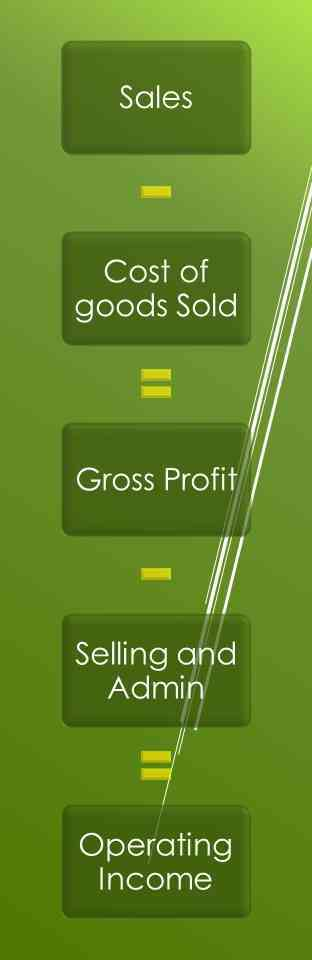
This figure shows the standard absorption costing (traditional) income statement format, organized into sales, cost of goods sold, and gross profit before deducting selling and administrative (non-production) expenses. It reinforces the exam skill of presenting costs by function and keeping production costs in inventory until the related units are sold. Source
sales revenue
opening inventory of finished goods, valued at absorption cost
cost of production of goods completed during the period
goods available for sale
closing inventory of finished goods, valued at absorption cost
cost of sales
gross profit
less non-production overheads
profit for the period
This structure matters because closing inventory carries part of fixed production overhead forward to a later period. As a result, profit does not depend only on sales.
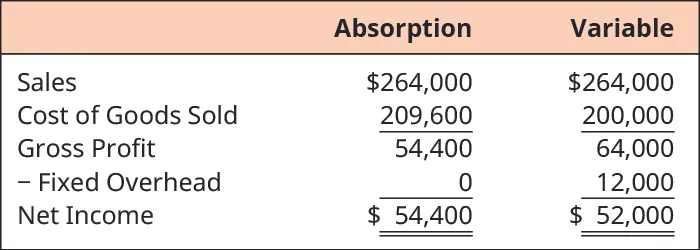
This diagram compares net income under absorption costing versus variable costing when ending inventory remains unsold. It highlights that absorption costing includes a fixed overhead amount in unit cost, so some fixed overhead is carried forward in closing inventory, raising current-period profit relative to variable costing when production exceeds sales. Source
It is also affected by the relationship between production and sales.
If the question gives opening and closing work in progress, adjust factory cost to the cost of finished goods completed before dealing with opening and closing inventories of finished goods.
Key effect on reported profit
Under absorption costing, fixed production overhead is included in unit cost. Therefore:
if production exceeds sales, some fixed production overhead is carried in closing inventory, so current profit is higher
if sales exceed production, some fixed production overhead from opening inventory is released to cost of sales, so current profit is lower
if production equals sales and inventories do not change, this inventory effect disappears
This does not mean the profit figure is incorrect. It means the timing of fixed production overhead recognition depends partly on inventory levels. Managers should read absorption-costing profit alongside inventory movements rather than in isolation.
Uses for management decision-making
Absorption costing is useful when management needs a longer-term view of cost recovery. Its main uses include:
pricing decisions where all production costs should be covered over time
inventory valuation because closing inventories include a fair share of production overhead
profit measurement by matching unsold production cost with a future period
product evaluation by showing a fuller manufacturing cost than a statement based only on direct costs
It can also help managers judge whether selling prices seem sufficient to cover both direct costs and factory overheads. For manufacturing businesses with large fixed production overheads, this fuller unit cost can be important. It is also widely accepted where inventory should not be understated.
Limitations and evaluation
Despite its usefulness, absorption costing has important limitations.
The absorption of overheads is based on estimates and selected bases. If the basis is unsuitable, product costs may be misleading.
Unit cost may change when output changes, even when total fixed production overhead is unchanged. This makes comparison between periods more difficult.
Profit can rise because inventories increase, not because sales performance improved. Managers may therefore overestimate operating success.
It may encourage overproduction if performance is judged by absorption-costing profit, because producing more units spreads fixed production overhead across more output and postpones some cost in inventory.
A product may appear profitable after overhead absorption even though those overheads would not change in the short run if the product were discontinued.
For some decisions, the full absorption cost includes amounts that are not relevant to the immediate choice.
For evaluation, the best judgment is balanced: absorption costing is useful for full production costing, inventory valuation, and longer-term pricing, but less reliable when managers need quick decisions based on the actual cost consequences of a specific action.
Practice Questions
State two features of absorption costing. (2 marks)
1 mark for stating that all production costs are included in product cost.
1 mark for stating that fixed production overhead is absorbed into units produced or included in inventory valuation.
A business produced 4,000 units and sold 3,500 units during one period. There was no opening inventory.
The following data relate to the period:
direct materials: 20,000
direct labor: 12,000
direct expenses: 4,000
absorbed production overhead: 8,000
non-production overheads: 6,000
sales revenue: 70,000
(a) Prepare an absorption costing profit statement for the period. (5 marks)
(b) State one limitation of using this statement for management decision-making. (1 mark)
(6 marks)
1 mark: total production cost = 44,000
1 mark: absorption cost per unit = 11
1 mark: closing inventory = 5,500 and cost of sales = 38,500
1 mark: gross profit = 31,500
1 mark: profit for the period = 25,500
1 mark: one valid limitation, such as profit being affected by inventory changes, or overhead absorption depending on estimates, or limited usefulness for short-term decisions
FAQ
Inventory is valued at the cost of bringing goods to their present condition before sale. Selling and distribution costs arise after production is complete, so they are treated as period expenses rather than product costs.
This helps avoid carrying sales-related costs forward in inventory when those costs do not create or complete the product itself.
If fixed production overhead is spread using actual output in a very low-output period, the cost per unit can become unusually high. If output is unusually high, the cost per unit can look too low.
Using normal capacity smooths these extremes. It gives a more stable unit cost and makes comparison between periods more meaningful.
Yes, if the business can identify a sensible cost unit, such as:
a patient day
a consulting assignment
a hotel room night
a repair job
Direct costs are traced first, then service overheads are absorbed using an appropriate basis, such as labor hours or room occupancy. The main difficulty is choosing a basis that reflects how overheads are actually consumed.
Work in progress includes:
direct materials used
direct labor incurred
direct expenses incurred
absorbed production overhead related to the stage of completion
Where units are only partly complete, businesses often use equivalent units so labor and overhead are assigned fairly. This prevents partly finished goods from being valued using direct costs alone.
Businesses can reduce this risk by using controls such as:
setting inventory limits
monitoring inventory turnover and aging
linking bonuses to sales, cash flow, or inventory targets instead of profit alone
requiring approval for production above forecast demand
reviewing slow-moving and obsolete inventory regularly
These controls make it harder for managers to improve reported profit simply by increasing closing inventory.
