CIE Syllabus focus:
'Apply traditional costing methods to prepare costing statements using unit, job and batch costing in manufacturing and service businesses.'
Traditional costing identifies the cost of output in different production situations. The key skill is selecting the right method and preparing a costing statement that matches how goods or services are produced.
Choosing the correct costing method
The costing method depends on the nature of the output. A business must decide whether it is costing one identical item, one specific customer order, or a group of identical items produced together.
Unit costing: A method used when a business produces a continuous flow of identical units, so total cost is averaged over the units produced.
This method is suitable where output is standardized and each unit passes through the same production process. The main aim is to find a reliable cost per unit for valuation, control, and pricing.
Job costing: A method used to collect and assign costs to a specific job, order, contract, or customer request.
Job costing is appropriate when work is customized. Each job is separately identified, usually by a job number, so that materials, labor, and production overheads can be assigned to that individual piece of work.
Batch costing: A method used when identical units are produced in groups, with costs collected for the whole batch and then divided by the number of units in that batch.
Batch costing can be seen as a form of job costing because the batch is treated as one cost object. The difference is that the final cost usually needs to be expressed both as total batch cost and as cost per unit within the batch.
What goes into a costing statement
A costing statement under any of these methods follows the same broad structure. It gathers the costs that can be traced directly to the unit, job, or batch, then adds production overheads assigned to that output.
Common sources of information include:
material issue records
labor time records
job cards or batch sheets
production summaries
cost ledger data
A useful structure is to begin with prime cost, meaning direct materials, direct labor, and direct expenses, and then add production overheads to arrive at total cost.
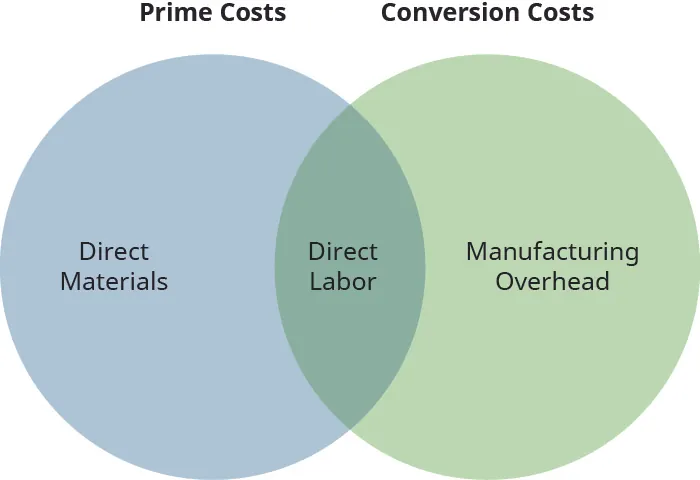
This Venn diagram distinguishes prime costs (direct materials and direct labor) from conversion costs (direct labor and manufacturing overhead). It helps you see immediately why direct labor appears in both categories, while overhead is treated as an indirect manufacturing cost that must be absorbed/allocated. Source
= total cost assigned to the unit, job, or batch
= direct materials, direct labor, and direct expenses traced to the output
= indirect production costs assigned to the output
= cost of one identical unit, or one unit within a batch
= completed units over which the total cost is spread
The same formula structure applies across all three methods, but the way costs are collected is different. In examinations, the costing statement must clearly show the sequence of costs and the final figure required.
A sensible process is:
identify the item being costed: a unit, a job, or a batch
collect direct materials used for that output
collect direct labor and any direct expenses
add production overheads assigned to that output
calculate total cost
divide by units only when a cost per unit is required
Applying each method
Unit costing
In unit costing, the focus is on average cost for one identical unit of output.
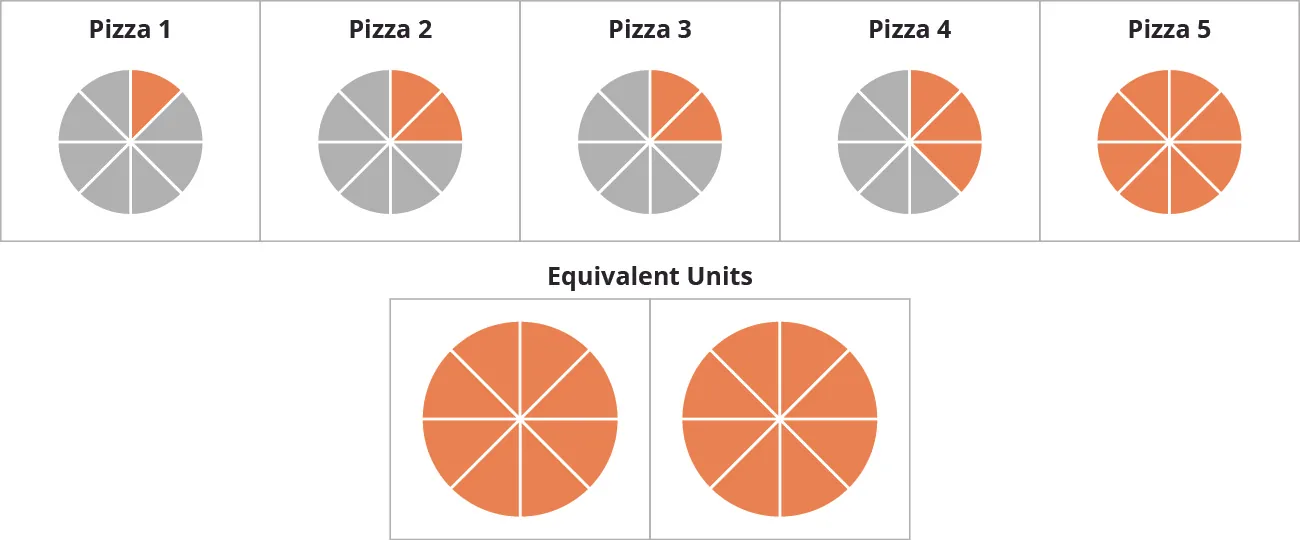
This diagram illustrates the concept of equivalent units by converting several partially completed items into a smaller number of whole (equivalent) units. It provides a visual rationale for why continuous/standardized production uses averaging to compute a representative unit cost, rather than tracing costs to individual items. Source
This method is commonly used in continuous manufacturing, where one unit is indistinguishable from another. The costing statement usually summarizes total production cost for a period and then spreads that cost across the units produced.
The main feature is uniformity. Since the units are the same, separate records for each item are unnecessary. Management is interested in the average cost of one unit rather than the cost of individual orders.
Job costing
In job costing, each job has its own costing statement or job cost sheet. Costs are accumulated separately for that job, allowing the business to know exactly what that customer order or contract has cost.
This method is especially useful when jobs differ in design, size, materials, labor time, or skill required. Accurate identification is essential because costs must be traced to the correct job. A poorly recorded job can lead to incorrect pricing, understated cost, or the wrong reported profit on that job.
Batch costing
In batch costing, costs are first collected for the batch as a whole.
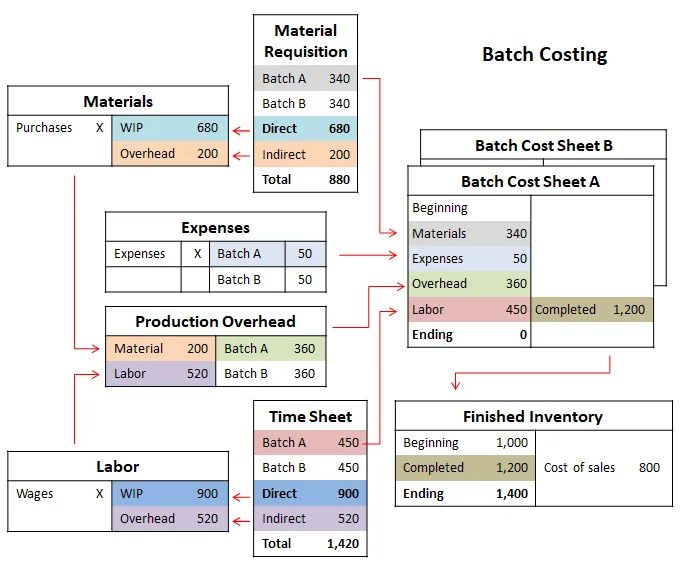
This flow diagram summarizes a batch costing system, showing how direct materials, direct labor, and overhead are collected via source documents and accumulated in a batch cost sheet. It also illustrates the key accounting idea that, once the batch is completed, its total cost is transferred out of work-in-process into finished inventory (and later into cost of sales). Source
Once the total batch cost is known, the cost per unit is obtained by dividing by the number of units in the batch.
The key point is that all items within the batch are treated as identical. This makes batch costing suitable where production is organized in runs rather than as one continuous flow or as one-off customer orders. The statement should therefore distinguish between the cost of the batch and the cost of each unit in the batch.
Manufacturing and service businesses
These methods are relevant to both manufacturing and service organizations. In manufacturing, direct materials are often a major cost, especially in unit and batch production. In service businesses, direct labor may be the most important element, particularly in job costing.
A service business can use:
unit costing for repeated standardized services
job costing for client-specific assignments
batch costing for groups of identical service outputs delivered together
The same accounting logic applies in both sectors: identify the output, trace direct costs, assign production-related overheads, and prepare a clear costing statement.
Common distinctions to remember
Students often lose marks by confusing these methods. The differences are straightforward:
unit costing averages cost across all identical units
job costing keeps each job separate
batch costing collects cost for one group, then averages within that group
Another common error is stopping at total cost when the question requires a unit figure. In batch costing, both figures may be important. In unit costing, the main result is usually the unit cost. In job costing, the main result is often the total cost of that specific job, although a unit figure may still be needed if the job contains several identical items.
A strong answer always matches the costing method to the production method and presents the costing statement in a clear, logical order.
Practice Questions
State two characteristics of production for which unit costing would be appropriate. [2 marks]
1 mark for any valid characteristic, up to 2 marks.
Valid points include:
output is identical or standardized
production is continuous or repetitive
costs are averaged over many units
separate costing of each item is unnecessary
A bakery produces Batch 56 of 800 identical cakes. Direct materials are 960, direct labor is 440, and production overheads assigned are 200.
Required: (a) Calculate the total cost of Batch 56. [2]
(b) Calculate the cost per cake. [1]
(c) State two reasons why batch costing is suitable for this production. [2]
[5 marks]
(a)
1 mark: correct inclusion of all costs
1 mark: total batch cost = 1600
(b)
1 mark: cost per cake = 2
(c)
1 mark each for any two valid reasons:
cakes are produced in a group
units within the batch are identical
costs can be collected for the whole batch and then divided by units
batch costing is suitable for production runs of similar items
FAQ
Setup costs are usually collected as part of the total cost of the batch, not as the cost of one individual unit.
This means they are spread across all units in the batch:
a larger batch gives each unit a smaller share of setup cost
a smaller batch gives each unit a larger share of setup cost
That is one reason why batch size can have a major effect on unit cost.
Its accumulated cost is usually carried forward as work in progress until the job or batch is completed.
The business should keep recording:
materials already used
labor already charged
production overheads assigned so far
The full cost is only finalized when the work is complete.
Can one business use more than one of these costing methods at the same time?
Job costing depends on accurate tracing of cost to a specific job. If records are weak, one job may be overcosted while another is undercosted.
Important documents often include:
job cards
time sheets
material requisitions
authorization records for extra work
Good documentation supports pricing, billing, and control of profitability on each job.
In many service jobs, labor is the main resource consumed. Materials may be small or even negligible.
This makes time recording very important:
hours must be linked to the correct client or assignment
different staff grades may have different cost rates
unrecorded time can cause the job cost to be understated
For service businesses, careful labor tracking is often the key to reliable job costs.