IB Syllabus focus: 'Psychologists should recognize researcher, participant, sampling, confirmation and publication biases, and understand how they affect research conduct and interpretation.'
Psychological research aims to be objective, yet systematic bias can shape what is studied, who is studied, how data are collected, and how findings are understood by researchers and readers.
Why bias matters
In psychology, bias is not just a simple mistake. It is a systematic influence that pushes research away from a fully accurate picture of behavior. Because psychologists work with people, beliefs, and complex methods, bias can appear at many stages of the research process. Because bias is systematic, it can create patterns that look convincing even when they do not reflect the underlying population or process.
Bias affects research conduct and research interpretation. During conduct, it can influence the design of a study, the wording of questions, the behavior of participants, or the selection of a sample. During interpretation, it can cause researchers or audiences to overestimate support for a theory, ignore limitations, or assume findings apply more widely than they actually do.
Major forms of bias in psychological research
Researcher bias
Researcher bias happens when a psychologist’s expectations, values, or preferred explanation influence the study. This does not always happen intentionally. A researcher may unknowingly give clearer instructions to one group, code behavior in a way that fits a hypothesis, or pay more attention to data that seem meaningful. In observational or qualitative work, subtle choices about what counts as meaningful can strongly shape the final dataset.
Researcher bias can affect conduct by:
shaping the research question
influencing how variables are observed or recorded
changing interactions with participants
encouraging selective attention during data analysis
It can affect interpretation when researchers:
emphasize findings that support their prediction
minimize contradictory evidence
write conclusions that go beyond the actual data
Participant bias
Participant bias occurs when participants respond in a distorted way because of the research situation. They may try to appear socially acceptable, guess the aim of the study, or behave differently simply because they know they are being studied. This is particularly problematic in experiments and interviews, where cues from the setting can influence performance and answers.
This can affect conduct in several ways:
self-report answers may reflect social desirability rather than honest views
participants may change behavior to fit what they think is expected
sensitive topics may lead to underreporting or exaggeration
As a result, findings may not reflect everyday behavior. A study could seem to show an effect when it is really measuring participants’ reactions to the research setting.
Sampling bias
Sampling bias occurs when the people selected for a study are not representative of the target population. Some groups may be easier to reach, more willing to volunteer, or more likely to remain in the study.
Common sources include:
relying on convenience samples
recruiting from only one school, clinic, or online platform
excluding people who are harder to contact or less available
A large sample can still be biased if it consistently overrepresents one demographic or one type of volunteer. Sampling bias affects conduct because the pool of participants is already limited before data collection begins. It affects interpretation because researchers may generalize too far. Findings from a narrow sample should not automatically be treated as true for all people.
Confirmation bias
Confirmation bias is the tendency to notice, seek out, and give greater weight to evidence that supports an existing belief. In psychological research, this can influence literature reviews, hypotheses, interviews, coding, and analysis.
For example, a researcher who strongly expects a result may:
ask questions that encourage confirming responses
pay closer attention to supportive patterns
treat inconsistent findings as less important
Confirmation bias is especially important in interpretation.
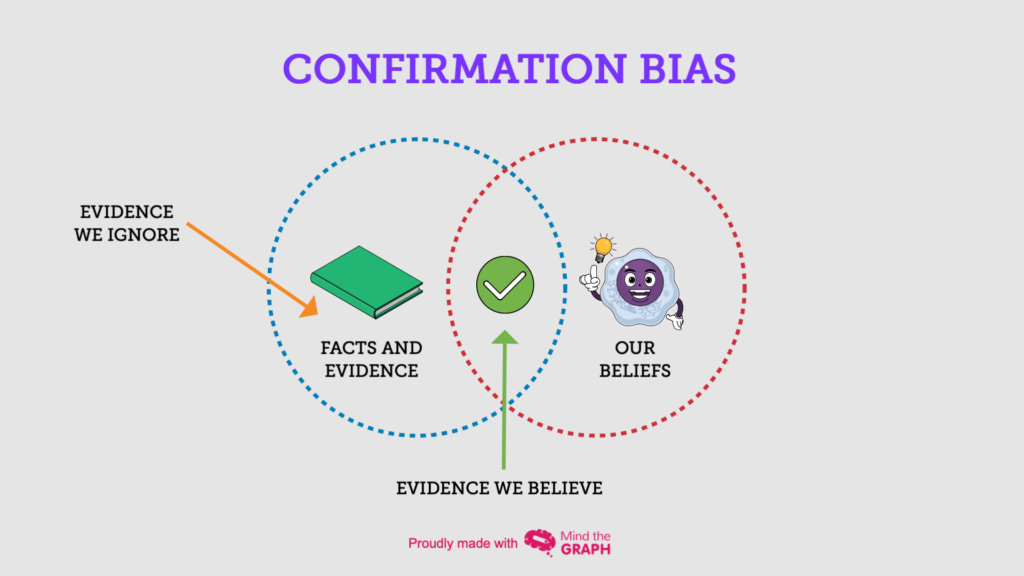
This diagram illustrates confirmation bias as a filtering process: information consistent with existing beliefs is treated as more convincing, while conflicting evidence is more likely to be ignored. It helps explain why researchers (or readers) can come away with conclusions that seem well-supported even when the full evidence base is mixed. Source
If contradictory evidence is discounted, conclusions may appear stronger and more consistent than the full data justify.
Publication bias
Publication bias occurs when studies with statistically significant, positive, or striking results are more likely to be published than studies with null or mixed findings. This means the published literature may not represent all the research that has been conducted.
This affects conduct indirectly because researchers and journals may place greater value on exciting outcomes. It affects interpretation more directly because:
the available evidence base becomes distorted
theories may seem better supported than they are
reviews and meta-analyses may overestimate the size or reliability of effects
Textbooks, media reports, and professional practice may then rely on an incomplete picture of the evidence. When only certain results enter the published record, psychologists and the public can form misleading impressions about what the evidence really shows.
How bias shapes interpretation of findings
Bias does not end once data are collected. Interpretation is vulnerable when researchers, teachers, media outlets, or policy makers read findings without considering how the evidence was produced.
Key interpretation problems include:
assuming a biased sample represents a whole population
treating self-report data as fully accurate despite participant bias
accepting published findings without asking what unpublished research is missing
confusing consistency in the literature with true certainty, when publication bias may be operating
This is why critical reading matters in psychology. A strong study is not judged only by its final result, but by how carefully bias has been considered throughout the research process.
Questions to ask when evaluating a study
When reading psychological research, ask:
Did the researcher’s expectations have opportunities to influence procedure or coding?
Could participants have changed their responses because they knew they were being studied?
Who was included in the sample, and who may have been left out?
Were alternative findings or contradictory patterns fully discussed?
Does the published study represent the whole body of evidence, or only the most noticeable part of it?
These questions help students move beyond simply memorizing findings. They encourage evaluation of whether the evidence is trustworthy, limited, or possibly distorted by bias.
Practice Questions
State one way sampling bias may affect psychological research findings. [2 marks]
1 mark for identifying that the sample is unrepresentative or that some groups are overrepresented or underrepresented.
1 mark for explaining that this limits generalization or may distort the findings.
Explain how researcher bias and publication bias may affect the conduct and interpretation of psychological research. [6 marks]
1 mark for identifying researcher bias as the influence of researcher expectations or beliefs.
1 mark for explaining one effect on research conduct, such as selective observation, leading questions, or biased coding.
1 mark for explaining one effect on interpretation, such as overstating support for a hypothesis.
1 mark for identifying publication bias as the greater likelihood of publishing significant, positive, or striking findings.
1 mark for explaining one effect on interpretation of the literature, such as null findings being missing and effects appearing stronger than they are.
1 mark for a clear, organized psychological explanation using appropriate terminology.
FAQ
Publication bias is the broader pattern in which some findings are more likely to appear in journals than others.
The file-drawer problem is one specific form of publication bias: studies with null or weak results are completed but never published, so they stay in researchers’ files instead of entering the evidence base.
This matters because readers may think a theory has stronger support than it actually does.
Yes. Participants do not need to know the full aim of the study to change their behavior.
They may react to:
being watched
the researcher’s tone or body language
the setting of a lab or interview
concern about being judged
This is why even vague awareness of being studied can influence responses.
Replication helps show whether a finding appears again under new conditions, with new researchers, or with different samples.
If a result is difficult to replicate, that does not automatically prove bias, but it may suggest that the original finding was influenced by:
sampling problems
researcher expectations
participant reactions
selective publication
Replication is valuable because it tests whether an effect is robust rather than accidental or distorted.
Preregistration means researchers publicly record their hypotheses, methods, and planned analyses before collecting or analyzing data.
This can reduce confirmation bias because it makes it harder to:
change hypotheses after seeing results
focus only on supportive analyses
ignore outcomes that do not fit expectations
Preregistration does not remove bias completely, but it increases transparency and makes interpretation more credible.
Yes. A large sample improves precision, but it does not automatically improve representativeness.
If thousands of participants all come from a narrow source, such as one website or one type of volunteer group, the research can still be biased.
In simple terms:
large does not always mean balanced
precise does not always mean accurate
A biased large sample can produce very stable results that are still misleading.