IB Syllabus focus: 'Anchoring, representativeness and availability biases can affect thinking and everyday decision-making when time, information or motivation is limited.'
Everyday decisions often seem rational, but psychologists show that people rely on fast mental shortcuts. These shortcuts save effort while also creating predictable errors in judgment under pressure.
Cognitive Biases and Decision-Making
Psychologists use the term cognitive bias to describe a consistent error in thinking that affects judgment and choice.
Cognitive bias: A systematic pattern of thinking that leads judgments away from more accurate or fully objective decision-making.
Decision-making is never entirely objective; people often use quick mental shortcuts when information is incomplete, time is short, or motivation to think carefully is low. These shortcuts are efficient, but they can produce predictable distortions.
Why biases are likely in everyday life
Everyday decisions often occur under limited conditions: not enough time, not enough information, or not enough mental effort. In these situations, people tend to:
focus on the most noticeable cue
compare new information with a familiar pattern
rely on examples that are easy to remember
These tendencies make judgment faster, but not always more accurate.
The three biases named in the syllabus show different ways this happens.
Anchoring Bias
One common distortion is anchoring bias, in which an initial piece of information strongly shapes later judgment.
Anchoring bias: The tendency to rely too heavily on an initial value, impression, or piece of information when making a later judgment or decision.
Anchors can be numbers, first impressions, or early labels. Once an anchor is present, people often adjust from it, but not enough. If a shopper first sees a high price, a later discount may seem better than it objectively is. If a person hears an early estimate of risk, later judgments may stay too close to that first figure.
Anchoring matters because the first information is not always the best information. It may be arbitrary, misleading, or incomplete. Under time pressure, people are even less likely to reevaluate the anchor carefully, so the starting point continues to influence the final decision.
Representativeness Bias
A different shortcut is representativeness bias, which affects judgments about probability and category membership.
Representativeness bias: The tendency to judge how likely something is by how much it resembles a mental prototype or stereotype, rather than by more complete evidence.
Instead of asking how common something actually is, people may ask how much it resembles a typical example. If a person seems quiet and analytical, others may quickly judge them as more likely to be a scientist than a salesperson because the description matches a stereotype. The problem is that similarity does not automatically equal likelihood.
This bias can distort decisions because people may ignore base rates, meaning the actual frequency of an event or group.
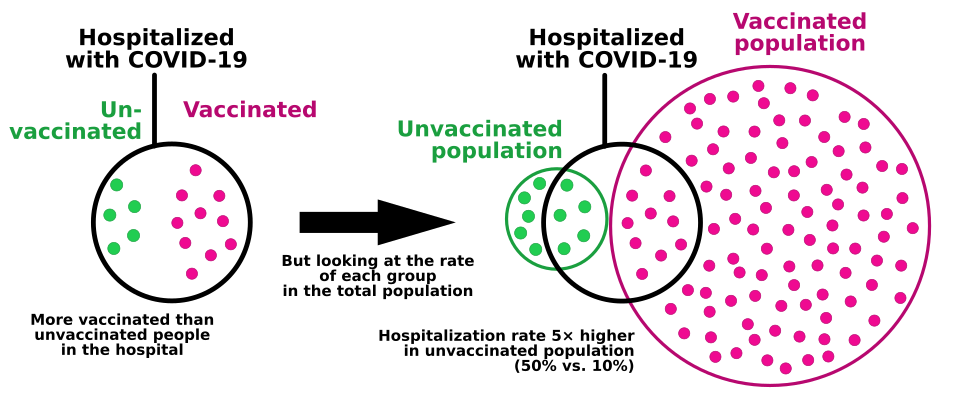
A labeled Euler-style diagram illustrating the base-rate fallacy (base-rate neglect): the overall sizes of groups in the population (base rates) can make a raw count look misleading if you ignore denominators. The image helps students see why “more cases in group A” does not automatically mean “higher risk in group A” without considering prevalence. This connects directly to representativeness-based judgments that feel intuitive but can contradict statistical reasoning. Source
When information is limited, the mind often prefers a vivid pattern over statistical reasoning. Representativeness therefore feels convincing, even when it leads to inaccurate predictions about people, risks, or future outcomes.
Availability Bias
Another important shortcut is availability bias, which relies on how easily examples come to mind.
Availability bias: The tendency to judge the frequency or likelihood of an event by how easily relevant examples can be recalled from memory.
If an event is recent, dramatic, emotional, or widely reported, it is easier to recall. People may then judge it as more common or more likely than it really is. A person who has recently heard several stories about airplane problems may overestimate the danger of flying, even though such events are rare. In the same way, memorable success stories can make risky choices seem safer than they are.
Availability bias shows that memory accessibility is not the same as objective frequency. What comes to mind quickly can dominate judgment, especially when people do not stop to search for broader evidence. Limited motivation is important here: if someone does not feel strongly motivated to think carefully, the easiest memory may become the basis of the decision.
Why These Biases Matter
These three biases are especially important because they shape ordinary choices, not only major life decisions. They can influence:
consumer decisions, such as judging value from an initial price
health decisions, such as estimating illness risk from memorable cases
social judgments, such as classifying people through stereotypes
financial decisions, such as predicting outcomes from recent or vivid market events
safety judgments, such as overreacting to dramatic but rare dangers
In each case, the decision may feel reasonable from the person’s point of view. That is why cognitive biases are powerful: they are systematic and often unnoticed. People usually experience them as common sense rather than as error.
Improving Decision Quality
Psychologists are interested not only in identifying bias but also in reducing its effects in daily life. Helpful strategies include:
pausing before making quick judgments
asking whether the first number or impression is shaping the choice unfairly
checking statistical or background information rather than relying only on similarity
looking for less memorable but more representative evidence
comparing multiple options at the same time instead of judging each in isolation
These strategies do not remove bias completely, but they can make decisions more deliberate when time, information, or motivation are limited.
Practice Questions
Describe one feature of anchoring bias in decision-making.
1 mark for identifying that an initial value, estimate, or piece of information acts as an anchor.
1 mark for stating that later judgment is made in relation to that starting point.
1 mark for explaining that adjustment is often insufficient, so the final decision remains too close to the anchor.
Explain how representativeness bias can influence everyday decision-making when time, information, or motivation is limited.
1 mark for identifying representativeness bias as judging based on similarity to a prototype or stereotype.
2 marks for accurately explaining how resemblance is used as a shortcut for probability or category judgment.
1 mark for noting that actual frequency or base-rate information may be ignored.
2 marks for applying the bias to an everyday decision-making context and linking it clearly to limited time, information, or motivation.
FAQ
A heuristic is a mental shortcut used to make a judgment quickly.
A cognitive bias is the systematic error that can result from using that shortcut. Not every heuristic leads to a bad decision, but a bias appears when the shortcut pushes thinking away from a more accurate judgment.
An anchor often sets a mental range before careful thinking begins. After that, people tend to adjust from the starting point rather than beginning from zero.
Because adjustment takes effort, it is usually incomplete. Knowing an anchor is random can help, but it does not always erase the first influence.
Yes. Expertise can reduce bias in familiar situations, but it does not eliminate it.
Experts also work under deadlines, uncertainty, and routine pressure. In some cases, confidence from expertise can even make people less likely to question an early judgment.
Digital platforms often prioritize content that is recent, emotional, dramatic, or highly repeated.
That makes certain events and opinions easier to remember later. People may then confuse repeated exposure with true frequency, importance, or social agreement.
Not always. Fast shortcuts can be useful when time is short, stakes are low, or the environment is familiar.
The problem is that speed and ease can feel like accuracy. A shortcut that works well in one setting may produce a serious error in a more complex or unusual situation.