IB Syllabus focus: 'Biases toward particular psychological perspectives may result in reductionism and limit holistic understanding of behaviour.'
Psychologists often interpret behavior through preferred theoretical lenses. This can sharpen research questions, but it can also narrow explanations, producing reductionist accounts that overlook interacting influences and weaken a fuller understanding of human behavior.
Perspective bias in psychology
A psychological perspective provides a way of organizing evidence and explaining why behavior happens. Perspectives are useful because they guide research, define important concepts, and suggest which variables matter most. However, problems arise when a psychologist becomes overly committed to one perspective and treats it as the main or only valid way to explain behavior.
Perspective bias: A tendency to interpret behavior mainly through one preferred psychological perspective, giving greater weight to some explanations while neglecting others.
Perspective bias does not mean that a perspective is automatically wrong. A single perspective may generate strong evidence and valuable insights. The bias lies in overemphasis. Instead of asking what a perspective can explain well and where its limits are, the researcher or theorist assumes that the preferred lens is sufficient on its own.
How perspective bias can appear
Research focus: only certain variables are selected because they fit the preferred perspective.
Interpretation of findings: results are read in ways that support the favored explanation.
Language choices: behavior is described using terms from one perspective, shaping how readers understand it.
Neglect of alternatives: explanations from other perspectives are treated as less important or ignored.
This matters because human behavior is rarely simple. The more complex the behavior, the greater the risk that one-perspective explanations will miss important influences.
Reductionism
When perspective bias becomes strong, it often leads to reductionism.
Reductionism: Explaining a complex behavior by reducing it to a smaller set of parts or a single level of explanation, while overlooking other relevant influences.
Reductionism is not always inappropriate. In science, breaking a problem into smaller parts can make it easier to study. A narrower explanation can improve clarity, allow testing, and produce precise predictions. The issue for IB Psychology is that excessive reductionism can distort understanding when the simplified account is treated as complete.
For example, if a behavior is explained only in terms of internal processes, the explanation may ignore social context. If it is explained only in terms of external context, it may ignore how the individual interprets the situation. A reductionist account may therefore identify one genuine influence but still fail to explain the behavior fully.
Why perspective bias tends to produce reductionism
A perspective usually has core assumptions about what matters most. If those assumptions dominate thinking, the psychologist may:
treat one level of explanation as primary
frame other influences as secondary or irrelevant
search mainly for evidence that fits the preferred account
present a partial explanation as if it were a full one
This creates a narrow model of behavior. The explanation may seem convincing because it is neat and coherent, but simplicity is not the same as completeness.
Limiting holistic understanding
A holistic understanding of behavior recognizes that behavior can be shaped by multiple interacting influences.
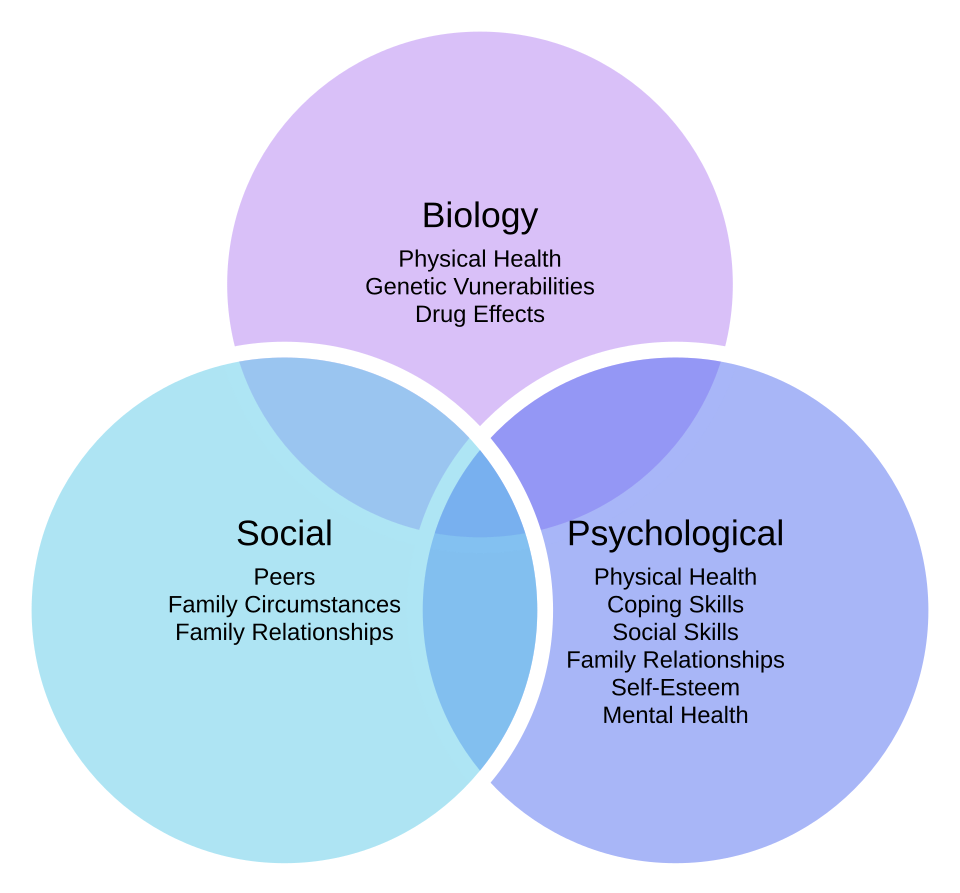
This biopsychosocial Venn diagram shows how biological, psychological, and social factors can jointly contribute to an outcome, with overlap emphasizing interaction rather than single-cause explanations. It supports evaluation answers that contrast reductionist, one-level accounts with multi-level, integrative explanations. Source
It looks at the person in context rather than isolating only one part of the explanation. Perspective bias makes this harder because it pushes attention toward one favored slice of the bigger picture.
A limited holistic understanding can affect psychology in several ways.
Important features that may be overlooked
Interaction among influences: different factors may work together rather than separately.
Context: the same behavior may have different meanings in different situations.
Complexity: a simple explanation may not capture variation between individuals.
Interpretive depth: focusing on one perspective can miss the subjective meaning of behavior.
As a result, psychology may produce explanations that are internally consistent but incomplete. A theory can be elegant and still leave out key dimensions of human behavior.
This is why evaluation in psychology should ask not only, “Is this explanation supported?” but also, “What does this explanation leave out?” That second question is central to identifying perspective bias.
Recognizing perspective bias in theories and research
Students should be able to spot signs that an explanation has become too perspective-driven. This requires attention to both what is present and what is absent.
Questions to ask
What factors does the explanation emphasize most strongly?
Which possible influences are not considered?
Is the explanation presented as the explanation or as one explanation?
Does the argument acknowledge complexity, interaction, and context?
Could the same behavior be interpreted differently from another perspective?
These questions do not require rejecting a theory. Instead, they help evaluate the scope of the explanation. A strong response in IB Psychology often recognizes that a theory may be useful, evidence-based, and still reductionist if it excludes other important influences.
Moving beyond a single-perspective view
Avoiding perspective bias does not mean every explanation must include everything. That would make psychology too vague to study. Instead, the goal is balance: using focused explanations when they are useful, while recognizing their limits and considering whether additional perspectives are needed for a fuller account.
A more balanced approach usually involves:
acknowledging that behavior can have more than one valid level of explanation
distinguishing between a partial explanation and a complete explanation
comparing what different perspectives can each contribute
remaining cautious about claims that one perspective alone fully explains behavior
In practice, this means psychologists should remain open to the idea that behavior may be best understood through complementary insights rather than a single preferred lens. That openness helps prevent reductionism from narrowing psychological understanding.
Practice Questions
State what is meant by perspective bias in psychology. [2 marks]
1 mark for identifying that a researcher or theorist favors one psychological perspective.
1 mark for stating that alternative explanations or influences are neglected or given less weight.
Explain how bias toward a particular psychological perspective may lead to reductionism and limit holistic understanding of behavior. [6 marks]
1 mark for defining or clearly describing perspective bias.
1 mark for defining or clearly describing reductionism.
1 mark for explaining that one perspective emphasizes a limited set of assumptions or variables.
1 mark for linking this narrow focus to an oversimplified explanation of complex behavior.
1 mark for explaining that other relevant influences, context, or interactions may be overlooked.
1 mark for explaining that this weakens or limits a holistic understanding of behavior.
FAQ
Parsimony means preferring the simplest explanation that adequately fits the evidence.
Reductionism means explaining behavior at a narrower or lower level, sometimes excluding other important levels.
A parsimonious explanation is not automatically reductionist. An explanation can stay relatively simple while still recognizing multiple influences if the evidence requires them.
Yes. Data do not always speak for themselves.
Researchers choose:
which variables matter most
what counts as meaningful evidence
how findings should be interpreted
Because of this, the same pattern of results can sometimes be explained differently depending on the perspective used. This is one reason perspective bias matters: interpretation can become narrower than the data actually require.
Perspective bias can be reinforced by the culture of a field, not just by one individual.
Common reasons include:
graduate training in one dominant model
journals favoring certain theories
supervisors shaping how questions are asked
citation patterns that reward familiar explanations
Over time, a perspective can start to feel “normal” or “obvious,” making its limits less visible.
Be cautious when explanations use absolute language such as:
“the real cause”
“nothing more than”
“all behavior comes from”
“this proves why people act this way”
These phrases suggest that one explanation is being treated as complete. In psychology, strong claims like these often hide omitted factors, context, or interactions.
Use qualified language that shows awareness of scope.
Helpful habits include:
saying a theory explains part of a behavior
noting the level of explanation being used
briefly acknowledging what the theory does not cover
avoiding claims that one account explains behavior fully
This makes your writing more balanced and shows critical thinking without rejecting the theory entirely.