IB Syllabus focus: 'Psychology debates whether behaviour changes through free will and agency or through biological and environmental determinism.'
Understanding behavior change requires asking whether people actively choose to change or whether change is shaped by forces beyond conscious control. This debate influences explanation, responsibility, and expectations about psychological intervention.
The core debate
Psychologists use the debate between free will and determinism to ask a central question: when behavior changes, is that change chosen by the person, or produced by causes acting on the person? The issue is not just philosophical. It affects how psychologists explain habits, self-control, mental disorders, recovery, and resistance to change.
Free will: The idea that people can make choices and act intentionally rather than being completely controlled by prior causes.
In psychology, free will is closely linked to agency, the capacity to act intentionally and direct one’s own behavior.
Determinism: The view that behavior is caused by factors such as biology, learning, and environment, so actions do not arise from completely independent choice.
A deterministic explanation does not mean behavior can never change. Instead, it argues that change itself has causes. A person may stop smoking because of genetic differences in addiction sensitivity, strong social support, new consequences, or a changed environment. The key claim is that behavior shifts for reasons, not from unconstrained choice alone.
Free will, agency, and intentional change
A free-will perspective emphasizes conscious decision-making. People may reflect on goals, weigh options, and choose new behaviors because they want better outcomes. From this viewpoint, change often begins when a person recognizes a problem and decides to act differently.
Motivation is treated as something people can strengthen.
Self-regulation matters because individuals can monitor and adjust their actions.
Responsibility is emphasized, since choices are seen as meaningful causes of behavior change.
This approach is useful because it captures real features of experience. Many people report that they changed through commitment, effort, and deliberate practice. It also supports the idea that people are not simply passive. They can plan, resist impulses, and pursue long-term goals.
However, a strong free-will view can underestimate constraints. It may overlook how difficult change is when habits are automatic, environments are stressful, or biology increases vulnerability. If psychologists focus only on choice, they may wrongly assume that failure to change is just a lack of effort.
Biological and environmental determinism
Biological determinism
Biological determinism explains change in behavior through internal physical causes such as genes, neurochemistry, hormones, brain structure, or inherited temperament.
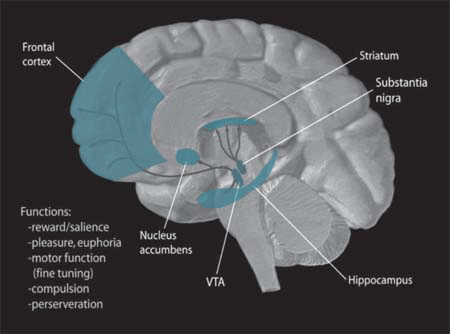
This diagram maps major dopaminergic pathways, linking midbrain structures (e.g., VTA/substantia nigra) to targets involved in reward and movement (e.g., nucleus accumbens, striatum, prefrontal cortex). It supports biological-determinist explanations by showing how changes in neurochemistry and circuitry can bias motivation, self-control, and vulnerability to compulsive habits. Source
For example, some people may be more prone to impulsivity, anxiety, or substance dependence because of biological predispositions. In this view, change may require altering brain or body processes, not just making a decision.
Biological determinism can help psychologists avoid blaming people for problems that are partly outside conscious control. It also supports interventions that target underlying mechanisms, such as medication or strategies matched to neurological limits. Yet taken too far, it can suggest that change is fixed or unlikely, which may reduce hope and effort.
Environmental determinism
Environmental determinism explains behavior change through external causes such as reinforcement, punishment, role models, family influence, culture, trauma, education, and opportunity.
A person may improve because the environment rewards new behavior, or may fail to change because everyday conditions keep triggering the old pattern.
This perspective is valuable because it shows that behavior does not occur in isolation. Choices are shaped by contexts. If environments change, behavior often changes too. However, an extreme environmental view may understate personal reflection and the fact that people sometimes resist pressures around them.
Why the debate matters for understanding change
How psychologists answer this debate influences important judgments about behavior change:
Responsibility and blame: A stronger free-will view supports personal accountability, while stronger determinism encourages attention to constraints and circumstances.
Treatment goals: If behavior is chosen, intervention may focus on decision-making and commitment. If behavior is determined, intervention may focus more on changing causes.
Expectations of progress: Deterministic explanations can make change seem slower and more complex, especially when multiple causes are involved.
Public attitudes: Explanations of addiction, aggression, or relapse affect whether society sees people as weak, ill, disadvantaged, or capable of recovery.
Because of this, the debate is not only about theory. It shapes how psychologists speak about people, how they design support, and how success or failure is interpreted.
A balanced psychological view
Most contemporary psychology does not treat free will and determinism as complete opposites. A more realistic position is that behavior is constrained but not meaningless. People make choices, but those choices are influenced by biology, learning history, social conditions, and immediate situations. Agency may operate within limits rather than outside them.
This matters for change. Psychologists often assume that people can change, but not simply by “wanting it” in isolation. Effective change usually depends on both personal effort and altered conditions. A student can choose to study more, but success is easier if stress is managed, sleep improves, distractions are reduced, and support is available. In this sense, psychology often explains change as the result of intentional action within causal systems.
Seeing behavior this way allows psychologists to preserve human responsibility without ignoring real constraints. It also avoids two unhelpful extremes: blaming people as if all outcomes are pure choice, or assuming people are passive products of forces they can never influence.
Practice Questions
Explain one difference between free will and determinism in relation to behavior change.
1 mark for identifying free will as behavior change through conscious choice, intention, or agency.
1 mark for identifying determinism as behavior change caused by biological or environmental factors outside full voluntary control.
Explain how the debate between free will and determinism influences psychologists’ understanding of why people do or do not change their behavior.
accurate explanation of free will
accurate explanation of determinism
reference to agency, intention, or conscious decision-making
reference to biological or environmental causes of change
explanation of how the debate affects judgments about responsibility, blame, or accountability
explanation of how the debate affects intervention, expectations of change, or a balanced view that behavior reflects both choice and constraints
FAQ
Compatibilism is the idea that human actions can be caused and still count as free in a meaningful sense.
In psychology, this is useful because it avoids an all-or-nothing choice between total freedom and total control. A person may be influenced by genes, habits, and social context, yet still act in line with goals and values.
This view helps psychologists explain why support and structure matter without treating people as helpless.
Not necessarily. Some neuroscience studies show that brain activity can appear before a person reports a conscious decision.
However, these findings are limited:
the tasks are often very simple
early brain signals may reflect preparation, not a final choice
complex real-life decisions involve reflection, conflict, and delayed action
So neuroscience can challenge simple ideas about conscious control, but it does not settle the debate completely.
Yes, they can. If people believe they have some control over their actions, they may be more likely to persist, plan, and take responsibility for setbacks.
But there is a downside. If belief in control becomes too strong, people may blame themselves harshly for difficulties that also involve stress, biology, or disadvantage.
A balanced belief often works best: “My behavior has causes, but I can still influence what happens next.”
Habits sit at the center of the free will versus determinism debate because they show how behavior can become automatic.
Repeated actions in stable contexts create strong cue-response links. That means people may act before they fully reflect. In that sense, habits support deterministic explanations.
At the same time, habits can be redesigned through:
cue awareness
routine replacement
repetition in a new context
So habits show both sides of the debate: behavior can be automatic, yet still open to gradual change.
Yes. Cultural beliefs can affect how much importance people give to individual choice versus social context.
Some cultures emphasize:
personal independence
individual responsibility
self-directed action
Others place more weight on:
relationships
duties
social roles
situational influence
This matters in psychology because clients, families, and communities may interpret behavior change differently. An approach that stresses individual choice may feel empowering in one setting but unrealistic or insensitive in another.