IB Syllabus focus: 'Change relates to development, maturation, motivation, barriers to change and intervention, prevention or promotion strategies.'
Psychological change is shaped by age-related growth, biological readiness, and the forces that drive action. Understanding these factors helps explain why some behaviors change easily while others resist intervention.
Development and Change
The concept of development is central to understanding change across the lifespan.
Development: A pattern of change over time in physical, cognitive, social, and emotional functioning.
In psychology, development is broader than simple learning. It includes changes in thinking, emotion, relationships, and self-regulation from infancy through old age. Some developmental changes are fairly predictable, such as increasing language ability in childhood or changing social roles in adolescence and adulthood. However, development is not identical for everyone. The rate, timing, and expression of change vary between individuals and are shaped by both biology and experience.
Why development matters for psychological change
Psychologists need to know a person’s developmental stage because behavior that is realistic at one age may be unrealistic at another. A change strategy that assumes strong impulse control, abstract reasoning, or long-term planning may be less effective if those abilities are still developing. Development therefore affects both what change is possible and how change should be supported.
A second key influence on change is maturation.
Maturation: Biologically guided growth processes that unfold with age and increase readiness for particular abilities or behaviors.
Maturation refers to changes that depend heavily on inherited biological processes, especially in the nervous system, endocrine system, and body. It helps explain why some abilities emerge only when the organism is ready. Motor coordination, puberty-related changes, and some aspects of emotional regulation depend partly on maturational processes.
Development, Maturation, and Readiness
Although development and maturation are related, they are not the same. Development is the wider pattern of change; maturation is one important source of that change. A useful idea here is readiness: people are often more likely to benefit from learning or behavior change when underlying capacities have developed enough to support it.
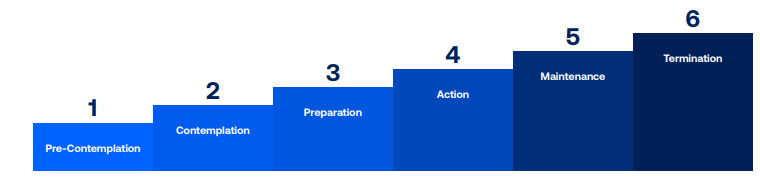
This diagram visualizes the Transtheoretical Model (Stages of Change) as a stepwise progression from precontemplation through maintenance (and termination). It’s useful for linking the idea of readiness to intervention planning: different supports are typically appropriate depending on which “stage” someone is currently in. Source
This means psychologists cannot assume that effort alone produces change. If a skill or form of self-control depends on a level of brain or bodily development that has not yet occurred, progress may be limited. At the same time, maturation does not automatically create the final behavior. Experience, practice, social support, and context still shape outcomes. Biological readiness opens a window for change, but it does not fully determine what will happen.
Motivation and Behavioral Change
Another major factor in change is motivation.
Motivation: The internal and external processes that energize, direct, and sustain behavior toward a goal.
Motivation helps explain why people start a behavior, continue it, or give up. In psychology, motivation is especially important when the goal is to change existing habits or maintain new ones over time. A person may understand that change is beneficial, yet still fail to act if motivation is weak, conflicted, or inconsistent.
Motivation can come from different sources:
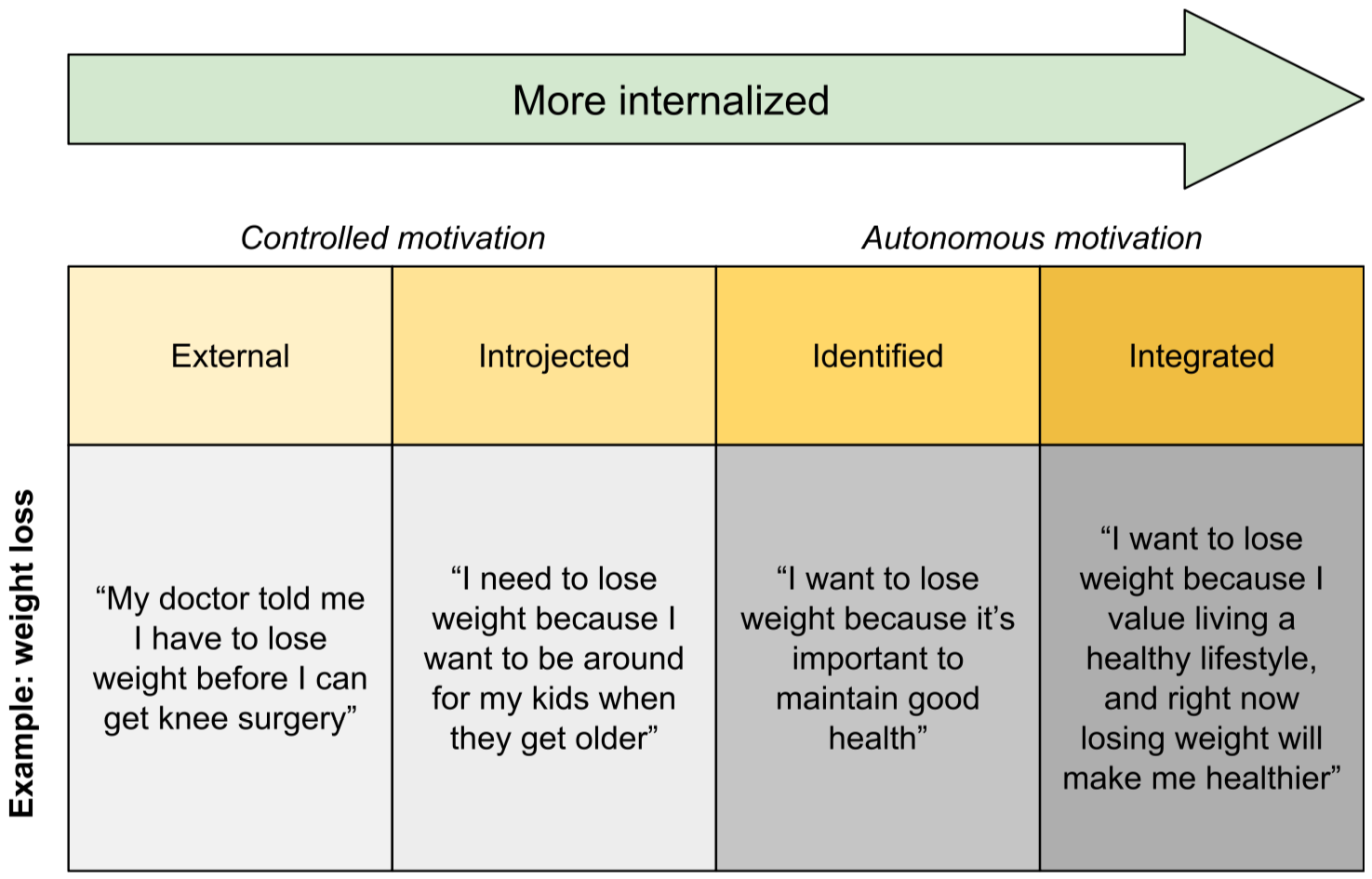
This figure shows motivation on a continuum from more controlled (externally regulated) to more autonomous (internalized) forms, culminating in intrinsic motivation. It helps explain why “extrinsic” motivation is not one category—some extrinsic reasons can become more value-consistent and therefore more persistent over time. Source
Intrinsic motivation: engaging in a behavior because it feels meaningful, satisfying, or consistent with personal values
Extrinsic motivation: engaging in a behavior for rewards, approval, or to avoid punishment
Perceived competence: believing “I can do this”
Goal value: believing the outcome matters
Strong motivation often increases persistence, especially when change is slow or uncomfortable. However, motivation is not enough on its own. People also need opportunity, support, and a change strategy that matches their developmental level.
Barriers to Change
Psychologists also study why change does not happen. Barriers to change are factors that block, weaken, or delay behavior change, even when a person intends to improve.
Common barriers include:
Habits that run automatically with little conscious thought
Immediate rewards from the current behavior, even if long-term consequences are negative
Low self-efficacy, meaning low confidence in one’s ability to succeed
Social influences, such as peer pressure or family norms
Environmental constraints, including limited time, resources, or access to support
Developmental limits, such as immature self-regulation or difficulty appreciating long-term outcomes
Barriers matter because resistance to change is not always a sign of unwillingness. Sometimes the problem is a poor fit between the person and the strategy. A highly abstract message may fail with younger individuals, while a strategy that ignores identity or peer influence may fail with adolescents or adults.
Intervention, Prevention, and Promotion Strategies
Psychologists use these ideas to design strategies for change. An intervention targets a problem or risk factor that is already present. Prevention aims to stop a problem from developing. Promotion focuses on strengthening healthy behavior and protective factors before serious problems appear.
Matching strategies to the person
Effective strategies usually consider:
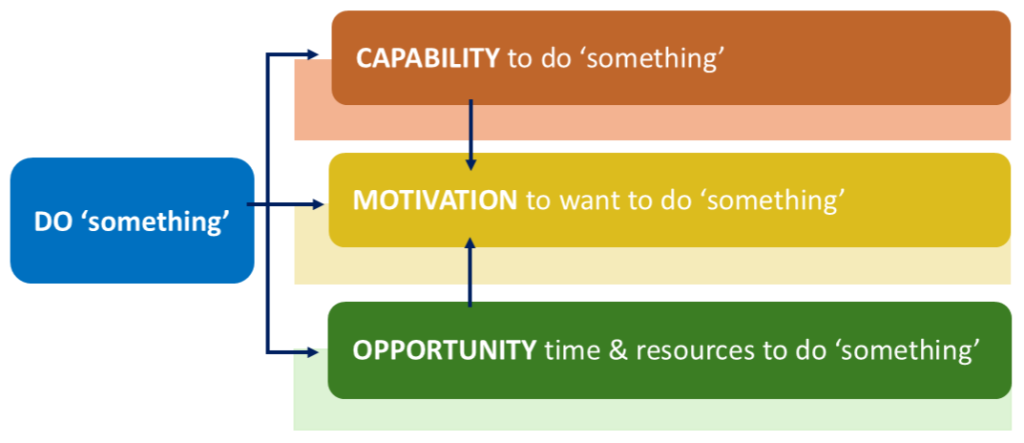
This COM-B diagram summarizes behavior change as requiring sufficient Capability, Opportunity, and Motivation, which together shape Behavior. It’s a practical way to organize barriers (e.g., limited skills, social pressure, environmental constraints, habits) and to see how interventions can target different “leverage points.” Source
the person’s developmental stage
their level of maturational readiness
their current motivation
the specific barriers maintaining the behavior
For children, change efforts often work better when they use concrete instructions, routines, and support from caregivers. For adolescents, strategies may be stronger when they respect autonomy, identity, and peer influence. For adults, change may depend more on self-monitoring, goal setting, and restructuring everyday environments.
Psychologists may increase motivation by making goals feel relevant, achievable, and worthwhile. They may reduce barriers by simplifying tasks, changing environmental cues, building skills gradually, or adding social support. Successful change usually reflects the interaction of development, maturation, motivation, and the conditions surrounding behavior.
Practice Questions
(2 marks)
Define motivation in the context of behavior change.
1 mark for identifying motivation as internal and/or external processes that drive behavior.
1 mark for linking motivation to starting, directing, or sustaining behavior toward a goal or change.
(6 marks)
Explain how development, maturation, and motivation can influence the success of a prevention or intervention strategy.
1 mark for explaining development as change over time in physical, cognitive, social, or emotional functioning.
1 mark for explaining maturation as biologically guided growth or readiness.
1 mark for explaining motivation as processes that energize and sustain goal-directed behavior.
1 mark for explaining that a strategy should match the person’s developmental level.
1 mark for explaining that limited maturational readiness can reduce the effectiveness of change efforts.
1 mark for explaining that stronger motivation, or fewer barriers to change, improves persistence or adherence.
FAQ
A critical period is a narrow time window in which a specific experience is necessary for typical development. If that input is missed, later recovery may be very difficult.
A sensitive period is broader and more flexible. Learning is especially effective during that time, but change can still happen later. This matters because psychologists often time interventions to sensitive periods when people are especially receptive.
Puberty involves hormonal and brain changes that can increase sensitivity to reward, novelty, and social evaluation. That can make short-term rewards feel especially powerful.
At the same time, systems involved in long-term planning and self-control are still developing. This can create an imbalance:
rewards feel intense
peer approval becomes more important
risky choices may become more attractive
Major transitions, such as starting school, moving to high school, or leaving home, disrupt routines and social expectations. Old habits may weaken during these periods.
That makes prevention easier because new patterns can be established before unhealthy behaviors become stable. Psychologists sometimes call this a “window of opportunity” for change, especially when social support and clear guidance are available.
Motivational interviewing is a counseling approach designed to strengthen a person’s own reasons for change rather than forcing change through confrontation.
It fits this subsubtopic because it focuses directly on:
motivation
ambivalence about change
readiness to act
It is especially useful when people know a behavior is harmful but are not yet fully committed to changing it.
This is difficult because people often change naturally over time. Researchers try to separate these influences by comparing people who receive an intervention with similar people who do not.
Useful methods include:
control groups
longitudinal studies
repeated measurements over time
If both groups improve equally, maturation may be the main explanation. If the intervention group improves more, the intervention is more likely to have had an effect.