IB Syllabus focus: 'Psychological research applies theory and findings with the goal of changing individual behaviours.'
Psychology is not only descriptive; it is also practical. Researchers use evidence about learning, thinking, and social influence to design interventions that help individuals start, stop, or maintain behaviors.
Why behavior change matters
A major aim of psychology is to move from explaining behavior to improving behavior. This means applying research findings to real-life problems such as smoking, poor sleep, low exercise, unhealthy eating, weak study habits, or poor treatment adherence. In this subsubtopic, the focus is on how psychologists use evidence to help a person change a specific behavior.
Psychologists do not simply tell people what to do. Instead, they ask questions such as:
What triggers the behavior?
What consequences keep it going?
What thoughts or expectations support it?
What features of the environment make change easier or harder?
The answer to these questions guides the intervention.
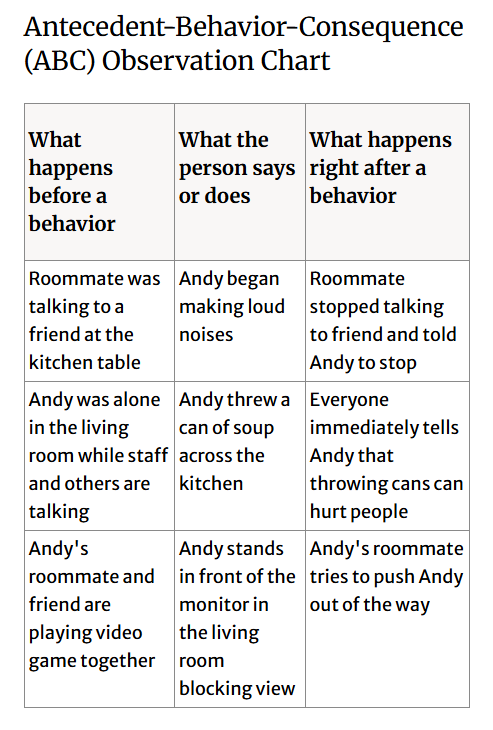
This ABC (Antecedent–Behavior–Consequence) observation chart illustrates how psychologists break a behavior episode into what happens before the behavior, the behavior itself, and what happens immediately after. The structure supports functional thinking: consequences can maintain a behavior, so changing consequences (or antecedent cues) can shift future behavior. It also connects naturally to collecting baseline data and tracking change over time. Source
Behavior change intervention: A planned psychological strategy designed to alter a specific behavior by using theory and evidence about why the behavior occurs.
A strong intervention is usually targeted, measurable, and based on a clear explanation of the behavior.
From research to practice
Identifying the behavior
Psychologists first define the target behavior clearly. Vague goals such as “be healthier” are difficult to change. More useful targets are specific actions, for example:
walking for 30 minutes each day
checking a phone less during class
completing homework before leisure activities
taking prescribed medication on time
Researchers often collect a baseline, meaning a record of the behavior before the intervention begins. This shows how often the behavior occurs and makes later change easier to judge.
Matching the technique to the cause
The same behavior can have different causes in different people. One student may procrastinate because of low confidence, while another procrastinates because distractions are heavily rewarded. Because of this, psychologists try to match the technique to the psychological process involved.
Common strategies include:
changing rewards and consequences
modifying thoughts and beliefs
using role models or social support
changing cues in the environment
breaking a difficult goal into smaller steps
This reflects a central idea in applied psychology: interventions work best when they are tied to an evidence-based mechanism.
Major psychological principles used to change behavior
Learning principles
Research on learning shows that behavior is shaped by its consequences.
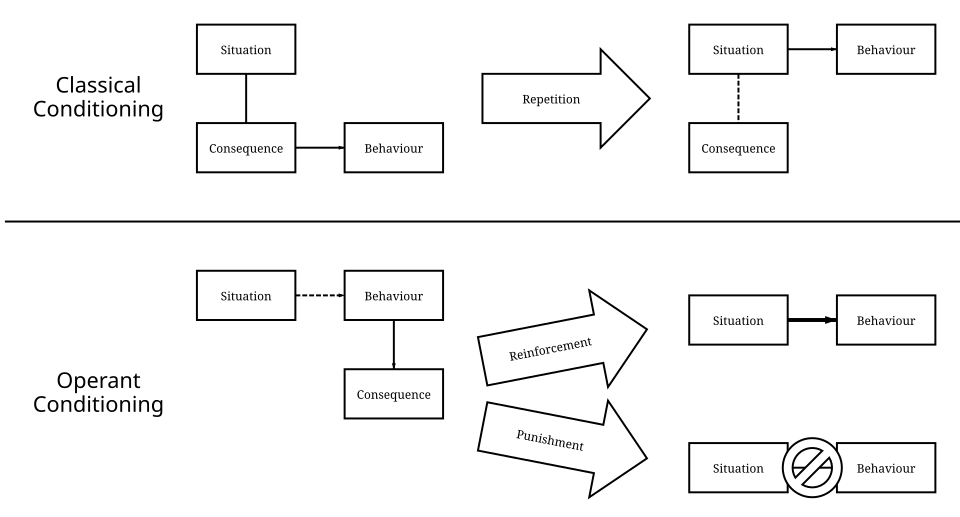
This diagram contrasts classical conditioning (learning by association between stimuli) with operant conditioning (learning where consequences increase or decrease future behavior). It helps clarify why behavior-change interventions often focus on reinforcement and punishment when targeting specific actions. Use it to connect the idea of “behavior shaped by consequences” to a concrete learning framework. Source
Reinforcement increases the likelihood that a behavior will occur again. If a student receives praise or a sense of achievement after studying, studying may become more frequent. Desired behaviors are often strengthened more effectively by positive outcomes than by criticism.
Psychologists may also use shaping, where small improvements are reinforced until a larger goal is reached. This is useful when the final behavior is too difficult to achieve immediately.
Another useful idea is stimulus control, which means changing cues that trigger behavior. For example, placing running shoes by the door can increase exercise, while removing snacks from sight can reduce eating triggered by convenience rather than hunger.
Cognitive principles
Behavior is also influenced by how people interpret situations. Thoughts such as “I will fail anyway” or “missing one day does not matter” can block change even when motivation exists. Cognitive research supports techniques such as:
self-monitoring, where a person records behavior and becomes more aware of patterns
goal setting, especially when goals are specific and realistic
feedback, which shows whether progress is occurring
cognitive restructuring, which challenges unhelpful beliefs
DEFINITION
Self-efficacy: A person’s belief that they can successfully perform a behavior or meet a goal.
Self-efficacy matters because people are more likely to begin and continue a behavior when they believe success is possible. Small early successes can strengthen self-efficacy and improve persistence.
Social and contextual principles
Behavior change is not only individual; it is shaped by the social world. People often copy models, respond to approval, and persist when they feel supported. Research therefore supports strategies such as:
using a peer or family member for accountability
observing a competent model perform the behavior
joining a group that values the desired behavior
arranging the environment so the preferred behavior becomes the easiest option
These techniques show that applying psychology is not just about “willpower.” It also involves designing contexts that support change.
Features of effective behavior-change programs
Psychological applications are usually stronger when they include several features together rather than relying on a single technique.
Clear goals and small steps
Behavior change is easier when the target is:
specific
realistic
broken into manageable stages
Large goals can feel abstract, but short-term steps create momentum. This is important because early success increases confidence and encourages continuation.
Monitoring and adjustment
Psychologists often track change over time by measuring the frequency, duration, or consistency of the target behavior. If the intervention is not working, the strategy may need to be adjusted. For example, a reward may be too delayed, the goal may be too difficult, or the environmental cues may still support the old behavior.
Maintenance over time
Starting a behavior is not the same as maintaining it. A person may change briefly and then return to old patterns. For this reason, applied psychology often focuses on:
making the new behavior part of a routine
reducing opportunities for the old behavior
preparing for setbacks
replacing an unwanted behavior with a more adaptive one
Maintenance is especially important because many behaviors are tied to habits, emotion, and daily context.
Limits and cautions
Applying psychology to change behavior is valuable, but it has limits. Human behavior is complex, and a technique that works for one person may not work for another. Motivation can fluctuate, environments can undermine progress, and people may understand what to do without actually doing it consistently.
Another limitation is that behavior change is often easier in the short term than in the long term. Immediate rewards, stress, fatigue, and competing habits can all weaken new patterns. This is why psychologists usually combine theory, ongoing observation, and practical support instead of assuming that information alone will produce change.
Practice Questions
[2 marks]
Identify one psychological principle that can be used to change individual behavior.
1 mark for identifying a relevant principle, such as reinforcement, self-monitoring, modeling, goal setting, or stimulus control.
1 mark for a brief accurate statement of how that principle helps change behavior.
[6 marks]
Explain how psychological research can be applied to change one individual behavior. Use one relevant example in your answer.
Mark scheme:
1-2 marks for accurate knowledge of a relevant theory or finding from psychology.
1-2 marks for explaining how that theory or finding is turned into a behavior-change intervention.
1-2 marks for applying the explanation to one clear individual behavior, such as exercise, study behavior, sleep, or medication adherence.
FAQ
There is no fixed number of days. Habit formation depends on how simple the behavior is, how often it is repeated, and whether it happens in a stable context.
Research suggests habits usually become automatic gradually rather than suddenly. Missing one day does not normally ruin progress, but irregular repetition often slows habit formation.
People can become used to repeated cues. When the same reminder appears too often, it may stop attracting attention and become part of the background.
Reminders work better when they are timed carefully, linked to a specific action, and changed occasionally. A cue is strongest when it appears right before the target behavior is possible.
Not always. Financial rewards can increase behavior quickly, especially when the target is simple and the reward is immediate.
However, if the reward stops, the behavior may also stop. In some cases, rewards can weaken intrinsic motivation if people begin to act only for the incentive rather than for personal value or satisfaction.
A lapse is a brief slip, such as missing one workout or one study session. A relapse is a broader return to the old pattern of behavior.
This distinction matters because a lapse does not have to become a relapse. Many interventions teach people to treat slips as temporary and restart quickly instead of assuming they have failed completely.
Yes. People often maintain behaviors more easily when the action fits how they see themselves. For example, “I am a runner” or “I am a reliable student” can be more powerful than a temporary goal.
Identity-based change tends to strengthen consistency because the behavior feels connected to the self. Repeated small actions can gradually build this identity over time.