IB Syllabus focus: 'Psychologists operationalize variables to allow reliable measurement and valid representation of the behaviour being studied.'
Psychological ideas are often abstract, so researchers must turn them into observable and measurable forms. This process allows studies to produce data that are consistent, interpretable, and connected to the behavior being investigated.
Why operationalization matters
Psychological research often studies constructs such as stress, prejudice, attachment, or intelligence. These cannot be observed directly; only their indicators can.
Construct: An abstract psychological idea that is inferred from observable responses, such as actions, self-reports, or physiological signs.
To investigate a construct scientifically, researchers must decide exactly what will count as evidence of it. This decision shapes what data are collected and what claims can be made.
When a construct is turned into a measurable form, the researcher has operationalized it.
Operationalization: Defining a construct or variable in terms of the specific procedures used to measure or manipulate it in a study.
Operationalization links theory to evidence. If it is vague, two researchers may appear to study the same thing while actually measuring different phenomena. Good operational definitions make measurement more consistent and interpretation more defensible.
From construct to variable
A variable is any characteristic that can vary between people, situations, or time points. In many studies, the independent variable is manipulated or compared, and the dependent variable is measured as the outcome.
A strong operational definition usually includes:
what behavior, response, or score will count
how and when it will be recorded
what instructions participants receive
who does the measuring or coding
how the final score or category is produced
For example, a researcher interested in stress could operationalize it as a questionnaire score, a cortisol reading, or the number of stressful events reported. A researcher interested in memory could operationalize it as the number of words recalled after a delay. Each choice produces different data and may represent different aspects of the same construct.
Because one construct can be operationalized in several ways, psychologists must avoid assuming that a single measure captures the whole construct. In some cases, researchers use more than one indicator to represent a complex variable more fully.
Reliability and valid representation
Researchers do not operationalize variables only to make them measurable; they do so to make them measurable well. Two key standards are reliability and validity.
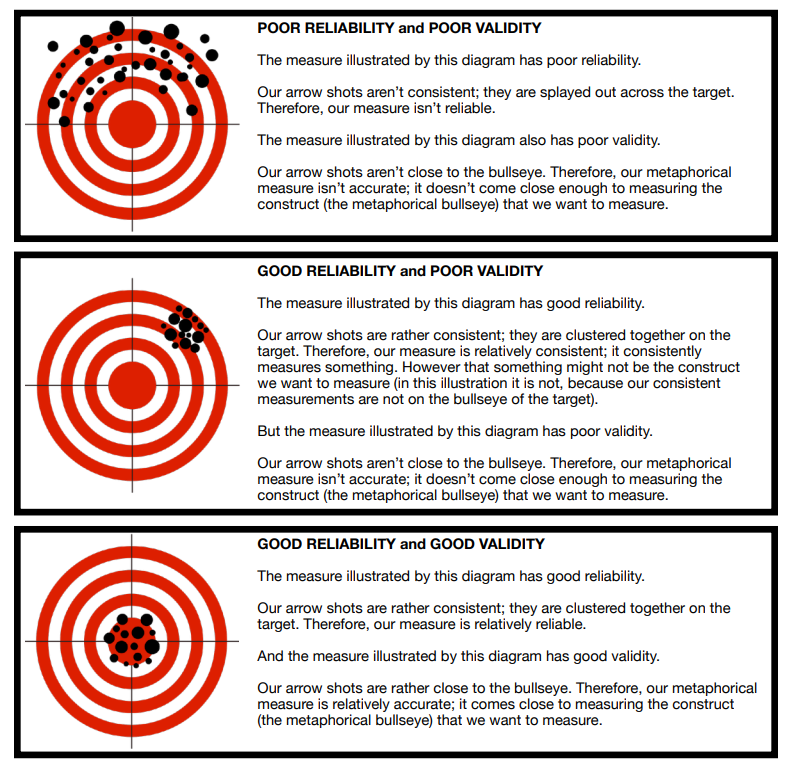
This bullseye diagram contrasts reliability (consistency of measurements) with validity (accuracy in capturing the intended construct). Clusters that are tight but off-center illustrate how a measure can be reliable yet invalid, while tight clusters on the center represent measurements that are both reliable and valid. Source
Reliability: The extent to which a measure produces stable or consistent results across time, items, observers, or situations.
Reliable measurement depends on clear procedures.
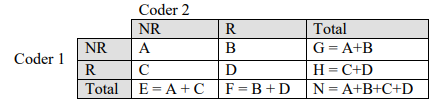
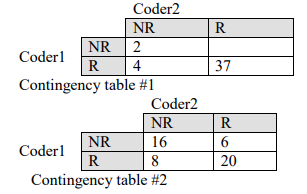
This figure shows a standard rater-by-rater contingency table used to record how often two coders assign the same versus different categories. The diagonal cells represent agreements, while off-diagonal cells represent disagreements—making reliability an observable, countable outcome before any summary statistic is computed. Source
If observers disagree on what counts as aggression, or if instructions vary between participants, scores may fluctuate because of measurement error rather than real differences. Standardized instructions, precise coding rules, training, and pilot testing can improve reliability.
A measure must also represent the target behavior accurately, not just consistently.
Validity: The extent to which a measure actually captures the construct or behavior it is intended to represent.
A measure can be reliable but still invalid. For example, counting how often a student speaks in class might be consistent, but it may not be a valid measure of confidence if speaking is influenced by culture, language ability, or classroom norms. Valid representation requires a close fit between the concept and the chosen indicator.
Features of a strong operational definition
Clarity
Terms should be unambiguous. A label such as helpful behavior is too broad unless the study states exactly which actions count as help.
Observability
The definition should specify observable indicators, even when the construct itself is internal. Anxiety, for instance, might be measured through questionnaire responses, physiological arousal, or avoidance behavior.
Standardization
Every participant should experience the same measurement conditions as far as possible. Consistent timing, instructions, scoring rules, and equipment support dependable data.
Sensitivity
A measure should detect meaningful differences between people or conditions. If nearly all participants receive very similar scores, the operational definition may not distinguish levels of the construct effectively.
Theoretical fit
The chosen indicator should match the researcher’s theory. If a study claims to measure memory but uses only recognition rather than recall, the data may reflect only one part of the broader construct.
Population and context
An operational definition should suit the age group, setting, and population being studied. A measure that works well with adults in a laboratory may not represent the same construct accurately in children, schools, or clinical settings.
Common problems in operationalization
Poor operationalization can lead to several problems:
construct underrepresentation: the measure captures only a narrow part of the target behavior
construct contamination: scores reflect other factors as well as the intended construct
artificial categories: complex behavior is reduced to oversimplified labels
low comparability: studies are harder to compare because they define variables differently
misleading interpretation: conclusions become stronger than the data justify
These problems matter because psychological findings depend heavily on how variables were defined at the start of the study.
How psychologists evaluate operationalized variables
Psychologists often ask:
Does the measure match the research question?
Would another researcher be able to repeat the procedure exactly?
Does the measure capture the construct in this population and setting?
Are the scoring rules objective enough to reduce inconsistency?
Would a different indicator represent the behavior more accurately?
In practice, operational definitions are often revised after early testing. Ambiguous items may be rewritten, scoring categories may be clarified, and measures that do not capture the target behavior may be replaced before the main study begins.
Practice Questions
Define operationalization in psychological research. [2]
1 mark for stating that operationalization means turning an abstract construct or variable into something observable or measurable.
1 mark for stating that this is done by specifying the exact procedures, indicators, or scoring rules used in the study.
Explain how the operationalization of a variable can influence both reliability and validity in a psychological study. [6]
1 mark for identifying operationalization as the specific way a variable is measured or manipulated.
1-2 marks for explaining that clear, standardized procedures improve consistency and therefore reliability.
1-2 marks for explaining that the chosen measure must closely match the construct for validity or accurate representation.
1-2 marks for applying the explanation to a relevant example, such as stress, memory, or aggression.
Full marks require clear links to both reliability and validity, not just one.
FAQ
A manipulation check is a measure used to confirm that an experimental manipulation actually worked as intended.
For example, if a study operationalizes social exclusion through a computerized game, a manipulation check might ask participants how excluded they felt afterward. If the check fails, the problem may be with the operationalization of the independent variable rather than the theory itself.
A composite measure combines several indicators into one score.
This is useful when a construct is broad and no single measure captures it well. For example:
depression may involve mood, sleep, appetite, and cognition
academic motivation may involve persistence, interest, and effort
Composite measures can improve coverage of a construct, but only if all parts clearly reflect the same underlying idea.
Translation does not simply change language; it can also change meaning.
A word or phrase in one language may not carry the same emotional intensity, social meaning, or cultural assumptions in another. That means the translated version may no longer operationalize the construct in exactly the same way. Researchers often use back-translation and cultural review to reduce this problem.
A continuous score contains more information than broad categories.
If a researcher turns stress scores into only “low,” “medium,” and “high,” important differences within each group are lost. This can:
reduce sensitivity
hide patterns in the data
make people near a cutoff look more different than they really are
Categorization can be practical, but it may weaken the precision of the operational definition.
A direct behavioral indicator records the behavior itself, such as the number of times a child shares toys.
A proxy measure uses something related to the behavior, but not the behavior directly. For example, teacher ratings of sociability may act as a proxy for observed peer interaction. Proxy measures can be efficient, but they may reflect rater expectations or unrelated influences, which can change what is actually being measured.