IB Syllabus focus: 'Human behaviour is difficult to observe and objectively measure, so measurement depends on context and underlying theory.'
Measuring behavior in psychology is challenging because many important processes are hidden, situation-dependent, and interpreted through concepts created by researchers. Good measurement therefore requires careful thought about what is being observed and what it represents.
Why behavior is difficult to measure
Observable and hidden targets
Psychologists study behavior, but not all behavior is directly visible. Some actions, such as speaking, leaving a room, or pressing a button, can be observed. Other important targets of psychology, such as beliefs, memories, intentions, and emotions, are not seen directly; they must be inferred from signs. This creates difficulty because the researcher is often measuring an indicator rather than the psychological process itself.
A second problem is that the same visible act can have different meanings. Silence might reflect calmness, boredom, fear, or cultural respect. A fast heartbeat might show anxiety, exercise, or excitement. Because human behavior is flexible, one observation rarely explains itself.
Many topics in psychology are therefore based on a construct, an idea that organizes a pattern of behavior but cannot be directly read from a person.
Construct: An abstract idea, such as memory, stress, or aggression, that cannot be observed directly and must be inferred from indicators.
This means researchers must decide which signs count as evidence of the construct, and those decisions can change the results.
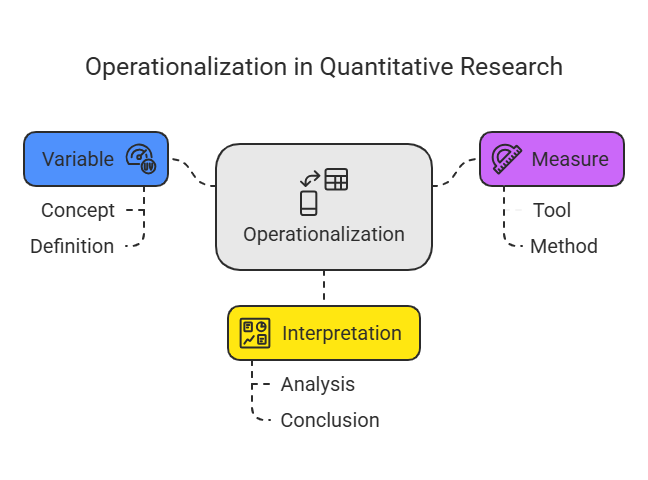
This diagram summarizes operationalization: translating an abstract variable (a concept plus definition) into a concrete measure (a tool plus method), and then interpreting the results. It reinforces that measurement choices are theory-laden decisions that shape what the construct becomes inside a study. Source
Context shapes what behavior means
Behavior does not occur in isolation. Context strongly affects how a person acts and how that action should be interpreted. A person may respond one way in a laboratory, another way in a classroom, and another way at home. If psychologists ignore context, they may measure a reaction to the setting rather than the target behavior.
Important contextual influences include:
Physical setting: noise, temperature, crowding, and familiarity can affect performance.
Social setting: the presence of peers, authority figures, or researchers can change responses.
Cultural context: norms influence what counts as politeness, distress, aggression, or independence.
Time and situation: fatigue, stress, and recent events can alter behavior from one moment to the next.
Because of this, a measure that appears useful in one setting may be weak or misleading in another. A behavior is not just an action; it is an action occurring under specific conditions. Psychologists must therefore ask not only what was measured, but also where, when, and around whom it was measured.
Why objectivity is limited
Measurement involves judgment
Psychology aims for objectivity, but complete objectivity is difficult because measurement involves human decisions at several stages. Researchers choose what to record, when to record it, how long to record it, and how to classify what they see. Even apparently simple categories, such as “aggressive act” or “off-task behavior,” require interpretation.
Objective measurement: Measurement that aims to reduce personal judgment so that observations are as consistent and impartial as possible.
In psychology, objectivity is usually a goal rather than a perfect state.
Another challenge is that people often change when they know they are being observed. They may try to appear cooperative, hide socially undesirable behavior, or guess the purpose of the study. As a result, the measure may partly capture the measurement situation itself rather than the person’s usual behavior. This is especially important in psychological research because human participants can reflect on what is happening and adjust their actions.
Underlying theory guides measurement
Theory affects what counts as evidence
Measurement also depends on underlying theory. A theory tells researchers what they think the behavior is, what causes it, and which signs should count as evidence. Because theories differ, psychologists may measure the same topic in different ways.
If a researcher sees learning mainly as a change in observable performance, they may focus on correct responses or speed. If they see learning as a change in mental representation, they may pay more attention to recall patterns, errors, or explanations. Neither measure is automatically the single correct one; each reflects theoretical assumptions.
This matters because the way a phenomenon is defined shapes the findings. If stress is measured mainly as physiological arousal, one picture emerges. If it is measured as perceived pressure or difficulty coping, a different picture may emerge. The measure does not simply discover behavior; it helps frame what the behavior becomes within the study.
Implications for interpreting psychological research
These challenges do not mean psychological measurement is impossible. They mean results should be interpreted carefully. Strong measurement usually involves:
clear definitions of the target behavior
consistent rules for observing or recording it
recognition that indicators are partial, not perfect
attention to the context in which data were collected
justification for why a chosen measure fits the theory being used
When reading a study, students should ask whether the measure truly matches the behavior being discussed. A narrow measure may miss important parts of a complex human action. Likewise, a highly controlled setting may increase precision but make behavior less natural. In psychology, measurement is always shaped by what can be seen, the context in which it occurs, and the theoretical lens through which it is interpreted.
Practice Questions
State one reason why human behavior is difficult to measure objectively. [2 marks]
1 mark for identifying a valid reason, such as behavior being partly unobservable, context-dependent, or open to interpretation.
1 mark for a brief explanation linking that reason to difficulty in objective measurement.
Explain how context and underlying theory can affect the measurement of behavior in psychological research. [6 marks]
Up to 2 marks for explaining the role of context, such as setting, culture, social situation, or timing changing behavior or its meaning.
Up to 2 marks for explaining the role of underlying theory, such as theoretical assumptions shaping what counts as evidence.
Up to 2 marks for development, including psychological detail about indirect indicators, different interpretations of the same behavior, or consequences for interpreting findings.
Full marks require attention to both context and theory.
FAQ
Reaction time tasks are useful because many mental processes happen too quickly or too privately to observe directly.
Researchers use response speed as an indirect sign of processes such as attention, decision-making, or memory retrieval. The advantage is precision, but the limitation is that slow or fast responses can have multiple causes, including fatigue, distraction, or motor differences.
Rare behaviors are hard to capture because short observation periods may miss them entirely.
This can create data that look clean but are actually incomplete. Researchers may need:
longer observation periods
repeated observation sessions
event-based recording instead of fixed time intervals
Even then, one rare event can be difficult to interpret without broader context.
A pilot study is a small trial run done before the full research project.
It helps researchers check whether:
instructions are clear
participants understand the task
the behavior actually appears in measurable form
the recording system is practical
Pilot testing can reveal hidden measurement problems early, reducing wasted time and improving the quality of the final study.
Not fully. Devices can increase precision by automatically recording movement, location, sleep, or heart rate, but they do not remove interpretation.
Researchers still must decide:
what variable matters
how to define meaningful patterns
whether the recorded data truly represent the target behavior
Digital measures can be highly useful, but they still reflect theoretical and practical choices.
A coding manual gives detailed rules for classifying behavior during observation.
It usually includes:
exact category definitions
examples and non-examples
instructions for handling unclear cases
This helps different observers apply the same standards. Coding manuals do not eliminate judgment, but they reduce inconsistency and make measurement more systematic.