IB Syllabus focus: 'Triangulation of methods helps researchers establish credibility and evaluate strengths and limitations of evidence.'
Psychological evidence is rarely perfect. Comparing findings from different methods helps researchers judge whether an explanation is dependable, where uncertainty remains, and how confidently results should be interpreted.
What triangulation means
In psychology, triangulation means investigating the same phenomenon in more than one way and then comparing the findings. The goal is not simply to gather extra data. The goal is to check whether different methods support a similar interpretation or expose important gaps in the evidence. In this syllabus point, the main focus is methodological triangulation.
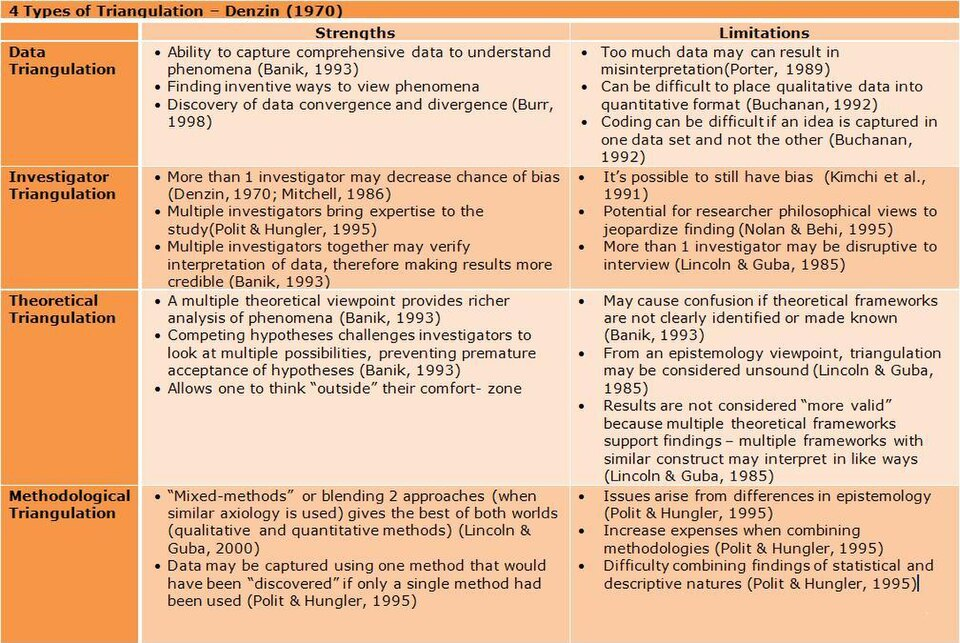
This table-style diagram summarizes four types of triangulation (data, investigator, theory, and methodological), helping you distinguish methodological triangulation from other ways researchers strengthen trust in findings. It supports evaluation by making explicit what is being varied (methods vs researchers vs theories vs data sources). Source
Triangulation is the use of multiple methods to study the same research question so that evidence can be compared.
A strong triangulation design links each method clearly to the same construct or behavior.
Credibility is the degree to which research findings and interpretations appear trustworthy, believable, and well supported by the evidence.
If findings converge across methods, psychologists can be more confident that the result is not just an artifact of one procedure. If findings differ, this can still be valuable because it highlights limits, unanswered questions, or problems in the way the construct was measured.
Why triangulation matters
Human behavior is complex, so any single method usually provides only a partial picture. A self-report measure may show what participants say they feel, but not what they actually do. An observation may show behavior in context, but not private thoughts. A physiological measure may indicate arousal, but not the meaning of that arousal for the person.
Triangulation matters because it reduces overreliance on one source of evidence. When several methods point in the same direction, the interpretation becomes more persuasive. This does not prove that the finding is true, but it does make it less dependent on the weaknesses of a single method.
It is especially useful when psychologists study broad constructs such as stress, prejudice, memory, attachment, or well-being. These constructs are difficult to capture with one measure alone, so comparing methods can improve the quality of interpretation.
How psychologists use triangulation
Researchers may combine methods in several practical ways:
Use questionnaires alongside observations.
Compare interview data with behavioral measures.
Pair qualitative accounts with quantitative scores.
Collect information from different settings or time points using more than one method.
The methods may be used at the same time or in sequence.
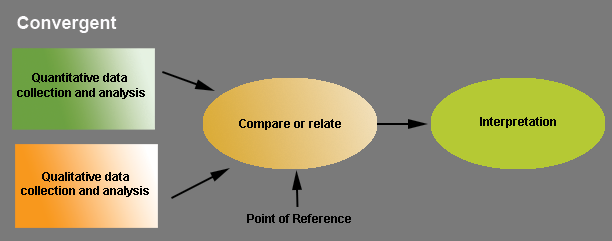
A convergent (concurrent) mixed-methods design collects qualitative and quantitative data in parallel, analyzes them separately, and then merges the results for direct comparison. This visual makes the logic of triangulation explicit: credibility increases when independent strands converge, and interpretation becomes more cautious (but often more informative) when they diverge. Source
One method may first identify a pattern, while another checks whether the pattern appears in a different form. What matters is that the methods are genuinely relevant to the same research question.
When psychologists analyze triangulated evidence, they often look for:
Convergence: different methods produce a similar overall pattern.
Complementarity: different methods add different kinds of useful insight.
Discrepancy: different methods produce conflicting results that need explanation.
A discrepancy is not automatically a weakness. It may suggest that a construct changes across situations, that participants answer differently from how they behave, or that one method is less sensitive than another.
Evaluating strengths and limitations of evidence
Triangulation helps psychologists judge both what their evidence can support and what it cannot. If two or more methods reach similar conclusions, the strengths of the evidence may include:
greater confidence in the interpretation
a broader picture of behavior
less dependence on one measurement technique
better awareness of whether a finding is stable across forms of data
Triangulation also helps reveal limitations. If results differ across methods, psychologists may ask whether one measure was too narrow, whether social desirability affected responses, or whether the construct was operationalized in different ways. A weak measure may become visible when it fails to match evidence from other methods.
This makes triangulation a tool for critical evaluation, not just confirmation. It can show that a claim is well supported, only partly supported, or supported only under certain conditions. In other words, triangulation helps researchers avoid simplistic interpretations of complex behavior.
Questions to ask when judging triangulated evidence
Do the methods really address the same construct, or only related aspects of it?
Are the findings consistent in direction, even if the details differ?
Does each method add something useful rather than repeating the same weakness?
After comparing methods, what uncertainties still remain?
Common misunderstandings and practical limits
One misunderstanding is that using more methods automatically creates better research. In reality, triangulation only strengthens evidence when the methods are well designed and clearly connected to the research question. Several weak methods do not automatically produce strong evidence.
Another misunderstanding is that triangulation guarantees objectivity. It improves credibility, but researchers still have to interpret the data carefully. Different methods can share blind spots, and combining them does not remove the need for critical thinking.
Practical limits also matter:
It often takes more time, money, and expertise to use multiple methods.
Different methods may produce data at different levels of detail, making integration difficult.
One method may dominate the interpretation, reducing the benefit of triangulation.
Conflicting findings can be hard to explain clearly.
Because of these issues, triangulation is most useful when it is planned from the beginning of the research rather than added superficially at the end.
Practice Questions
Explain one way triangulation can increase credibility in psychological research.
1 mark for identifying triangulation as the use of more than one method to investigate the same research question.
1 mark for stating that similar findings across methods increase trustworthiness or believability.
1 mark for explaining that this reduces dependence on a single method or helps rule out method-specific weaknesses.
Discuss how triangulation helps psychologists evaluate the strengths and limitations of evidence.
Identifies that triangulation involves comparing evidence from multiple methods.
Explains that converging findings strengthen confidence in the interpretation.
Explains that different methods can provide a broader picture of behavior.
Explains that conflicting findings can reveal weaknesses in a measure or in the interpretation.
Explains that triangulation helps identify limitations such as narrow operationalization or response bias.
Explains that triangulation improves credibility but does not guarantee objectivity or truth.
FAQ
Triangulation compares different methods within the same study or research design.
Replication repeats a study, or a very similar study, to see whether the findings can be reproduced later or with a different sample.
Both increase confidence, but they do so differently:
triangulation checks whether a finding holds across methods
replication checks whether a finding holds across repeated investigations
A result that is both triangulated and replicated is usually more convincing than one supported by only one of these.
Yes, if the methods are chosen carefully and fit the research question.
In a small sample study, triangulation can still be useful because it may show whether a pattern appears across different forms of evidence, such as interviews and observations.
However, the researcher should be cautious:
small samples can limit how far findings can be generalized
one unusual participant may affect patterns more strongly
integrating several methods may become interpretively difficult
So, triangulation can strengthen depth of understanding in small samples, but it does not remove the limits created by sample size.
The first step is to check whether the methods were really measuring the same construct.
After that, the researcher should examine:
whether one method was poorly matched to the research question
whether timing, setting, or participant interpretation affected responses
whether scoring or coding decisions created the difference
The goal is not to force agreement. It is to understand why the disagreement happened.
Sometimes the conflict shows measurement weakness. Sometimes it shows that the behavior changes by context. Both are meaningful outcomes.
Not necessarily.
Some methods may be more directly linked to the construct, more reliable in the setting, or better suited to the research aim. In that case, researchers may give one method greater interpretive weight.
What matters is transparency. The researcher should explain:
why one method was prioritized
what the other method still contributed
how the weighting affected the final interpretation
Equal weighting can be useful, but automatic equal weighting may hide important differences in quality or relevance between methods.
A clear structure helps.
One common approach is:
state the research question
describe each method briefly
present the main finding from each method
compare where they agree and disagree
explain what that means for credibility
It is usually clearer to organize the write-up around the pattern of evidence rather than discussing each method in isolation for too long.
The key is to make the comparison explicit. Readers should be able to see exactly how the combined evidence supports, qualifies, or limits the interpretation.