IB Syllabus focus: 'Psychologists work with human participants and should treat them with respect, especially when holding positions of power.'
Research in psychology depends on people sharing time, experiences, and often sensitive information. Because researchers can hold authority, ethical practice requires active respect, careful boundaries, and protection against misuse of influence.
Respect as a foundation of research
Respect in psychological research means viewing participants as persons with dignity, not just as sources of data. Their time, privacy, emotions, background, and decision-making capacity all matter. A respectful psychologist communicates honestly, avoids manipulation, listens to concerns, and takes participants seriously throughout the study.
When researchers ignore respect, they risk more than ethical problems. Participants may feel pressured, misunderstood, or objectified. This can harm well-being and reduce the quality of the data because people may respond defensively, withdraw emotionally, or say what they think the researcher wants to hear.
Power in the researcher-participant relationship
A key reason respect matters is that research often involves a power imbalance.
Power imbalance: A situation in which one person or group has greater authority, knowledge, status, or control than another, increasing the risk of pressure or unfair treatment.
Psychologists often know more about the study than participants do. They may control access to information, the research setting, incentives, or the start and end of participation. Some researchers also hold social or institutional authority, such as being a teacher, supervisor, clinician, or expert. Even when no direct threat is made, participants may feel they should cooperate.
Sources of researcher power
Researcher power can come from several sources:
Expert knowledge: participants may assume the psychologist knows best.
Institutional role: universities, hospitals, or schools give researchers legitimacy.
Control over procedures: the researcher decides tasks, questions, timing, and environment.
Evaluation concerns: participants may worry about being judged as intelligent, healthy, honest, or cooperative.
Access to benefits: payment, course credit, services, or approval can make refusal harder.
Power is especially important because it can be subtle. Participants may comply not because they freely want to, but because they feel awkward, dependent, or unable to challenge authority.
Risks created by power differences
Power differences can affect both participant welfare and research quality. If people feel pressured, their participation is less genuinely voluntary. They may agree without feeling comfortable, stay in the study longer than they want, or hide confusion and distress.
A strong power imbalance can also influence responses. Participants may try to please the psychologist, protect themselves from embarrassment, or avoid disagreement. This may produce demand characteristics, socially desirable answers, or silence about negative experiences. As a result, the study may no longer reflect authentic thoughts or behavior.
Respect and the limits of influence
Respect requires psychologists to recognize that “permission” is not enough if the surrounding relationship makes refusal difficult. For example, a participant may sign up, yet still feel trapped by the setting, the researcher’s authority, or fear of negative consequences. Ethical research therefore involves reducing unnecessary influence, not simply obtaining formal agreement.
Respect also means avoiding language or behavior that humiliates, stereotypes, or dismisses participants. The way questions are asked, instructions are delivered, and emotions are handled can either reinforce hierarchy or support dignity.
Participants who may need extra protection
Some participants are more exposed to researcher power because they are more vulnerable.
Vulnerability: Increased risk of harm or undue influence because a participant has limited power, dependence on others, or reduced ability to protect their own interests.
This may include children, hospitalized patients, prisoners, employees, students, people with cognitive difficulties, or anyone experiencing severe stress, trauma, or dependency. Vulnerability does not mean a person cannot participate in research. It means psychologists must think more carefully about whether the participant can act freely and safely within the study.
Dependency and role conflict
Problems become more serious when the researcher has a dual role. A teacher-researcher, therapist-researcher, or manager-researcher may unintentionally blur the boundary between professional authority and research participation. Participants may fear that refusal will affect grades, care, employment, or relationships. In these cases, respect involves making the research role separate and minimizing any impression that participation is expected.
Building respectful research practice
Respect should be visible at every stage of the research process.
Recruitment and communication
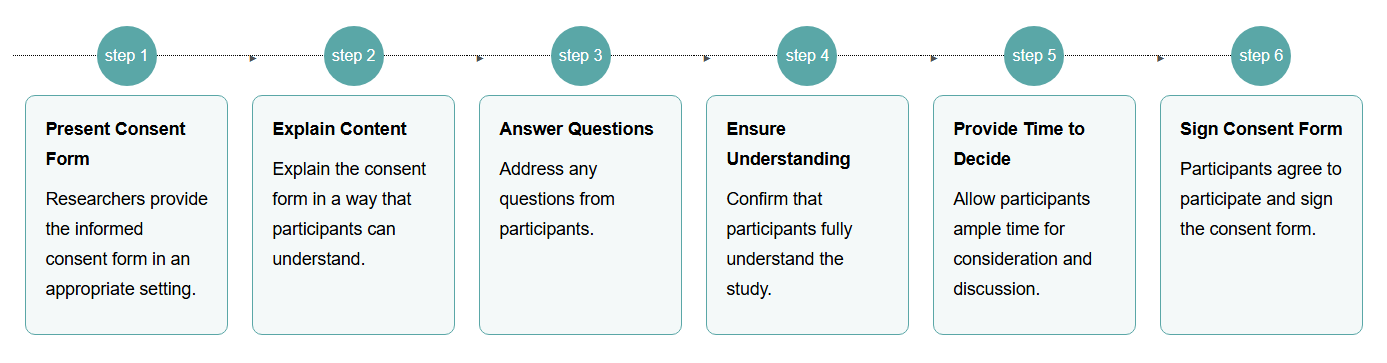
This flowchart summarizes the informed consent process as a sequence of concrete researcher actions (e.g., explaining content, answering questions, checking understanding, and giving time to decide) before participation begins. It reinforces that consent is an ongoing communication process designed to protect voluntariness, not just a signature on a form. Source
Psychologists should use clear, accessible language and avoid exaggerated promises or pressure. Invitations should make it clear that participation is a choice. If a pre-existing authority relationship exists, recruitment should ideally be handled in ways that reduce personal pressure, such as using neutral announcements or third parties.
During data collection
Respect includes protecting dignity in the moment. Psychologists should monitor discomfort, respond seriously to signs of distress, allow pauses when appropriate, and interact professionally rather than casually exploiting trust. Participants should never be treated as if scientific goals matter more than their well-being.
After participation and in reporting
Respect continues after data collection ends. Psychologists should handle participant information carefully, represent experiences accurately, and avoid presenting people in degrading or simplistic ways. Reporting should not turn human participants into anonymous “cases” stripped of context or humanity.
Reflexivity and responsible researcher behavior
Because power can be invisible to the person holding it, psychologists need reflexivity, meaning ongoing self-awareness about how their position may shape participant experiences. A respectful researcher asks:
Could my role make refusal difficult?
Am I interpreting silence as agreement?
Have I created a setting where participants feel safe to speak honestly?
Am I treating participants as collaborators in knowledge, rather than as tools?
This self-monitoring helps researchers notice hidden pressure before it affects participants or distorts the study.
Practice Questions
Question 1 (2 marks) State one reason psychologists must be especially careful when they hold positions of power over participants.
1 mark for identifying that the psychologist may have authority, status, or control over the participant.
1 mark for explaining that this may create pressure, reduce genuine choice, or increase the risk of unfair treatment.
Question 2 (6 marks) Explain one way a power imbalance can influence participant behavior in a psychological study, and one way a psychologist can reduce this problem.
1-2 marks for explaining what a power imbalance is in the researcher-participant relationship.
1-2 marks for explaining one effect on participant behavior or data, such as pressured participation, socially desirable responding, reluctance to disagree, or hiding distress.
1-2 marks for explaining one appropriate way to reduce the problem, such as third-party recruitment, neutral instructions, separating authority roles from research roles, or making refusal clearly consequence-free.
FAQ
Payment is not automatically unethical. It can be respectful when it compensates people fairly for time, travel, or inconvenience.
It becomes problematic when the amount is so attractive that participants feel unable to refuse, especially if they are in financial difficulty. Ethics reviewers often look at:
how large the payment is
whether it matches the burden of participation
whether participants still receive partial payment if they stop early
That last point matters because otherwise payment can act like pressure to stay.
Small details can make authority feel much stronger. A white coat, a formal office, locked doors, clipboards, cameras, or technical equipment can signal expertise and control before the study even starts.
These cues may lead participants to:
trust instructions without question
hide confusion
feel they should behave “correctly”
hesitate to challenge the procedure
This is why respectful researchers think carefully about atmosphere, not just about written procedures.
Community advisors can help psychologists see problems that are easy to miss from an outsider perspective.
They may improve research by:
reviewing recruitment materials for tone and clarity
identifying language that sounds patronizing or stigmatizing
warning researchers about local histories of mistrust
suggesting more respectful ways to share findings
This is especially important when researchers are studying groups they do not belong to. Community input can shift the relationship from “research done on people” toward “research designed with people.”
No. Online studies may reduce face-to-face pressure, but power can still be built into the design.
For example:
participants may not understand what is being tracked
buttons and layout can nudge people forward
it may be unclear how to stop or delete responses
automated systems can feel impersonal, making people less likely to ask questions
Respect in online research depends on transparent design, clear exits, readable information, and simple ways to contact the researcher.
If information is too technical, participants may appear to agree without truly understanding what is happening. That is a power issue, not just a communication issue.
Accessibility can be improved by:
using plain language
translating materials accurately
checking reading level
offering audio or visual formats when needed
allowing questions without embarrassment
When researchers fail to adapt language, they place more burden on participants and increase dependency on the researcher’s interpretation. Clear communication helps make participation more genuinely informed and more respectful.