IB Syllabus focus: 'Ethical principles guide psychologists to maximize benefits, minimize costs and make reasoned decisions.'
Ethical decision-making in psychology is not just about following rules. It involves applying principles thoughtfully so that research and practice produce worthwhile knowledge while reducing unnecessary harm and unfairness.
Why ethical principles matter
Psychology studies people in ways that can affect dignity, welfare, and social relationships. Because of this, ethical principles help psychologists decide not only what can be done, but what should be done.
Ethical principles: Broad standards used to judge whether psychological actions and decisions are morally acceptable and professionally responsible.
These principles are not optional extras. They are a framework for judging whether a proposed action is justified, proportionate, and professionally responsible. In IB Psychology, the key idea is that ethics requires psychologists to seek worthwhile outcomes while avoiding unnecessary costs.
Ethics also protects the credibility of psychology. If psychologists make careless decisions, participants may lose trust, communities may become less willing to take part in future studies, and findings may be questioned. Responsible decision-making is therefore tied to both moral responsibility and scientific quality.
Maximizing benefits
Benefits may be direct, such as improved support for a group, or indirect, such as knowledge that informs future interventions. Ethical thinking asks whether the expected benefits are meaningful, realistic, and relevant.
A study with strong potential benefit may help explain behavior, improve treatment, or guide policy.
Benefits should not be exaggerated to defend weak or risky methods.
Psychologists should ask who benefits: participants, the scientific community, or society more broadly.
Responsible decisions depend on proportionality. Small gains in knowledge do not usually justify large burdens on participants. A project is more defensible when its potential value is clear and when the same goal cannot be reached by a less costly approach.
Minimizing costs
Costs are any negative consequences created by the research or professional action. They may involve time, stress, discomfort, stigma, loss of privacy, or effects on trust.
Ethical principles do not require zero risk in every situation, but they do require psychologists to reduce avoidable costs as far as possible. This means thinking ahead about what could go wrong and redesigning the procedure when needed.
For example, a responsible psychologist considers:
whether the task could create unnecessary distress
whether the setting places pressure on participants
whether the design could expose people to social or personal disadvantages
The focus is on minimizing unnecessary and disproportionate costs, not merely reacting after a problem appears.
Making reasoned decisions
Ethics in psychology is not simple rule-following. Different values can pull in different directions, so psychologists must justify decisions using evidence, logic, and professional judgment.
Reasoned decision-making: A process of justifying ethical choices through evidence, careful evaluation of benefits and costs, and professional judgment.
Reasoned decisions are especially important when no option is perfect. Psychologists may face cases where a study has genuine value but some unavoidable burden. In such situations, they weigh the seriousness and likelihood of costs against the importance and credibility of the benefits.
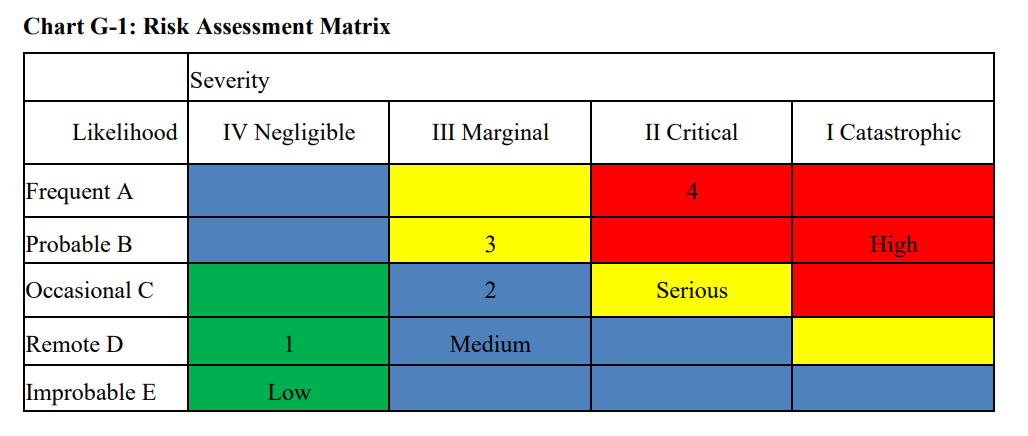
This figure shows a likelihood × severity risk assessment matrix that converts qualitative judgments (e.g., “Frequent” vs. “Improbable,” “Catastrophic” vs. “Negligible”) into an overall risk category. It supports reasoned ethical choices by making trade-offs explicit: higher-likelihood and higher-severity costs demand stronger justification, additional safeguards, or redesign. Source
This process requires more than good intentions. Psychologists should ask:
Is the aim important enough to justify involving people at all?
Are the expected benefits probable, or merely hoped for?
Can the question be investigated in a safer or less intrusive way?
Is the final choice consistent with professional ethical standards?
A reasoned decision is therefore transparent and defensible. Another qualified psychologist should be able to understand why the choice was made, even if alternative judgments were possible.
Responsible decision-making in practice
Ethical responsibility begins before research starts and continues throughout the work. It is a continuing process of reflection, monitoring, and adjustment.
A responsible psychologist typically:
identifies the likely benefits of the project
identifies possible costs for all affected groups
compares alternative methods
chooses the least costly method that can still answer the question well
documents the rationale for the decision
remains prepared to modify or stop the work if costs become greater than expected
In many settings, psychologists do not make these judgments alone. They explain and defend their reasoning to colleagues, supervisors, or ethics committees. This external review helps test whether the claimed benefits are strong enough and whether costs have been reduced appropriately.
This highlights an important point: ethical decisions are dynamic. New information can emerge during a study, and psychologists are expected to respond responsibly rather than relying on their original plan.
Limits and tensions
No ethical principle works in isolation. Maximizing benefits is not a license to ignore individual welfare, and minimizing costs is not a reason to avoid all valuable research. Ethical practice involves balancing these priorities carefully.
Some tensions are difficult:
immediate participant burden versus possible long-term social value
scientific ambition versus professional restraint
confidence in expected benefits versus uncertainty about actual outcomes
Psychologists also have to consider uncertainty. A benefit may seem likely at the design stage but turn out to be much smaller in practice. Likewise, a cost that appears minor may affect some people more strongly than expected. Responsible ethical judgment depends on recognizing these limits early.
Because human behavior and research settings are complex, ethical principles guide judgment rather than produce automatic answers. The quality of ethical decision-making depends on how carefully psychologists evaluate evidence, recognize uncertainty, and justify why their choice is the most responsible one available.
Practice Questions
State one purpose of ethical principles in psychology. [2 marks]
1 mark for identifying a valid purpose, such as maximizing benefits, minimizing costs, or guiding professional decisions.
1 mark for linking that purpose to psychological research or practice.
Explain how ethical principles help psychologists make responsible decisions. [6 marks]
1 mark for identifying ethical principles as standards that guide psychologists.
1 mark for explaining that psychologists should maximize potential benefits.
1 mark for explaining that psychologists should minimize possible costs.
1 mark for explaining that psychologists must weigh benefits against costs rather than follow rules automatically.
1 mark for explaining that decisions should be justified through evidence, logic, or professional judgment.
1 mark for making the answer clearly relevant to psychology, such as research design, professional action, or participant welfare.
FAQ
No. Laws are formal rules created by governments or institutions, while ethical principles are professional standards about what psychologists ought to do.
A decision can be legal but still unethical if it is careless, unfair, or unnecessarily harmful. Ethical principles often expect psychologists to meet a higher standard than the minimum required by law.
An ethics committee reviews proposed research before it begins.
It may:
ask researchers to clarify risks
require changes to the design
request stronger justification for the study
approve, reject, or conditionally approve a project
Its role is not to block research automatically, but to test whether the researcher’s ethical reasoning is strong enough.
Ethical principles do not always produce one single correct answer. Different psychologists may judge the same evidence differently, especially when benefits are uncertain or costs are low but not zero.
If both psychologists use careful reasoning, consider the evidence seriously, and stay within professional standards, disagreement can still be ethically acceptable.
The psychologist should reassess the study rather than continue automatically.
This may involve:
pausing the procedure
reviewing new risks or reduced benefits
consulting supervisors or an ethics board
changing or ending the study if necessary
Ethical responsibility continues after approval; it does not end once data collection starts.
The core aim of responsible conduct stays stable, but the application of ethical principles can change as psychology changes.
New methods such as online data collection, digital tracking, and artificial intelligence create new questions about fairness, monitoring, and risk. Historical mistakes also influence later standards, leading professional organizations to update guidance over time.