IB Syllabus focus: 'Students should understand deception, informed consent, anonymity, debriefing, right to withdraw and protection from harm.'
Ethical considerations shape every stage of psychological research, from recruitment to follow-up.
IB Psychology expects students to know what each principle means, why it matters, and how researchers manage tensions between them.
Why core ethical considerations matter
Psychological research studies real people, so scientific value does not override participant rights. Core ethical considerations protect autonomy, dignity, privacy, and well-being before, during, and after a study. They also improve research quality because participants are more likely to respond honestly when they feel respected and safe.
Ethics is not just a form to complete. Researchers must think about the likely effects of a procedure, whether people truly understand what they are agreeing to, and how any risks will be reduced. In practice, these considerations are linked: a problem with one area, such as weak consent, often creates problems in others.
Informed consent
One central principle is informed consent.
Informed consent: A participant’s voluntary agreement to take part in a study after receiving enough clear information to make a meaningful decision.
For consent to be valid, people should understand the general nature of the study, what they will do, how long it will take, any foreseeable discomfort, and how their data will be used. Consent must be voluntary, so pressure from authority figures, classmates, employers, or researchers can make consent ethically weak.
Consent is also an ongoing process, not a single signature. Participants should continue to feel free to ask questions or stop participating later. When participants are children or may have limited decision-making capacity, researchers usually need permission from a parent, guardian, or relevant authority, while still seeking the participant’s own agreement where possible.
Deception
Sometimes studies involve deception.
Deception: The deliberate withholding of information or the giving of misleading information about a study’s purpose or procedures.
Deception may be used when full disclosure would change behavior so much that the study could not answer its question. However, it creates an ethical tension because people cannot fully consent to something they do not fully understand. For that reason, deception should be limited, carefully justified, and never used to hide major risks or remove basic rights.
There are different forms of deception. Researchers may withhold the true aim, or they may give a false explanation for a task. Both require caution because participants may feel embarrassed, manipulated, or upset when they later learn the truth.
Debriefing
When deception or incomplete disclosure is used, debriefing becomes especially important.
Debriefing: A post-study explanation in which participants are told the true purpose and procedures of the research and any concerns are addressed.
A good debriefing does more than reveal the aim of the study. It checks whether the participant experienced distress, explains why deception was used, answers questions, and helps restore the participant’s sense of autonomy. If a procedure could have affected self-esteem, mood, or trust, the debriefing should actively reduce those effects rather than simply provide information.
Debriefing also matters in non-deceptive studies. Participants may want to know how their responses contribute to the research, what will happen next, and who to contact if concerns arise later.
Anonymity
Another key protection is anonymity.
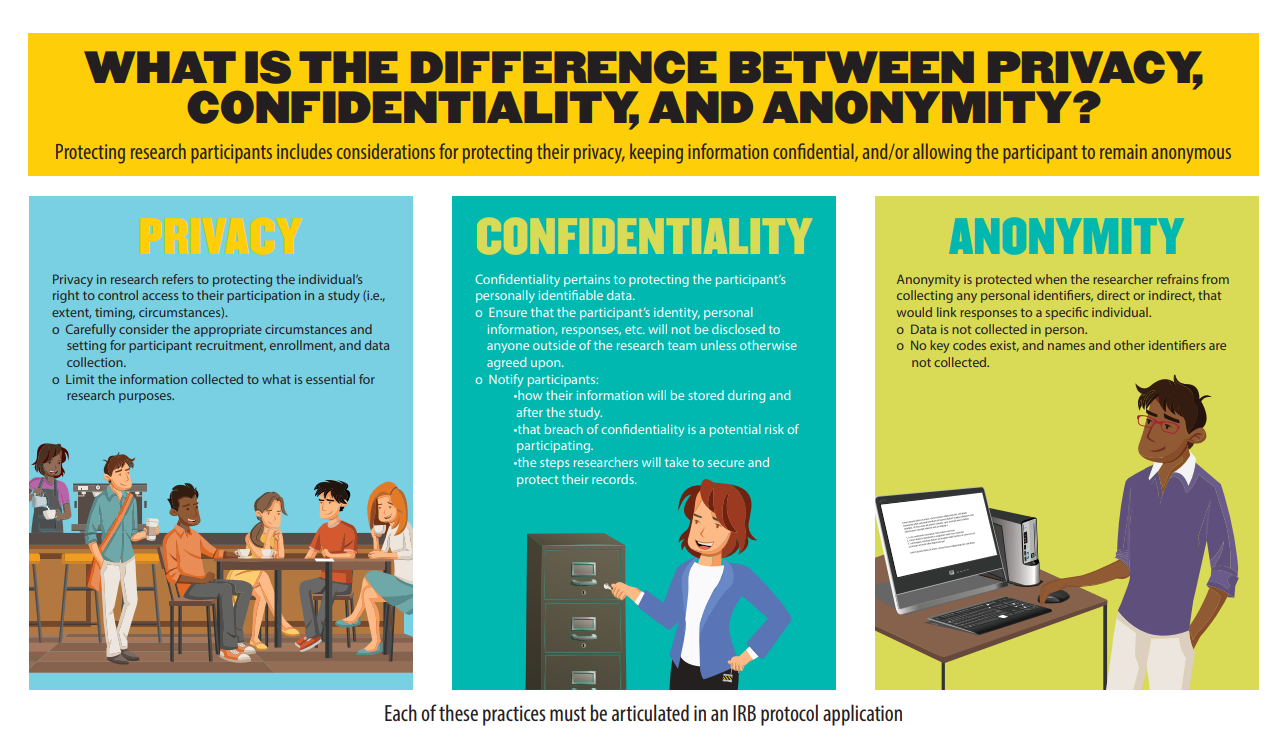
This infographic defines and contrasts privacy, confidentiality, and anonymity in human-subjects research. It clarifies that anonymity requires the researcher to avoid collecting direct or indirect identifiers, while confidentiality focuses on protecting identifiable data from disclosure. The visual comparison helps students avoid a common exam mistake: treating anonymity and confidentiality as interchangeable. Source
Anonymity: A condition in which a participant’s identity cannot be linked to the data collected from them.
Anonymity is especially important in research on sensitive topics such as mental health, sexuality, illegal behavior, or prejudice. If people fear identification, they may refuse to participate or change their answers. Researchers therefore try to remove names and other identifying details from the data as early as possible.
However, anonymity is not always easy to guarantee. Recorded interviews, video data, and very small samples may make identification more likely. Researchers should never promise anonymity if the design cannot genuinely provide it. Instead, they must explain the limits clearly and protect personal information carefully.
Right to withdraw
Participants have the right to withdraw at any stage of the research, without punishment, pressure, or the need to give a reason. This includes stopping the procedure, refusing to answer particular questions, or leaving a study early.
The right to withdraw matters because consent should remain voluntary throughout the research. A participant who agreed at the start may later feel tired, uncomfortable, or uneasy. Ethical researchers do not treat withdrawal as inconvenience or failure. They make the option visible, practical, and free from negative consequences.
This right can also apply to the participant’s data, but the limits should be explained in advance. For example, once data has been fully stripped of identifiers, removing one person’s responses may no longer be possible.
Protection from harm
Researchers must also ensure protection from harm. This means reducing the risk of physical pain, excessive stress, humiliation, loss of self-esteem, or lasting negative consequences. Harm can be psychological as well as physical, and it may be immediate or delayed.
Some research procedures involve temporary discomfort, such as mild stress or discussion of upsetting topics. Ethical judgment depends on whether that discomfort is necessary, proportionate, and carefully managed. Researchers should screen for vulnerability where relevant, monitor participant reactions, stop the procedure if distress becomes significant, and provide support information if needed.
Protection from harm is closely connected to the other principles. Weak consent, poorly justified deception, or inadequate debriefing can all increase the risk of harm.
Ethical tensions in practice
These core considerations do not always fit together perfectly.
Deception may conflict with informed consent.
Strong anonymity can make later data withdrawal difficult.
A participant may agree initially but still need extra protection if distress appears during the study.
Because of these tensions, ethical decision-making is about using the least deceptive, least harmful, and most respectful procedure that can still answer the research question.
Practice Questions
Define debriefing in psychological research. [2]
1 mark for stating that it takes place after participation or after the study.
1 mark for stating that participants are told the true purpose or procedures and any concerns are addressed.
Explain how two core ethical considerations may conflict in one psychological study. [6]
1-2 marks for identifying two relevant ethical considerations, such as deception and informed consent, or anonymity and right to withdraw.
1-2 marks for explaining clearly how the first consideration operates in research.
1-2 marks for explaining clearly how the second consideration operates and why a conflict arises.
1 mark for applying the explanation to a research situation.
1 mark for suggesting a reasonable way to reduce the ethical problem, such as careful debriefing or clear advance explanation of withdrawal limits.
Maximum 6 marks.
FAQ
Anonymity means the researcher cannot link responses to a specific person.
Confidentiality means the researcher does know who the person is, but promises not to share that identity beyond agreed limits.
This distinction matters because some studies cannot truly be anonymous, especially interviews, video recordings, or follow-up designs. In those cases, confidentiality may be the realistic safeguard.
Yes, but the information must still be clear, readable, and detailed enough for a meaningful decision.
Researchers should make sure participants can:
read the study information before agreeing
understand risks and data use
contact the researcher with questions
leave the study easily
Online consent becomes more complicated when age, identity, or legal capacity cannot be checked reliably.
Researchers still have responsibilities if distress appears later, especially if the procedure could reasonably have caused it.
Good practice may include:
giving contact details during debriefing
providing support resources
explaining how to raise concerns
having a plan for follow-up if risk was foreseeable
This is one reason debriefing materials should not be rushed or treated as a minor step.
Sometimes yes, but not always.
If the data can still be linked to the participant, researchers may be able to remove it. If the data has already been fully anonymized or merged into a larger dataset, removal may be impossible.
That is why withdrawal limits should be explained before participation, not only afterward.
Small wording choices can change whether participants truly understand their rights.
Review boards often look for:
vague descriptions of risk
misleading claims about anonymity
hidden limits on withdrawal
debrief statements that do not fully explain deception
Clear wording helps protect participants and also protects the researcher, because ethical problems often begin with unclear communication rather than bad intentions.