IB Syllabus focus: 'Animal researchers should reduce numbers, refine conditions to minimize harm and replace animals with alternatives where possible.'
Animal research remains one of the most debated areas of psychology. IB students should understand why animals may be used, how harm is limited, and why the Three Rs guide ethical scientific practice.
Why animal research is used in psychology
Some psychological questions cannot be studied fully or ethically in humans. Researchers may use animals to investigate learning, memory, stress, brain function, or the effects of drugs under highly controlled conditions. Animal studies can help psychologists examine processes that would otherwise be too invasive, risky, or impossible to manipulate in human participants.
Animal research is usually justified on the basis that it may:
increase understanding of biological and behavioral processes
support the development of treatments or interventions
allow tighter control over variables than is often possible with humans
make it possible to study development across shorter life spans in some species
However, using animals raises serious ethical concerns. Animals can experience pain, distress, and disruption to normal behavior. Because of this, animal research in psychology must not be treated as scientifically useful alone; it must also be ethically defensible.
The Three Rs
The main ethical framework for animal research is the Three Rs.
These principles help researchers balance scientific goals with responsibility toward animal welfare.
Three Rs: An ethical framework for animal research that requires researchers to replace animals with alternatives where possible, reduce the number of animals used, and refine procedures and conditions to minimize harm.
The Three Rs are connected. A well-designed study should ask whether animals are needed at all, how many are genuinely necessary, and how suffering can be minimized throughout the research process.
Replacement
Replacement means using non-animal alternatives whenever possible. This is the first question researchers should ask: can the research goal be achieved without using animals?
Possible replacements include:
computer simulations
cell or tissue cultures
already existing datasets
observations of naturally occurring behavior
non-invasive studies with human participants
Replacement matters because if a valid alternative exists, using animals is harder to justify. In IB Psychology, the key idea is that animals should be used only when there is no suitable alternative that can answer the research question adequately.
Reduction
Reduction means using the smallest number of animals necessary to produce reliable findings. This does not mean using as few animals as possible without regard for science. If too few animals are used, results may be weak or inconclusive, which wastes animal use and may require the study to be repeated.
Researchers can reduce numbers by:
designing studies carefully before data collection
avoiding unnecessary duplication of research
improving measurement so clearer results are obtained
sharing data where appropriate
using appropriate statistical planning
Reduction is therefore both an ethical and scientific principle. Fewer animals should be used, but the study must still be strong enough to answer the question.
Refinement
Refinement means changing procedures and living conditions to minimize pain, stress, and distress. Even when animals cannot be replaced and some number must be used, researchers still have a duty to reduce suffering as much as possible.
Refinement may involve:
better housing and cleanliness
environmental enrichment
careful handling by trained staff
less invasive procedures
use of anesthesia or pain relief when appropriate
close monitoring of health and behavior
Refinement also includes stopping or changing a procedure if harm becomes greater than expected. The aim is not simply to keep animals alive, but to improve their welfare throughout the study.
Applying the Three Rs in practice
The Three Rs should guide the entire research process, not just one stage. Before a study begins, researchers should justify why animal use is necessary. During the study, they should monitor whether animal numbers remain appropriate and whether procedures are causing avoidable harm. After the study, researchers should report methods clearly so other scientists do not repeat unnecessary work.
In practice, ethical animal research asks several linked questions:
Is there a non-animal alternative?
If not, what is the minimum number needed?
How can procedures and conditions be improved to reduce suffering?
This shows that the Three Rs are not separate checkboxes. They are part of responsible scientific decision-making.
Why the Three Rs matter scientifically
The Three Rs are often discussed as ethics, but they also affect research quality. Animals under severe stress may behave unusually, making findings less valid. Poor housing or painful procedures can introduce unwanted variables, which may reduce the reliability of results.
This means that good animal welfare can improve scientific quality. Refinement may lead to more stable behavior.
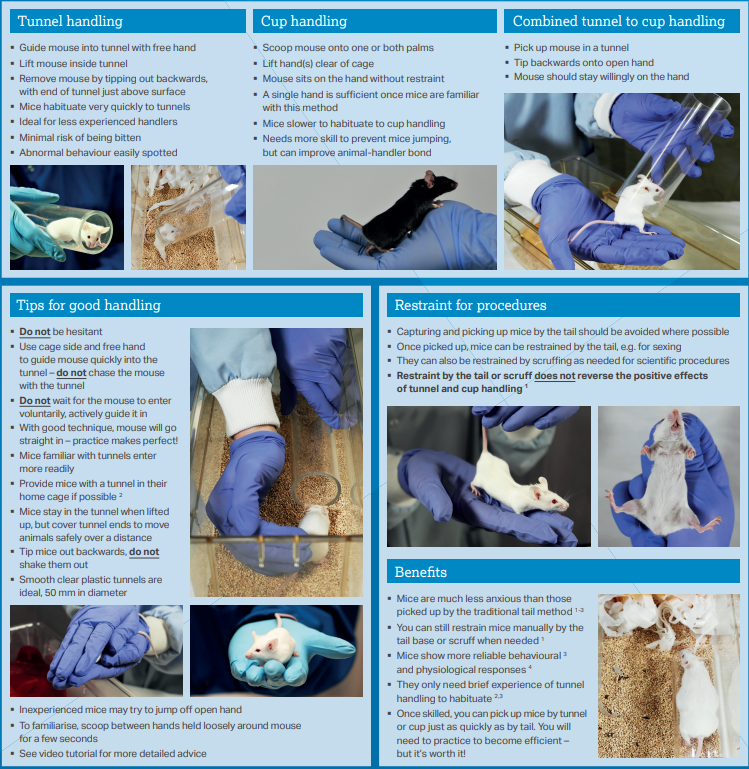
NC3Rs poster photographs demonstrate refined, non-aversive mouse handling (tunnel handling and cup handling) compared with traditional tail handling. The visual sequence highlights how changing routine procedures can reduce stress and improve the reliability of behavioral and physiological responses in animal studies. Source
Reduction encourages better planning. Replacement can sometimes produce methods that are cheaper, faster, or more directly relevant.
At the same time, animal research has limits. Findings from one species may not always generalize well to humans. This is one reason replacement is so important: if a suitable human-based or non-animal method exists, it may also provide more directly applicable evidence.
Common misunderstandings
A common misunderstanding is that the Three Rs allow any animal study as long as researchers are careful. In fact, the framework is more demanding than that. Researchers must first consider replacement, not only how to carry out an animal study more humanely.
Another misunderstanding is that reduction means simply cutting numbers. Ethical reduction means using enough animals for valid results, but no more than necessary.
Finally, refinement is not optional comfort. It is a core responsibility to minimize harm wherever possible.
Practice Questions
Question 1 (3 marks) Explain what is meant by the Three Rs in animal research.
1 mark for identifying replacement: using non-animal alternatives where possible.
1 mark for identifying reduction: using the minimum number of animals necessary for valid findings.
1 mark for identifying refinement: modifying procedures or conditions to minimize pain, stress, or distress.
Question 2 (6 marks) Explain how the Three Rs help psychologists conduct animal research responsibly.
1–2 marks: basic explanation that the Three Rs are ethical principles for animal research.
1 mark for explaining replacement and its role in avoiding animal use where valid alternatives exist.
1 mark for explaining reduction as limiting numbers while still obtaining reliable results.
1 mark for explaining refinement as improving procedures and living conditions to minimize harm.
1 mark for linking the Three Rs to responsible decision-making in research design or conduct.
1 mark for explaining that the Three Rs also support scientific quality, for example by reducing unnecessary stress or poorly designed studies.
FAQ
Absolute replacement means no animals are used at any stage of the research.
Relative replacement means animals are not exposed to procedures that are likely to cause pain or distress, or animal material is used in a way that avoids live animal experimentation.
This distinction helps researchers think more carefully about whether a method truly avoids harmful animal use, rather than assuming all “alternatives” are ethically equal.
Researchers often choose species because of:
similarities in basic biological systems
well-understood behavior
short life cycles
ease of care in controlled settings
Rodents are common because they are small, breed quickly, and have been studied extensively, which makes comparison across studies easier.
Still, convenience alone is not enough. Researchers must justify why that species is appropriate for the question being asked.
A humane endpoint is a preplanned point at which an animal is removed from a study, treated, or euthanized to prevent unnecessary suffering.
Instead of waiting for severe harm to occur, researchers decide in advance what signs will trigger intervention. These signs might include major weight loss, inability to eat, or clear signs of prolonged distress.
Humane endpoints are important because they turn the idea of refinement into a practical safeguard.
Animal ethics committees usually review:
the purpose and likely value of the study
whether replacement has been considered
whether animal numbers are justified
expected levels of pain or distress
housing, care, and monitoring plans
staff training and competence
Committees may approve, reject, or require changes.
Their role is not just administrative. They act as an independent check on whether the study is both scientifically justified and ethically responsible.
In some areas, technology has already reduced animal use a great deal. Brain imaging, computer modeling, and advanced cell methods can answer many questions without live animals.
However, complete elimination is difficult because some questions involve whole-organism behavior, development, or interactions among biological systems.
The long-term goal is often to expand replacement as methods improve. So technology may not remove all animal research immediately, but it can steadily narrow the situations in which it is considered necessary.