
Genetic material and nucleotide components
Living organisms use DNA as their genetic material; some viruses instead use RNA, but viruses are not considered living.
Each nucleotide contains a phosphate group, a pentose sugar and a nitrogenous base.
In simplified diagrams, represent phosphate as a circle, pentose sugar as a pentagon and the base as a rectangle.
The nitrogenous bases to know are adenine, guanine, cytosine, thymine and uracil.
DNA contains adenine, thymine, guanine and cytosine; RNA contains adenine, uracil, guanine and cytosine.
DNA double helix and complementary base pairing
DNA consists of two nucleotide strands arranged as a double helix.
The two strands are antiparallel, meaning they run in opposite directions.
Hydrogen bonds form between complementary base pairs and link the two strands.
Base pairing is specific: adenine pairs with thymine, while guanine pairs with cytosine.
In examination diagrams, show antiparallel strands and correct pairing; drawing the helical shape is not required.
Students do not need to memorize the numbers of hydrogen bonds or relative base lengths.\
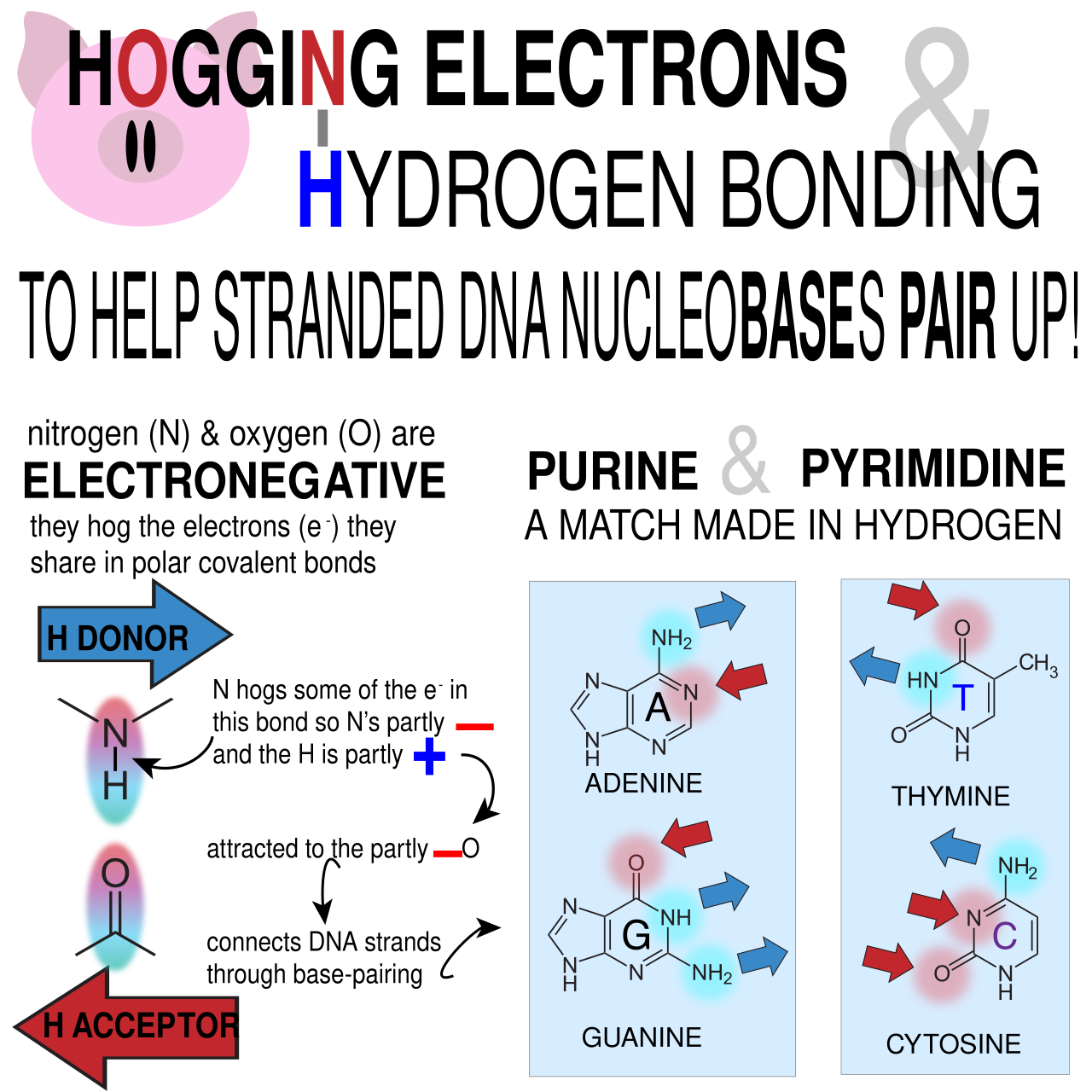
The diagram shows complementary DNA base pairing. Use it to connect specific base matching with hydrogen bonding between the two DNA strands. Source
HL Only: Hershey–Chase experiment
The Hershey–Chase experiment tested whether DNA or protein carries genetic information in bacteriophages.
Newly available radioisotopes allowed DNA and protein to be tracked separately during the experiment.
After infection, the DNA-associated label entered bacterial cells while most protein-associated label remained outside.
The results therefore supported the conclusion that DNA is the genetic material.
The NOS lesson is that technological developments can create new possibilities for scientific experiments.
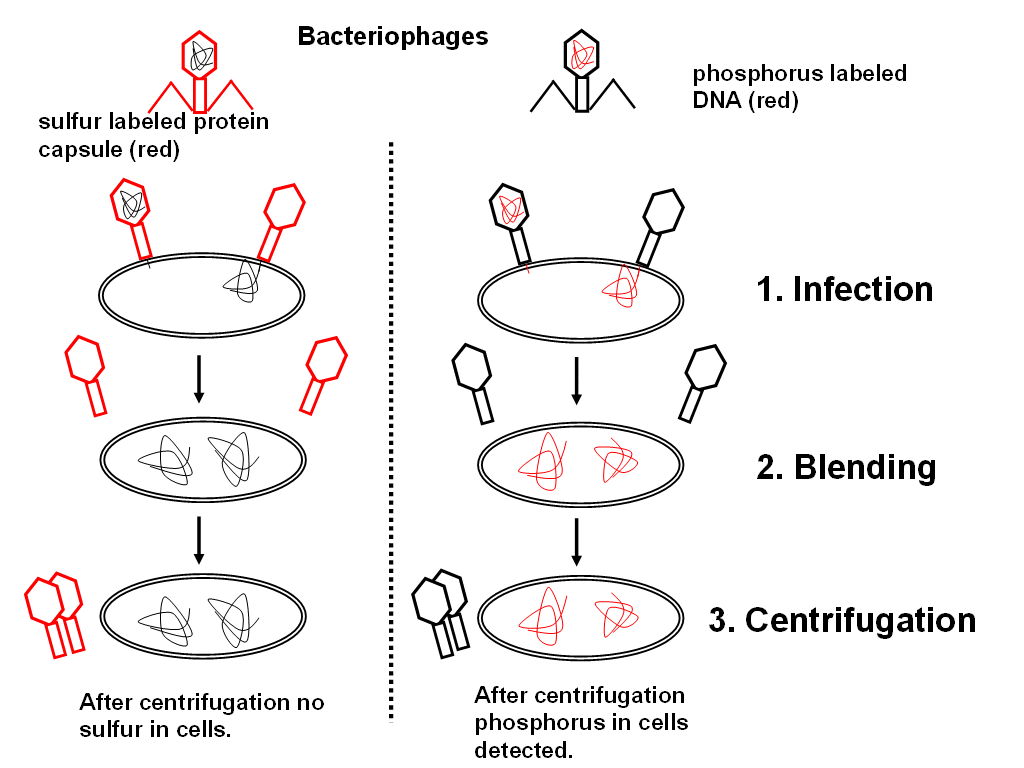
Follow the contrasting labelled phage experiments and where the radioactive material is detected. The key inference is that material associated with DNA, rather than the phage protein coat, enters the bacterial cells and carries genetic information. Source
Sugar–phosphate backbone and RNA polymerization
Successive nucleotides are joined by strong covalent sugar–phosphate bonds.
These bonds form a continuous sugar–phosphate backbone in each DNA or RNA strand.
The backbone provides a strong chain while the bases project from the sugars and can carry coded information.
RNA is a polymer produced when nucleotide monomers join by condensation reactions.
Students must be able to draw and recognize both individual nucleotides and RNA polymers.
DNA compared with RNA
Feature | DNA | RNA |
|---|---|---|
Number of strands | Two strands | One strand |
Pentose sugar | Deoxyribose | Ribose |
Nitrogenous bases | Adenine, thymine, guanine, cytosine | Adenine, uracil, guanine, cytosine |
Sugar sketch cue | Hydrogen rather than hydroxyl at the position | Hydroxyl group at the position |
Example of nucleic acid | DNA | RNA |
HL Only: Nucleosome structure
A nucleosome contains DNA wrapped around a core of eight histone proteins.
An additional histone protein is attached to linker DNA and helps hold the structure together.
Students should recognize the close structural association between DNA and histone proteins.
Students are required to use molecular visualization software to study protein–DNA association within a nucleosome.
HL Only: Chargaff’s data and falsification
Chargaff measured relative amounts of purine and pyrimidine bases in DNA from diverse life forms.
His data showed approximately and , linking the relative quantities of complementary bases.
The bases did not occur in a fixed repeating proportion, contradicting the tetranucleotide hypothesis.
The problem of induction means repeated supporting observations cannot establish a universal claim with absolute certainty.
Reliable contradictory evidence can falsify a hypothesis, illustrating the syllabus idea of certainty of falsification.
HL Only: Directionality and helix stability
Each DNA or RNA strand has directionality, with a end and a end.
Sugar–phosphate linkages run , giving nucleic-acid processes a defined direction.
Directionality is significant in replication, transcription and translation.
Each DNA base pair combines one purine with one pyrimidine.
The adenine–thymine and cytosine–guanine pairs have equal length.
Equal pair length helps DNA retain the same three-dimensional helix structure regardless of its base sequence.
Checklist: can you do this?
Can you draw and recognize the three components of a nucleotide and an RNA polymer?
Can you explain how condensation produces the strong sugar–phosphate backbone?
Can you distinguish DNA from RNA by strand number, sugar and nitrogenous bases?
Can you draw antiparallel DNA strands and show the correct complementary base pairs?
Can you explain how complementarity supports replication, expression and information storage?
Can you explain the HL significance of directionality and purine–pyrimidine pairing?
Can you describe a nucleosome and explain the required molecular-visualization skill?
Can you interpret the Hershey–Chase and Chargaff evidence, including the role of falsification?