
Cells as the basic unit and common structures
Cells are the basic structural unit of all living organisms.
Cell theory predicts that a newly discovered organism will consist of one or more cells.
Typical cells contain DNA as their genetic material.
Their cytoplasm is composed mainly of water, providing an aqueous internal environment.
A lipid plasma membrane encloses the cytoplasm and separates the cell from its surroundings.
Developments in microscopy
Electron microscopy allows cell ultrastructure to be investigated at substantially higher resolution than ordinary light microscopy.
Freeze fracture exposes internal fracture surfaces of cells and membranes for structural investigation.
Cryogenic electron microscopy examines rapidly frozen material while reducing structural alteration during preparation.
Fluorescent stains make selected cell structures easier to locate using light microscopy.
Immunofluorescence uses fluorescently labelled antibodies to reveal specific cellular molecules or structures.
Eukaryote cell structure
A plasma membrane encloses a highly compartmentalized cytoplasm containing ribosomes of type .
The nucleus contains chromosomes of DNA bound to histones and is surrounded by a double membrane with pores.
Required membrane-bound organelles include mitochondria, endoplasmic reticulum and the Golgi apparatus.
Know a variety of vesicles and vacuoles, including lysosomes.
The cytoskeleton includes microtubules and microfilaments.
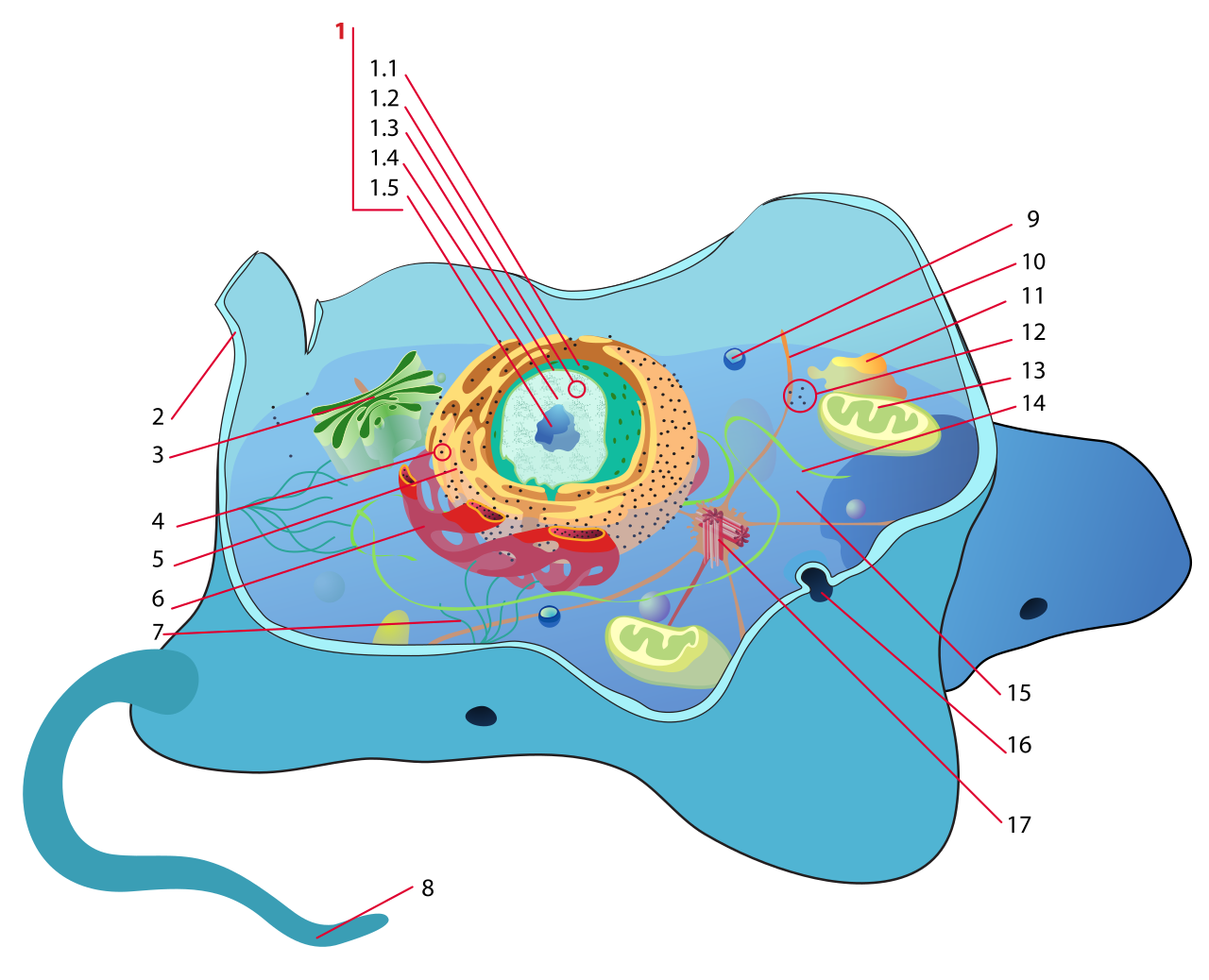
Use the image for active recall of typical eukaryotic cell structures. Identify structures corresponding to the nucleus, mitochondria, endoplasmic reticulum, Golgi apparatus, ribosomes and cytoskeleton. Source
Animal, fungal and plant cell differences
Feature | Animal cells | Fungal cells | Plant cells |
|---|---|---|---|
Cell wall | Absent | Present; mainly chitin | Present; mainly cellulose |
Vacuoles | Usually small if present | Vacuoles present | Typically a large sap vacuole |
Chloroplasts and plastids | Absent | Absent | Present in appropriate cell types |
Centrioles, cilia and flagella | Centrioles typical; cilia or flagella occur in some cells | Generally absent, with exceptions among fungal groups | Usually absent from typical cells, with exceptions in some reproductive cells |
Micrograph identification and annotation
From light and electron micrographs, distinguish prokaryotic, plant and animal cells.
In electron micrographs recognize the nucleoid, prokaryotic cell wall, nucleus, mitochondrion, chloroplast and sap vacuole.
Also recognize the Golgi apparatus, rough ER, smooth ER, chromosomes and ribosomes.
Identify the cell wall, plasma membrane and microvilli where visible.
Draw and annotate the required organelles and structures directly from electron micrographs.
Annotations must include the functions of the labelled structures.
HL Only: Differentiation and multicellularity
Cell differentiation is the process by which specialized tissues develop in multicellular organisms.
Its basis is different patterns of gene expression, often triggered by changes in the environment.
Multicellularity has evolved repeatedly rather than arising only once.
Many fungi and eukaryotic algae, and all plants and animals, are multicellular.
Major advantages of multicellularity are increased body size and greater cell specialization.
Checklist: can you do this?
Can you explain why cells are the basic structural unit of living organisms and identify structures common to typical cells?
Can you calculate magnification and actual size and produce a correct scale bar?
Can you explain the advantages of major microscopy developments named in the syllabus?
Can you distinguish prokaryotic and eukaryotic cells, and compare typical animal, fungal and plant cells?
Can you identify the atypical nuclear arrangements of fungal hyphae, skeletal muscle, red blood cells and sieve tubes?
Can you identify required structures in light and electron micrographs and produce functional annotations?
Can you explain the evidence for endosymbiosis? HL only
Can you explain cell differentiation and the advantages and repeated evolution of multicellularity? HL only
Microscopy practical skills
Be able to prepare temporary mounts of cells and tissues and use appropriate staining.
Use coarse and fine focus adjustments correctly when observing specimens.
Measure cell dimensions using an eyepiece graticule and treat instrument measurement as quantitative observation.
Calculate magnification using .
Calculate actual size using .
Be able to produce a scale bar and take photographs of microscopic specimens.
Prokaryote cell structure
Know the required model as a Gram-positive eubacterium, such as Bacillus or Staphylococcus.
A prokaryotic cell has a cell wall, plasma membrane and cytoplasm.
Its genetic material is naked DNA arranged in a loop rather than enclosed in a nucleus.
Protein synthesis involves ribosomes of type .
Prokaryotic structures vary, but detailed variations such as wall-less phytoplasmas and mycoplasmas are not required.
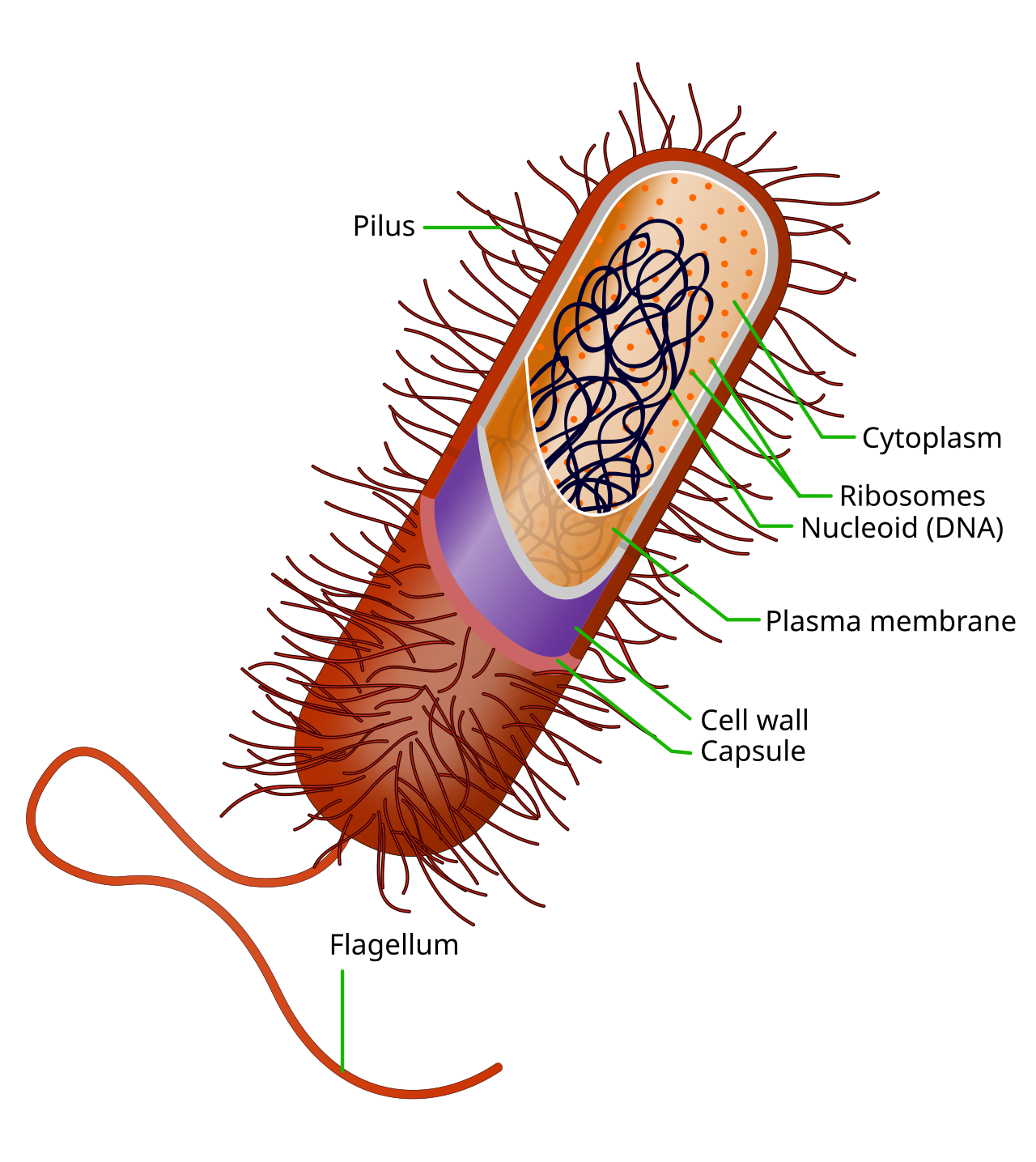
Use the diagram to recognize the overall organization of a prokaryotic cell and locate the cell wall, plasma membrane, cytoplasm, ribosomes and nucleoid/DNA region. Source
Processes of life in unicellular organisms
A unicellular organism must perform all essential processes of life within one cell.
These include homeostasis, metabolism, nutrition and excretion.
They also include movement, growth and response to stimuli.
The cell must also carry out reproduction.
Atypical eukaryotic cell structure
Aseptate fungal hyphae contain many nuclei within continuous cytoplasm rather than one nucleus per cell compartment.
Skeletal muscle fibres are unusually long cells containing many nuclei.
Mature red blood cells are atypical because they lack a nucleus.
Phloem sieve tube elements also lack a nucleus at functional maturity.
These examples show that the number of nuclei cannot always be used as a simple defining feature of a typical eukaryotic cell.
HL Only: Origin of eukaryotes by endosymbiosis
Evidence suggests all eukaryotes evolved from a common unicellular ancestor that possessed a nucleus and reproduced sexually.
Mitochondria subsequently evolved through endosymbiosis.
In some eukaryotic lineages, chloroplasts later also originated through endosymbiosis.
Evidence includes ribosomes, naked circular DNA and the ability of mitochondria and chloroplasts to replicate.
A scientific theory gains strength from the range of observations it explains and predictions it supports.
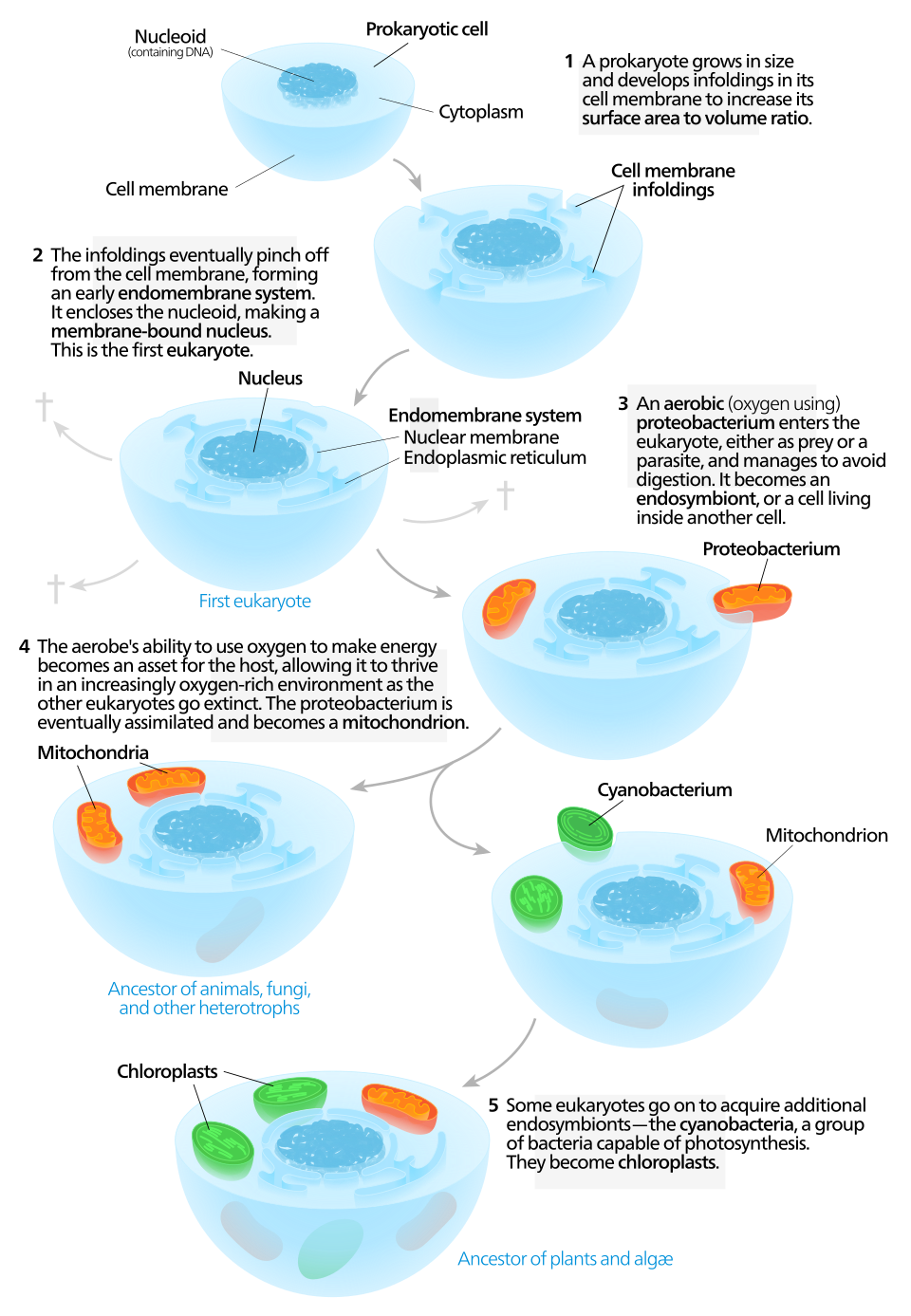
Focus on the sequence of endosymbiotic events rather than additional detail outside the syllabus. The key idea is that mitochondria originated first by endosymbiosis, with chloroplast endosymbiosis occurring later in some eukaryotes. Source