
HL Only: Why classification is needed
The immense diversity of species makes biological classification necessary.
Classification organizes organisms so their similarities, differences and relationships can be studied systematically.
Once organisms have been classified, a broad range of further biological study is facilitated.
HL Only: Evolutionary classification and clades
An ideal classification follows evolutionary relationships rather than relying only on traditional taxonomic ranks.
Members of a taxonomic group should have evolved from a common ancestor.
A clade is a group of organisms united by common ancestry and shared characteristics.
Characteristics can be predicted for members of a group because those characteristics are shared within the clade.
HL Only: Molecular clocks
Sequence differences gradually accumulate after clades diverge from a common ancestor.
A molecular clock uses this accumulation to estimate when two clades diverged.
Molecular clocks give estimates, not exact divergence times, because mutation rates are not constant.
Mutation rates are influenced by generation time, population size, selective pressure and other factors.
HL Only: Reading a cladogram
A cladogram can be analysed to deduce evolutionary relationships, common ancestors and clades.
The root represents the ancestral lineage from which all organisms shown on the cladogram ultimately descend.
A node is a branching point and represents a hypothetical common ancestor.
A terminal branch ends at one of the organisms or groups represented in the cladogram.
Exam questions may require relationships or common ancestors to be deduced directly from a diagram.

Follow branches back toward their shared nodes to identify common ancestry. The diagram provides a clear practice model for recognizing branches and branching points. Source
HL Only: The three-domain classification
Evidence from rRNA base sequences was used to classify all organisms into three domains.
The domain system introduced an additional taxonomic level above kingdoms.
This revolutionary reclassification was proposed in 1977.
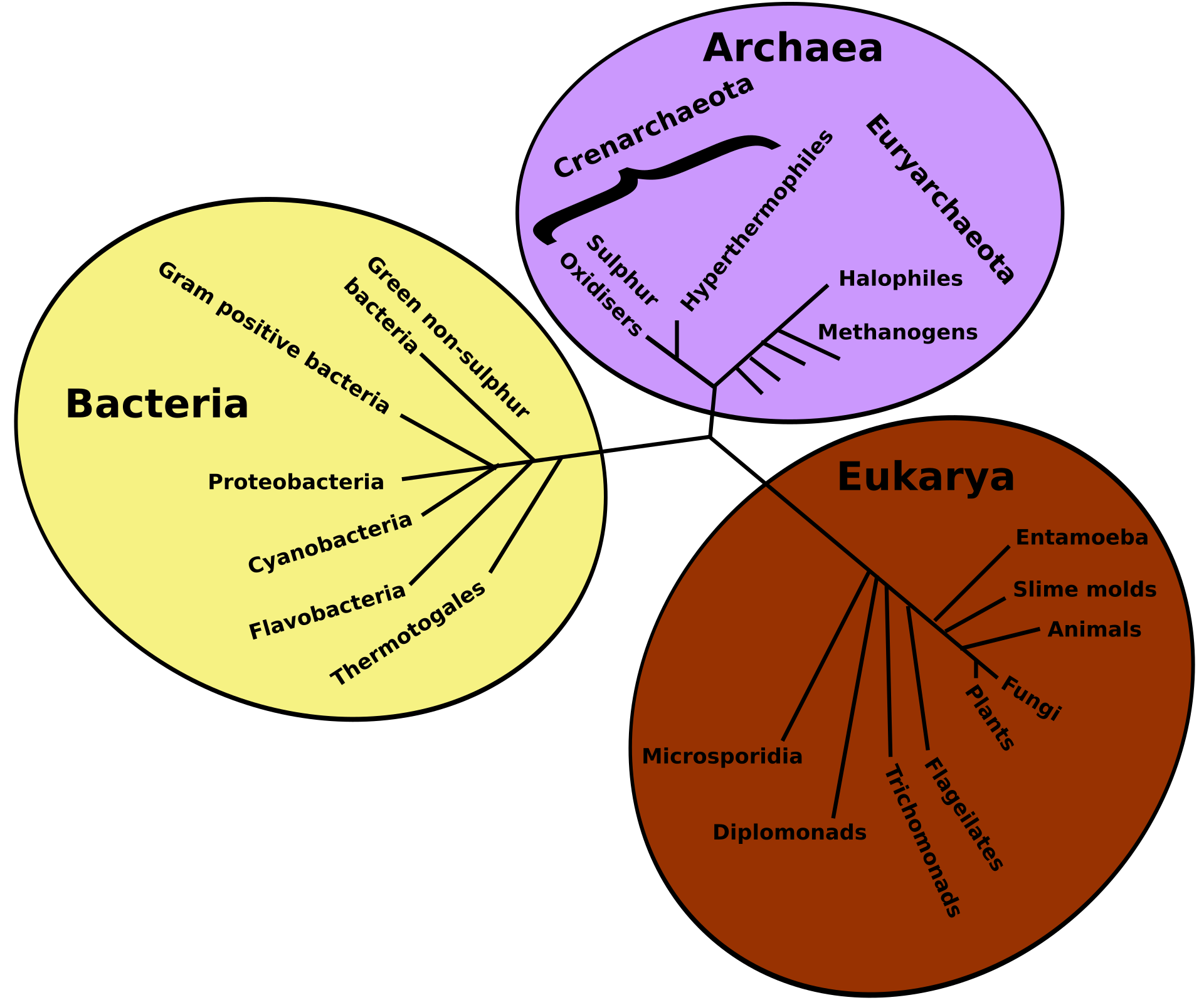
The diagram connects rRNA sequence evidence with the division of organisms into three domains. Focus on the major branches rather than memorizing every terminal group. Source
HL Only: Traditional hierarchy versus cladistics
Feature | Traditional hierarchy | Cladistics |
|---|---|---|
Organization | Uses kingdom, phylum, class, order, family, genus and species | Uses unranked clades |
Evolutionary fit | Fixed ranks do not always match evolutionary patterns of divergence | Groups organisms according to common ancestry |
Limitation | Fixed taxonomic ranks are partly arbitrary and do not reflect the gradation of variation | Avoids forcing evolutionary groups into predetermined ranks |
Nature of science | Represents the older classification framework | Provides an alternative approach and illustrates a paradigm shift |
HL Only: Evidence for placing organisms in clades
The most objective evidence for placing organisms in the same clade comes from molecular sequence data.
Biologists compare base sequences of genes when investigating evolutionary relationships.
They can also compare amino acid sequences of proteins.
Morphological traits may also be used to assign organisms to clades, but sequence evidence provides the most objective basis.
HL Only: Constructing cladograms and parsimony
Gene base sequences or protein amino acid sequences can provide the data used to construct cladograms.
Simple sample sequence data can be compared to generate hypotheses about evolutionary relationships.
Different criteria for judging the same evidence can produce different evolutionary hypotheses.
Parsimony analysis selects the most probable cladogram by explaining observed sequence variation with the smallest number of sequence changes.
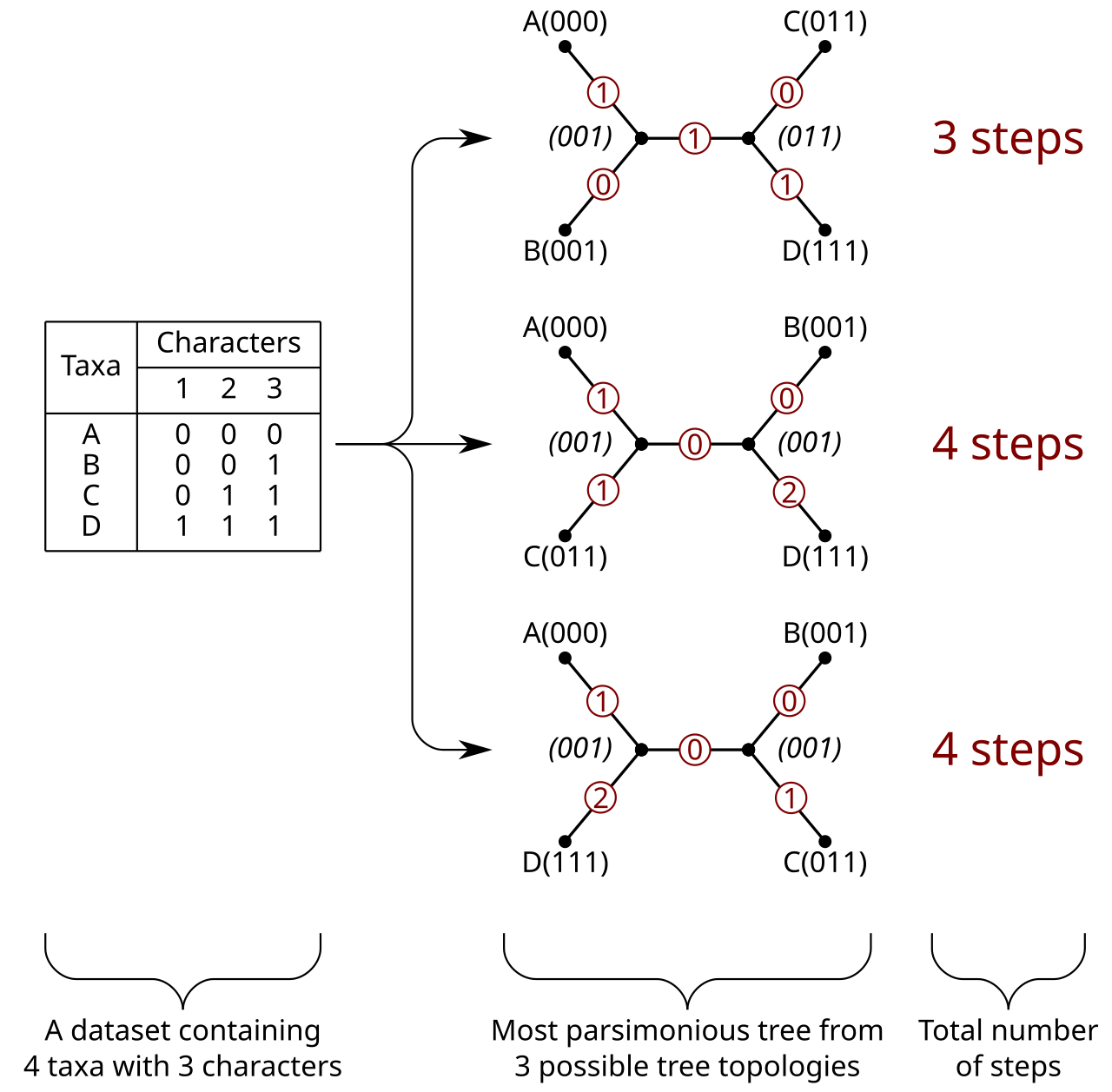
Parsimony favours the evolutionary hypothesis that accounts for observed variation using the fewest sequence changes. Source
HL Only: Testing and revising classifications
Cladistics can test whether an existing classification actually corresponds to evolutionary relationships.
A possible case study is the transfer of plant species between families, such as reclassification of the figwort family; case-study details need not be memorized.
Similar morphology can arise through convergent evolution rather than common ancestry.
Cladistic evidence can therefore falsify an earlier classification that was based on misleading morphological similarities.
HL Only: Checklist: can you do this?
Can you explain why classification is necessary for studying biological diversity?
Can you distinguish the traditional taxonomic hierarchy from classification using unranked clades?
Can you explain why evolutionary relationships provide an advantageous basis for classification?
Can you identify how gene base sequences, protein amino acid sequences and morphology can provide evidence for clades?
Can you explain how a molecular clock estimates divergence time and why its results are estimates?
Can you explain how parsimony analysis is used when constructing cladograms?
Can you interpret a cladogram using root, node, terminal branch, common ancestor and clade?
Can you explain how cladistics and rRNA sequence evidence can lead to major reclassification?