
HL Only: Structural features common to viruses
Viruses share relatively few structural features because their structures are highly diverse.
All viruses contain nucleic acid, either DNA or RNA, as their genetic material.
All viruses have a capsid made of protein.
Viruses have no cytoplasm and few or no enzymes.
Viruses are small and have a fixed size.
HL Only: Why viruses can have few genes
Viruses rely on a host cell for energy supply, nutrition, protein synthesis and other life functions.
Their lack of cytoplasm and possession of few or no enzymes are consistent with this dependence.
Host dependence helps explain how viruses can function with relatively few genes.
In an exam, connect minimal viral machinery with exploitation of host-cell functions.
HL Only: Bacteriophage lambda lysogenic cycle
Use bacteriophage lambda as the required example of a lysogenic cycle.
Web-supported lifecycle detail: lambda DNA can become integrated into the bacterial chromosome as a prophage.
The viral DNA is then replicated together with the host genome and inherited by daughter cells.
The host is not immediately destroyed while the phage remains lysogenic.
Lambda can later switch from the lysogenic state into lytic development.

Follow the branch into lysogeny, where viral genetic material persists with the host genome, and contrast it with the pathway ending in lysis. The diagram helps distinguish the two possible outcomes of bacteriophage infection. Source
HL Only: Why some viruses evolve rapidly
The syllabus requires explanation of very rapid evolution in some viruses, specifically influenza viruses and HIV.
Web-supported detail: influenza antigenic drift results from small mutations accumulating as influenza viruses replicate.
Influenza A can also undergo antigenic shift, an abrupt major change that can involve reassortment of viral gene segments.
Web-supported detail: HIV has an extremely high mutation rate, producing extensive genetic variation.
Rapid generation of genetic variation gives natural selection abundant variation on which to act.
HL Only: Diversity of viral structure
Viruses show very high diversity in shape and structure.
Viral genetic material may be DNA or RNA.
The nucleic acid may be single-stranded or double-stranded.
Some viruses are enveloped in host cell membrane, whereas others are non-enveloped.
Required examples include bacteriophage lambda, coronaviruses and HIV.
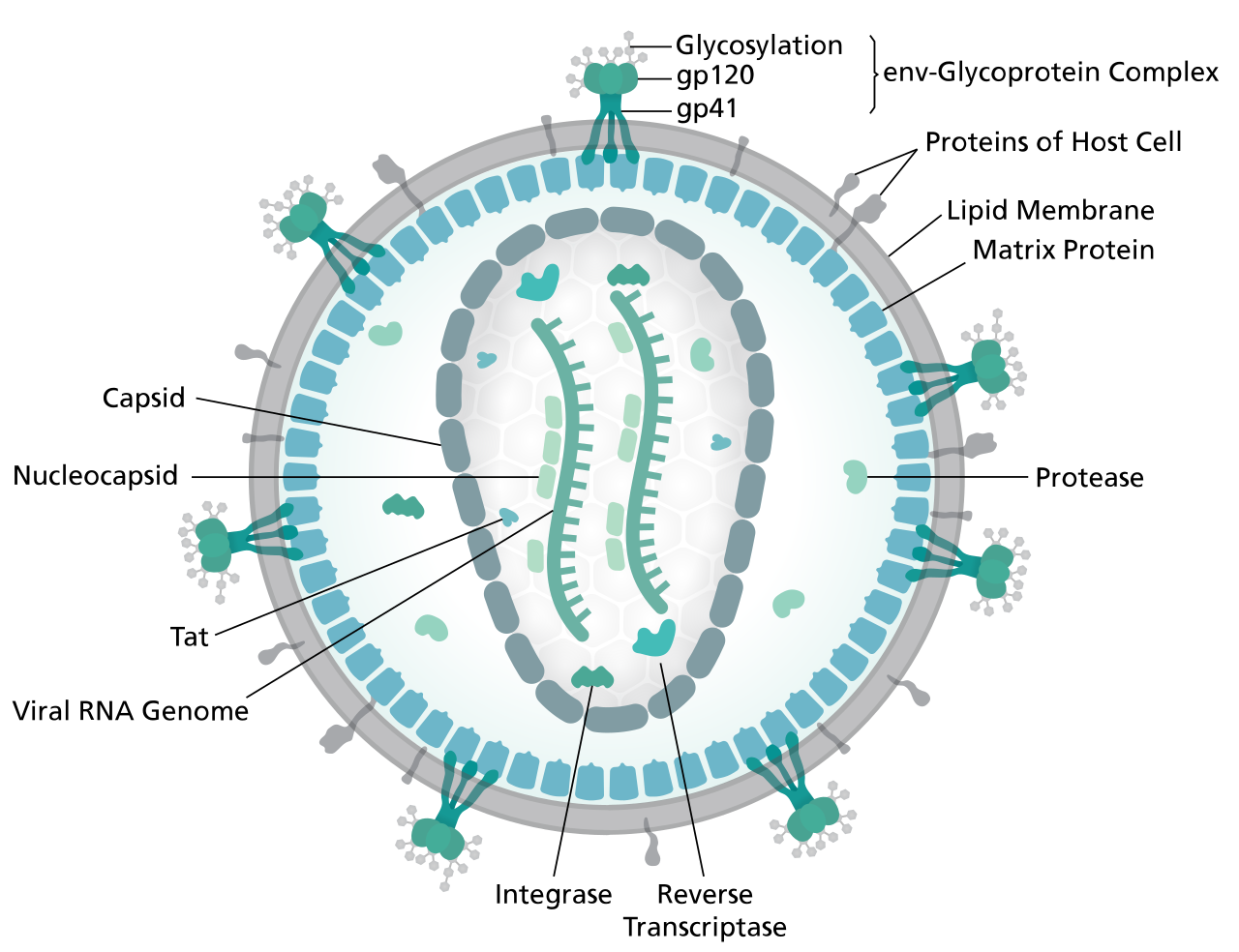
The diagram shows HIV as one example of the structural diversity of viruses. Identify the viral genetic material, protein structures and surrounding envelope rather than assuming all viruses have the same form. Source
HL Only: Bacteriophage lambda lytic cycle
Use bacteriophage lambda as the required example of a lytic cycle.
Web-supported lifecycle detail: the phage first attaches to the host and introduces its genome.
The viral genome exploits host ribosomes and metabolic machinery to produce viral components.
New virus particles are assembled inside the host.
The host cell then lyses, releasing newly produced phages.
Sequence the main phases as attachment and entry, biosynthesis, assembly, lysis and release.
HL Only: Several origins and convergent evolution
The enormous diversity of viruses suggests that viruses may have had several possible origins.
Viruses share an extreme form of obligate parasitism as their mode of existence.
Their shared structural features could therefore represent convergent evolution.
This means similarities need not indicate that all viruses arose from one common viral ancestor.
Viruses and living organisms share the genetic code, providing an important connection between them.
HL Only: Influenza, HIV and treatment challenges
The required rapid-evolution examples are influenza viruses and HIV.
Influenza antigenic drift can alter viral antigens enough to reduce recognition by existing antibodies.
Consequently, the composition of influenza vaccines is reviewed regularly and updated when needed.
Mutations in HIV can produce drug resistance, reducing the effectiveness of particular HIV medicines.
Exam answers should link rapid viral evolution directly to difficulties in maintaining effective disease prevention or treatment.
Checklist: can you do this?
Can you state the structural features common to all viruses?
Can you explain viral structural diversity, including genome and envelope variation?
Can you explain why viruses can exist with few genes and depend on host cells?
Can you outline the lytic cycle using bacteriophage lambda?
Can you outline the lysogenic cycle using bacteriophage lambda?
Can you explain why virus similarities could result from convergent evolution and several origins?
Can you explain why influenza viruses and HIV can evolve rapidly?
Can you relate rapid viral evolution to challenges in treating or preventing disease?