
HL Only: Fatty-acid vesicles and compartmentalization
Fatty acids can spontaneously coalesce into spherical bilayer vesicles.
This spontaneous organization illustrates the importance of self-assembly during early cell evolution.
A vesicle creates a membrane-bound compartment separated from its surroundings.
Compartmentalization allows internal chemistry to become different from chemistry outside the compartment.
Formation of such compartments was therefore a necessary step toward the evolution of the first cells.
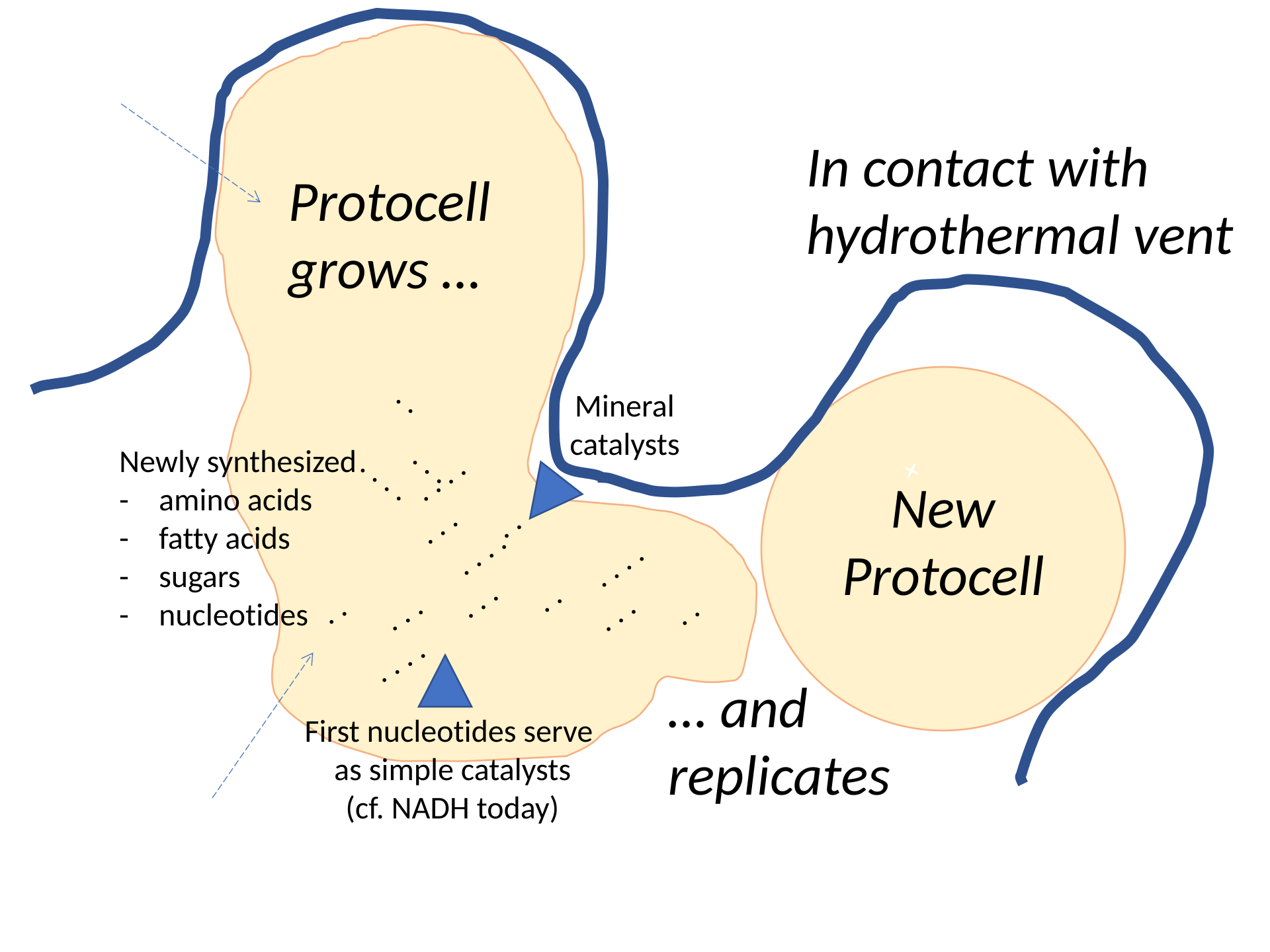
Use the diagram to visualize fatty acids contributing to a membrane around a protocell. The key syllabus idea is that a membrane-bound compartment permits internal chemistry to differ from the external environment. Source
HL Only: Evidence for LUCA
The last universal common ancestor (LUCA) is supported by characteristics shared across all living organisms.
A universal genetic code provides evidence for common ancestry.
Shared genes among organisms provide another line of evidence.
Other forms of life may also have evolved but later become extinct through competition with LUCA and its descendants.
LUCA therefore represents the common ancestor of surviving life, not necessarily the only early form of life.
HL Only: Checklist: can you do this?
Can you explain how early-Earth conditions could permit spontaneous formation of carbon compounds?
Can you distinguish self-sustaining life from non-living entities and explain why viruses are considered non-living?
Can you explain why catalysis, self-replication, self-assembly and compartmentalization were necessary for the first cells?
Can you evaluate the Miller–Urey experiment, including its evidential value and principal limitation?
Can you explain how fatty-acid vesicles provide compartmentalization?
Can you explain why RNA could function as both genetic material and a catalyst?
Can you identify evidence for LUCA and explain why other early forms of life may have disappeared?
Can you explain the evidence linking LUCA to hydrothermal vents and why dates for early life are estimates?
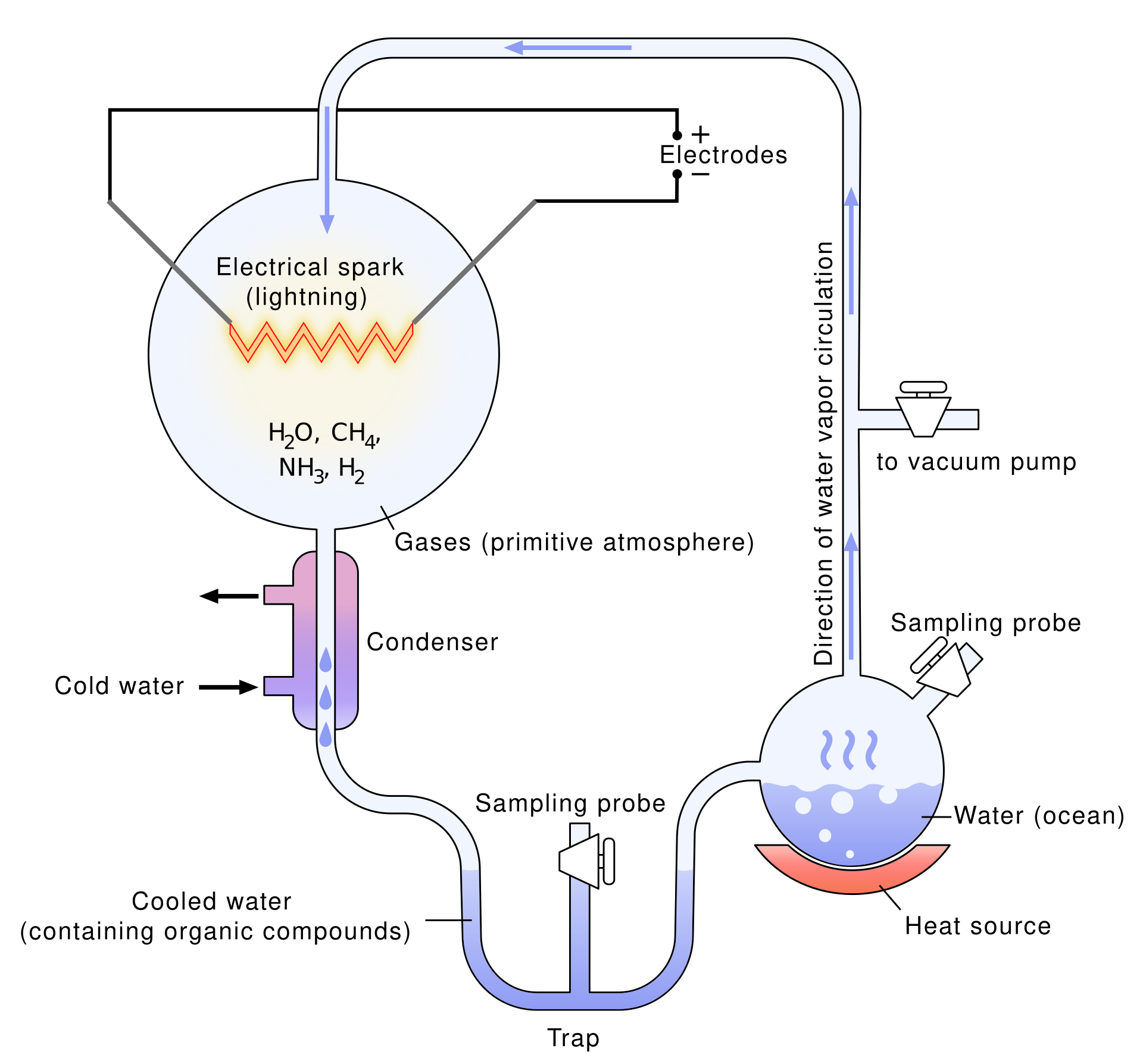
Use the apparatus diagram to visualize how the Miller–Urey experiment investigated pre-biotic formation of carbon compounds. Its results support the plausibility of spontaneous chemical formation, while uncertainty about exact early-Earth conditions limits the conclusions that can be drawn. Source
HL Only: RNA as the presumed first genetic material
RNA was a plausible first genetic material because it can be replicated and also has catalytic activity.
RNA may therefore initially have acted as both genetic material and the enzymes of the earliest cells.
Modern ribozymes provide an example of RNA retaining catalytic activity.
Ribozymes in the ribosome catalyse peptide bond formation during protein synthesis.
This dual capacity links heredity and catalysis, two key requirements in hypotheses for early cellular life.
HL Only: Estimating dates for early life and LUCA
Scientists use evidence-based approaches to estimate dates for both the first living cells and LUCA.
These dates are estimates of events that occurred extremely far back in Earth's history.
Students should appreciate the immense length of time over which life has been evolving on Earth.
HL Only: LUCA and hydrothermal vents
Evidence supports the hypothesis that LUCA evolved in the vicinity of hydrothermal vents.
One line of evidence is fossilized evidence of life in ancient seafloor hydrothermal vent precipitates.
A second line is conserved sequences identified through genomic analysis.
The hypothesis is therefore supported by both geological evidence and molecular evidence.
These evidence types help investigate early life despite the difficulty of reproducing ancient pre-biotic conditions.
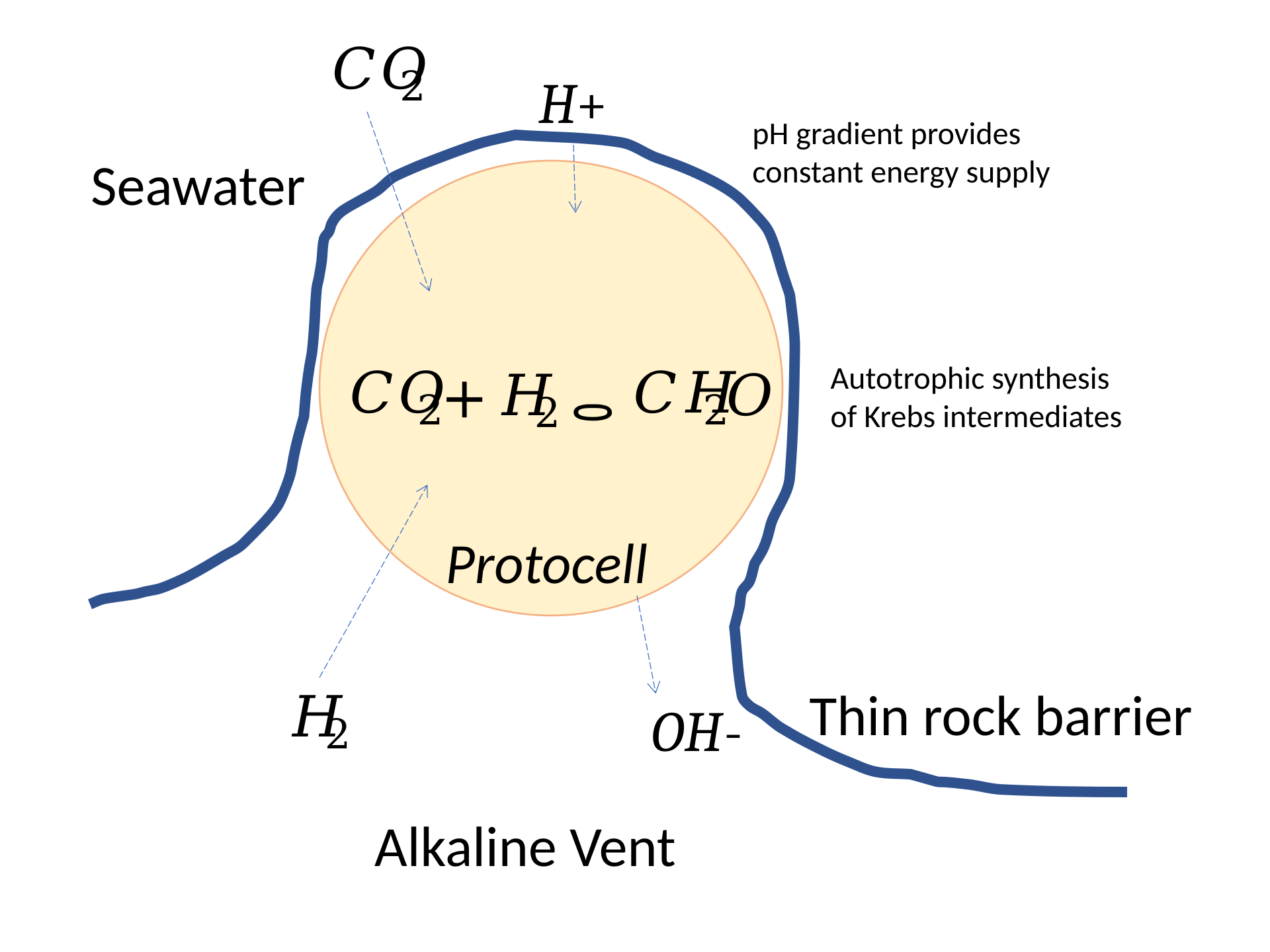
Use the diagram to visualize the hydrothermal-vent environment proposed for early cellular evolution. Pair this setting with the syllabus evidence from ancient vent precipitates and conserved genomic sequences. Source
Checklist
Early Earth: Can you explain how the lack of free oxygen and ozone, higher and methane levels, higher temperatures, and greater UV penetration could favour pre-biotic formation of carbon compounds?
Living vs non-living: Can you explain why cells are the smallest units of self-sustaining life and why viruses are regarded as non-living?
Origin of the first cells: Can you explain why catalysis, molecular self-replication, self-assembly and compartmentalization were necessary steps, and why hypotheses about the first cells are difficult to test?
Miller–Urey experiment: Can you describe and evaluate the experiment, explaining what it supports and why it does not prove how life originated? Modern evidence also shows uncertainty over how accurately its gas mixture represented the early atmosphere.
Vesicles: Can you explain how fatty acids spontaneously form spherical bilayer vesicles and why a membrane-bound compartment allows internal chemistry to differ from the surroundings?
RNA world: Can you explain why RNA is proposed as the first genetic material, including its ability to carry information and perform catalytic activity as ribozymes? This dual genetic-and-catalytic role is central to the RNA-world hypothesis.
LUCA: Can you explain how the universal genetic code and shared genes provide evidence for a last universal common ancestor, and why LUCA was not necessarily the only form of early life?
Dating and hydrothermal vents: Can you explain why dates for the first cells and LUCA are estimates, and describe the fossil evidence from ancient hydrothermal-vent precipitates plus conserved genomic sequences that support a hydrothermal-vent connection?