
Evolution: what counts as evolutionary change
Evolution is a change in the heritable characteristics of a population.
Only changes with a genetic basis count as evolution; acquired non-genetic changes are excluded.
This definition distinguishes Darwinian evolution from Lamarckism.
The theory of evolution by natural selection predicts and explains a broad range of biological observations.
Despite extensive support, it cannot be formally proved true by correspondence; it is treated as a pragmatic truth and remains a theory.
Homologous and analogous structures
Homologous structures share an evolutionary origin even when their functions differ.
The required example is the pentadactyl limb found in vertebrates.
Analogous structures perform the same function but have different evolutionary origins.
Convergent evolution is the evolutionary process that produces analogous structures.
For example, bird wings and insect wings both enable flight but evolved from different ancestral structures.
Reproductive isolation and differential selection
Reproductive isolation separates populations so that they no longer reproduce together.
Geographical isolation is one way reproductive isolation can be achieved.
Different conditions can produce differential selection, causing isolated populations to diverge.
The required example is separation of bonobos and common chimpanzees by the Congo River.
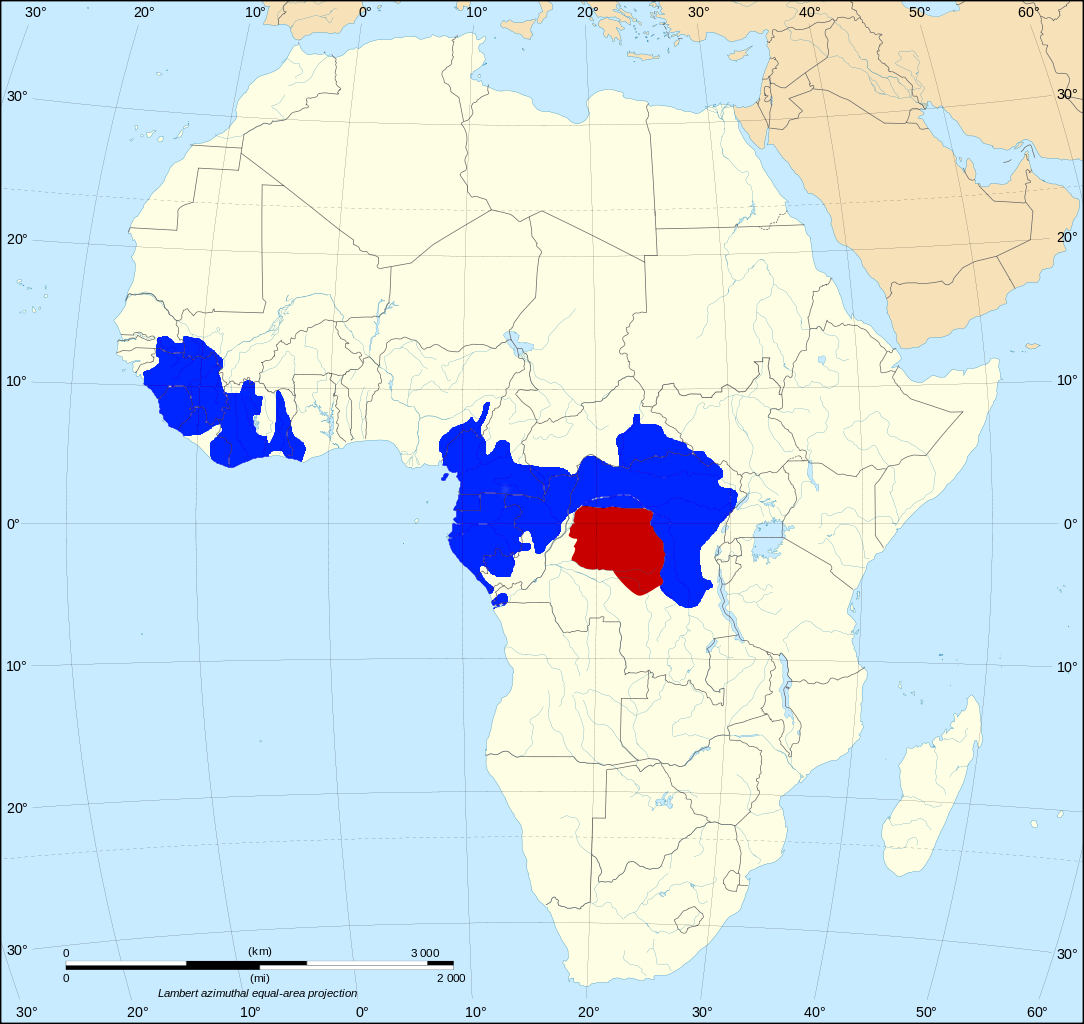
The Congo River separates bonobo and chimpanzee populations geographically. This illustrates how geographical isolation can contribute to reproductive isolation and divergence. Source
HL Only: Adaptive radiation
Adaptive radiation produces multiple closely related species occupying different ecological niches.
It increases biodiversity where vacant niches are available.
Closely related species can therefore coexist without competing directly for the same niche.
Adaptive radiation links speciation, niche differentiation and increasing biodiversity.
HL Only: Abrupt plant speciation
In plants, hybridization combined with polyploidy can cause abrupt speciation.
Polyploidy is the possession of additional complete chromosome sets.
The chromosome change can create rapid reproductive isolation from the parental populations.
The required example is knotweed or smartweed, genus Persicaria, which contains many species formed by these processes.
Evidence from sequences and selective breeding
DNA or RNA base sequences and amino acid sequences provide powerful evidence for common ancestry.
Selective breeding creates different domesticated animal breeds and crop varieties.
Domesticated forms can differ substantially from their original wild species.
These differences demonstrate how rapidly evolutionary change can occur.
Speciation by splitting
Speciation occurs when one pre-existing species splits into two or more species.
The syllabus identifies splitting of existing species as the way new species appear.
Speciation increases the total number of species on Earth, whereas extinction decreases it.
Gradual evolutionary change within one continuing species is not speciation.
HL Only: Allopatric vs sympatric speciation
Allopatric speciation involves populations separated by a geographical barrier.
Sympatric speciation occurs without geographical separation, with reproductive isolation developing within the same area.
Both ultimately require reproductive isolation between populations.
Reproductive isolation can be geographic, behavioural or temporal.
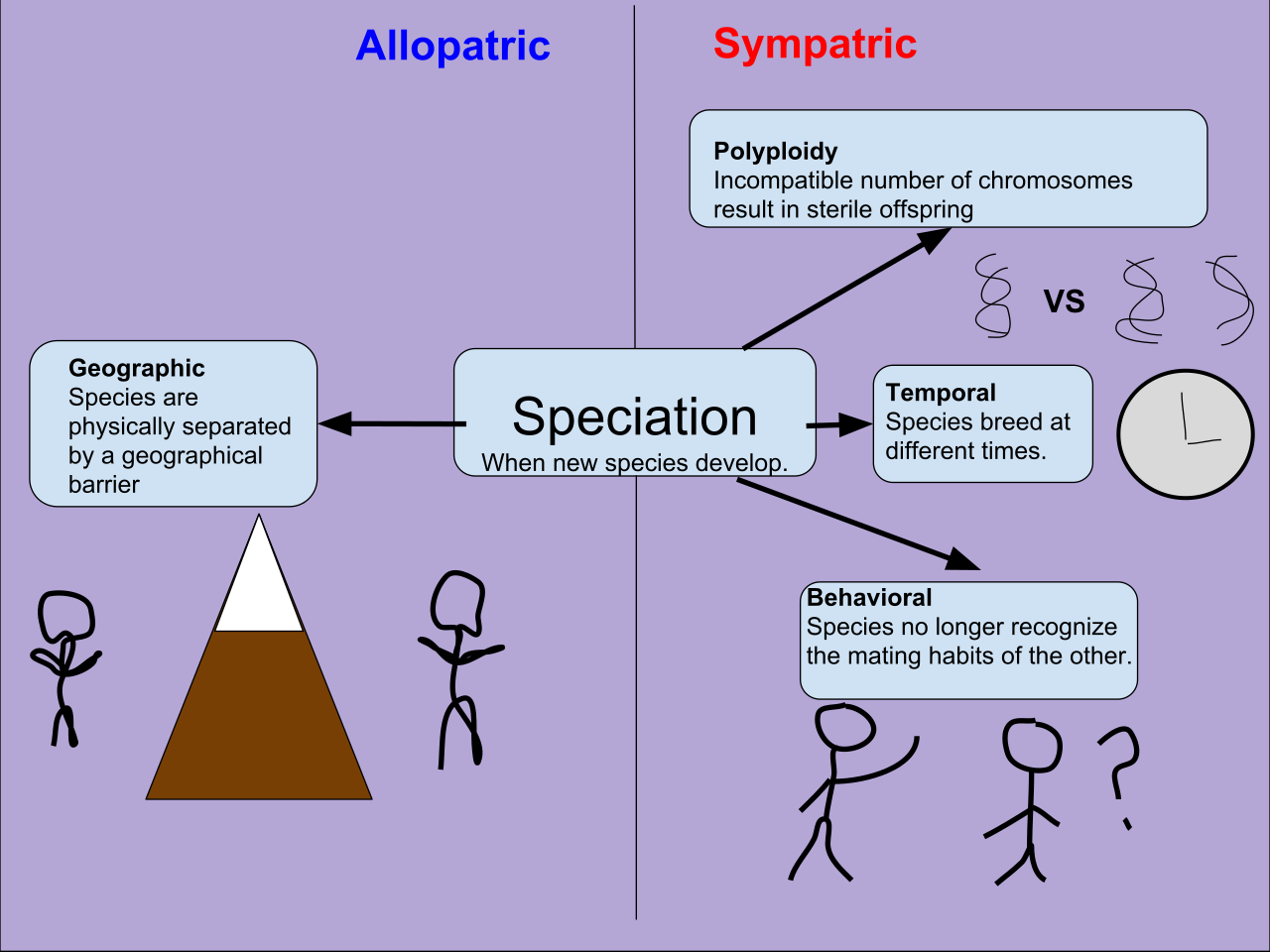
Allopatric speciation begins with geographical separation. Sympatric speciation develops without a geographical barrier, but reproductive isolation must still arise. Source
HL Only: Barriers between species
Barriers to hybridization prevent the mixing of alleles between species.
Differences in courtship behaviour often prevent hybridization between animal species.
If hybridization does occur, sterility of interspecific hybrids can prevent further reproduction.
A mule is the required example of a sterile hybrid.
Checklist: can you do this?
Can you define evolution as change in the heritable characteristics of a population?
Can you explain evidence from sequence data, selective breeding and homologous structures?
Can you distinguish homologous from analogous structures and link analogy to convergent evolution?
Can you explain why speciation requires splitting of a pre-existing species?
Can you explain how reproductive isolation and differential selection can cause divergence?
Can you distinguish allopatric and sympatric speciation, including geographic, behavioural and temporal isolation?
Can you explain how adaptive radiation increases biodiversity?
Can you explain how hybridization barriers, hybrid sterility, hybridization and polyploidy affect speciation?