
Variation and morphological species
No two individuals are identical in all traits; variation is a defining feature of life.
Complex patterns of variation underpin the naming and classification of organisms.
The morphological species concept groups organisms into species using shared traits.
This is the original species concept used by Linnaeus.
Gradual speciation and species boundaries
Speciation is the splitting of one species into two or more.
It usually occurs gradually as non-interbreeding populations become increasingly different in their traits.
Because divergence is gradual, deciding whether populations are one species or different species can be arbitrary.
Human chromosome fusion evidence
Evaluate the hypothesis that human chromosome arose from fusion of chromosomes and in a shared primate ancestor.
Use chromosome evidence to judge whether this testable hypothesis is supported.
NOS: Distinguish a testable hypothesis such as chromosome origin from a non-testable statement.
Genome-size data and whole genome sequencing
Use a database to extract genome-size data for taxonomic groups and compare genome size with organism complexity.
Whole genome sequencing is becoming faster and less costly.
Current use: research into evolutionary relationships.
Potential future use: personalized medicine.
HL Only: Species-concept limits and chromosome number
The biological species concept works poorly for organisms that reproduce asexually.
It also works poorly for bacteria where horizontal gene transfer moves genes between species.
Chromosome number is a shared trait within a species.
Cross-breeding closely related species is unlikely to produce fertile offspring when parental chromosome numbers differ.
HL Only: Environmental DNA barcodes
Identify species from environmental DNA in a habitat using barcodes.
Using barcodes with environmental DNA allows habitat biodiversity to be investigated rapidly.
Treat this as an applied method for rapid biodiversity investigation.
Checklist: can you do this?
Can you explain why variation is fundamental to naming and classifying organisms?
Can you distinguish the morphological species concept from the biological species concept?
Can you apply the capitalization rules of binomial naming?
Can you explain why gradual speciation can make species boundaries arbitrary?
Can you classify chromosomes by banding pattern, length and centromere position?
Can you evaluate evidence for the human chromosome fusion hypothesis?
Can you distinguish genome variation within species from variation between species?
Can you interpret genome-size database information and state uses of whole genome sequencing?
Binomial naming and biological species
Binomial names have two parts: the first identifies the genus; the second distinguishes the species.
Write the genus with an initial capital and the species name in lowercase.
Species in the same genus have similar traits.
The biological species concept defines a species as organisms that can breed and produce fertile offspring.
This definition has application challenges, and competing species definitions exist.
Chromosome diversity and karyotyping
Plant and animal species show diversity in chromosome number; humans have chromosomes and chimpanzees have .
Diploid cells should have an even chromosome number.
In a karyogram, classify chromosomes using banding patterns, length and centromere position.
Apply these chromosome features when interpreting karyotype evidence.
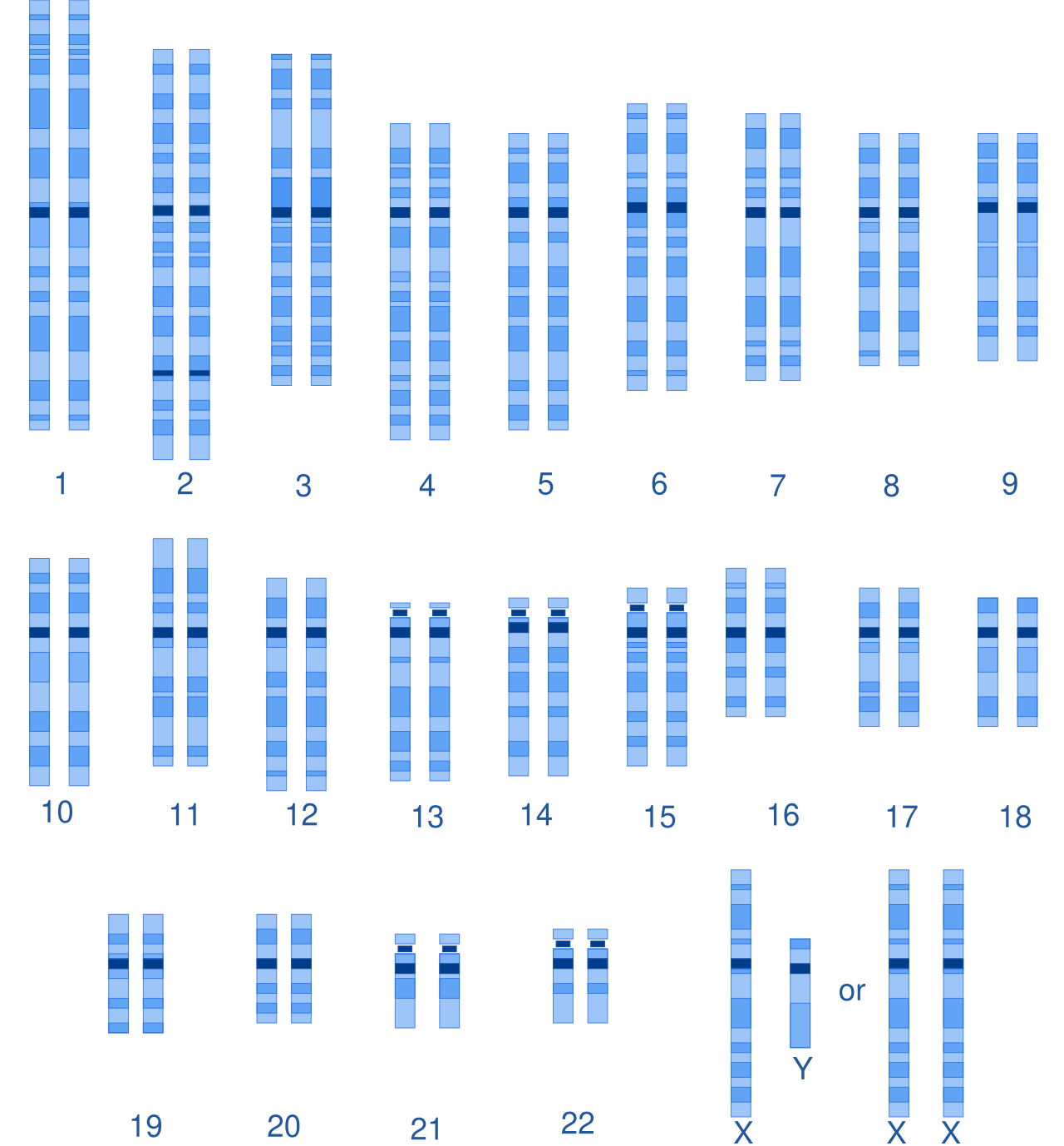
Use the karyogram to compare chromosome length, banding patterns and centromere position, the three classification features required by the syllabus. Source
Genome unity and diversity
An organism's genome is all of its genetic information.
Members of one species share most of their genome, while single-nucleotide polymorphisms create some diversity.
Eukaryote genomes vary in overall size, determined by total DNA, and in base sequence.
Genome variation between species is much greater than variation within a species.
HL Only: Dichotomous key skill
Engage with local plant species or local animal species.
Develop a dichotomous key for the species studied.
Treat constructing the key as an application of skills, rather than only terminology to memorize.