AP Syllabus focus:
‘Neural transmission involves resting potential, threshold, depolarization, the all-or-none principle, the refractory period, and reuptake.’
Neural transmission explains how neurons rapidly convert chemical energy gradients into electrical signals and then back into chemical messaging at synapses. AP Psychology emphasises a predictable sequence: resting potential → threshold → depolarisation → all-or-none firing → refractory period → reuptake.
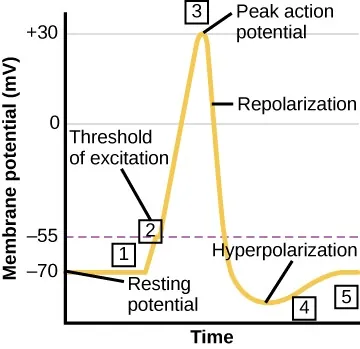
Membrane potential over time during an action potential, with the resting potential, threshold, peak, repolarization, and hyperpolarization phases labeled. This kind of trace makes the all-or-none idea concrete: once threshold is crossed, the waveform follows a stereotyped trajectory rather than scaling in height with stimulus strength. Source
Core electrical concepts in a neuron
Resting potential (polarised membrane)
Resting potential: The stable, negatively charged state of a neuron when it is not firing (about -70 mV inside relative to outside).
At rest, the neuron’s membrane is polarised because ions are unevenly distributed across it.
Key contributors include:
Sodium (Na⁺) tends to be higher outside the cell.
Potassium (K⁺) tends to be higher inside the cell.
Large negatively charged proteins remain inside, helping maintain a negative interior.
This polarity is maintained by selective membrane permeability and active transport (often described in terms of ion “pumps”), creating the conditions needed for rapid signalling.
Threshold (trigger point for firing)
Threshold: The minimum level of stimulation required to initiate an action potential in a neuron.
Inputs from other neurons (typically at dendrites and the cell body) combine to change the membrane’s voltage. If excitation is strong enough to push the neuron to threshold, the neuron initiates a brief electrical event that travels down the axon.
The action potential: depolarisation and all-or-none firing
Depolarisation (the rising phase)
When threshold is reached, voltage-sensitive ion channels open in sequence, producing depolarisation:
Na⁺ channels open first.
Na⁺ rushes into the neuron.
The inside of the cell becomes less negative, then briefly positive.
This is the start of the action potential, which propagates along the axon as a wave of changing membrane voltage.
All-or-none principle (signal size doesn’t scale)
All-or-none principle: Once threshold is reached, a neuron fires a full action potential; if threshold is not reached, it does not fire at all.
Stronger stimulation does not create a “bigger” action potential. Instead, intensity is commonly represented by:
Whether the neuron fires
How often it fires (firing rate), rather than action potential amplitude
Refractory period: reset and direction control
After depolarisation, the neuron must return to its resting state. During the refractory period:
The neuron is resetting its ion balance and membrane readiness.
It is difficult or impossible to fire another action potential immediately.
Functionally, this matters because it:
Enforces a brief pause between action potentials (limits maximum firing rate)
Helps ensure one-way transmission down the axon, because the segment that just fired is temporarily not ready to fire again
From electrical signal to chemical message: synaptic reuptake
Once an action potential reaches the axon terminal, it triggers neurotransmitter release into the synapse.
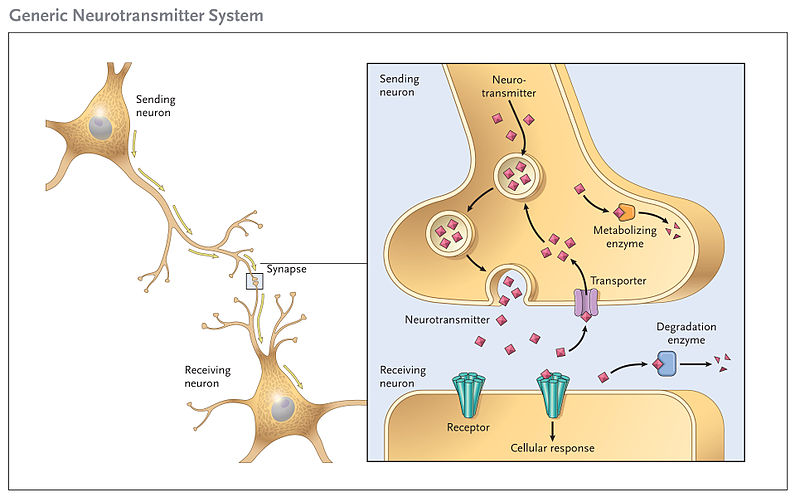
Diagram of a chemical synapse showing neurotransmitters released from presynaptic vesicles into the synaptic cleft and binding to receptors on the postsynaptic membrane. It provides a concrete place to point to “reuptake” conceptually: transporter-mediated removal of transmitter from the cleft is one of the main ways synaptic signaling is terminated and regulated. Source
The AP Psychology focus in this subtopic is what happens next: reuptake.
Reuptake is the process by which released neurotransmitters are taken back into the presynaptic neuron by transporter proteins.
This clears neurotransmitters from the synaptic gap, helping end the message and regulate how long receptors are activated.
Reuptake efficiency affects signalling strength and duration by controlling neurotransmitter availability in the synapse.
Together, resting potential, threshold, depolarisation, all-or-none firing, the refractory period, and reuptake describe how neurons reliably generate, propagate, and terminate signals.
Practice Questions
Explain the all-or-none principle in neural firing. (2 marks)
1 mark: States that a neuron fires only if threshold is reached.
1 mark: States that the action potential is full strength (does not vary in size with stimulus intensity).
Describe how neural transmission works, from resting potential to reuptake. Include threshold, depolarisation, the all-or-none principle, and the refractory period. (6 marks)
Resting potential is a polarised, negative resting state of the neuron.
Threshold is the minimum stimulation needed to trigger firing.
Depolarisation involves Na⁺ influx making the membrane potential less negative/briefly positive.
All-or-none: action potential fires fully once threshold is reached (otherwise no firing).
Refractory period is a brief time after firing when the neuron cannot or is less able to fire again; supports one-way transmission/limits rate.
Reuptake removes neurotransmitters from the synapse by transporting them back into the presynaptic neuron, terminating/regulating signalling.
FAQ
Excitatory and inhibitory postsynaptic potentials are summed at the axon hillock.
Whether threshold is reached depends on timing and location of incoming signals, plus current membrane state.
Leak channels allow small, continuous ion movement.
Voltage-gated Na⁺ channels open rapidly only when a voltage change reaches a trigger level, producing the steep rise of the action potential.
Absolute: a new action potential cannot be initiated.
Relative: firing is possible, but requires stronger-than-usual stimulation due to incomplete recovery.
Faster reuptake shortens receptor activation time.
Slower reuptake leaves more neurotransmitter in the synapse longer, increasing the chance of repeated receptor binding.
Neurons can increase firing frequency as stimulation increases.
Populations of neurons can also recruit additional firing neurons, adding a “number of signals” code alongside rate.