AP Syllabus focus:
‘Disruptions to neural transmission can contribute to disorders such as multiple sclerosis or myasthenia gravis.’
Neural transmission depends on reliable electrical conduction within neurons and chemical signalling at synapses. When these steps are disrupted, messages become slowed, weakened, mistimed, or blocked, producing characteristic cognitive, sensory, or motor symptoms.
What “disrupted neural transmission” means
Neural communication can fail at two main points: signal conduction along the neuron and signal transfer between neurons (or between neuron and muscle). Disruption is often due to disease processes that alter the neuron’s insulation, synaptic chemistry, or receptor functioning.
Common disruption points
Axon conduction problems
Damaged insulation slows or prevents action potential propagation.
Signals may “leak” or fail to reach terminals consistently.
Synaptic transmission problems
Too little neurotransmitter released, excessive breakdown, or impaired vesicle release.
Receptors blocked, reduced in number, or structurally altered.
Neuromuscular junction problems
The synapse between a motor neuron and skeletal muscle can fail, weakening movement.
Multiple sclerosis (MS): disrupted conduction in the CNS
MS is a major example of transmission failure caused by damage to myelin, the fatty insulation that increases the speed and reliability of neural signalling in the central nervous system (CNS).
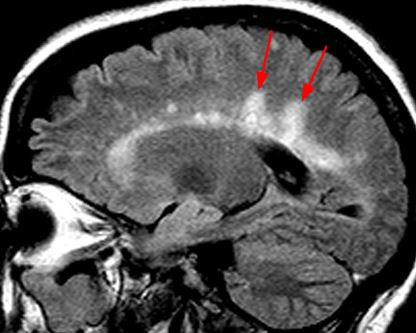
Sagittal FLAIR brain MRI illustrating periventricular demyelinating lesions, with arrows marking white-matter plaques typical of multiple sclerosis. These plaques reflect areas where myelin has been damaged, which can disrupt efficient conduction across CNS pathways and contribute to variable sensory, motor, and cognitive symptoms. Source
Multiple sclerosis (MS): An autoimmune disorder in which the immune system attacks CNS myelin, disrupting nerve signal conduction and producing varied neurological symptoms.
With MS, demyelination makes action potentials less efficient. Depending on which CNS pathways are affected, symptoms can include muscle weakness, numbness/tingling, visual problems, fatigue, balance/coordination difficulties, and cognitive changes. Symptoms often fluctuate because inflammation and damage can occur in episodes.
Why myelin damage matters for transmission
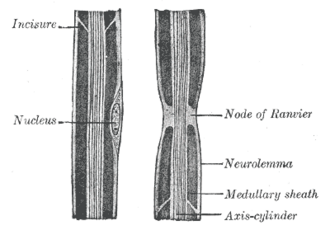
Labeled drawing of a myelinated axon segment showing the node of Ranvier (a gap between myelin segments) and adjacent sheath structures. Nodes are where action potentials are regenerated in myelinated fibers; when myelin is lost, current leaks and conduction becomes slower and less reliable. Source
Myelin normally supports rapid, energy-efficient conduction.
When myelin is lost:
Signals slow, become unreliable, or stop.
Neurons may struggle to coordinate timing across networks, affecting complex behaviour and mental processes.
The behavioural outcome depends on lesion location (e.g., motor pathways vs. sensory pathways).
Myasthenia gravis (MG): disrupted signalling to muscles
MG shows how neural transmission can be disrupted primarily at the neuromuscular junction, where motor neurons communicate with skeletal muscle fibres.
Myasthenia gravis (MG): An autoimmune disorder in which antibodies interfere with acetylcholine receptors at the neuromuscular junction, causing muscle weakness and rapid fatigue.
MG reduces the muscle’s ability to respond to the motor neuron’s signal. Because acetylcholine (ACh) is crucial for muscle contraction, blocking or reducing functional ACh receptors means that normal neural firing produces an abnormally weak muscle response.
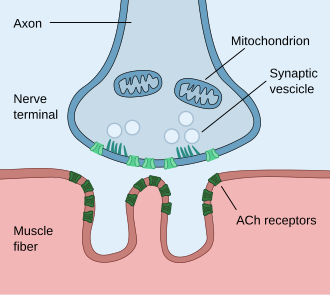
Schematic of the neuromuscular junction (NMJ), highlighting the motor neuron terminal, synaptic vesicles, and postsynaptic acetylcholine (ACh) receptors on the muscle fiber. In myasthenia gravis, antibodies reduce effective ACh receptor function, so the same presynaptic signal produces a smaller postsynaptic response and weaker muscle contraction. Source
Typical effects linked to disrupted transmission in MG
Weakness that worsens with use (fatigability), often improving with rest
Difficulty with facial/eye muscles (e.g., drooping eyelids), swallowing, speaking, or limb movement
Symptoms vary in severity depending on receptor impairment and muscle group demands
Connecting disruption to behaviour and mental processes
Disrupted neural transmission changes what the nervous system can do moment-to-moment:
Motor effects: slowed movement, weakness, poor coordination, tremors, or paralysis (depending on pathway affected)
Sensory effects: altered touch, pain, or vision due to unreliable sensory signalling
Cognitive/affective effects: attention, processing speed, and mood can shift when communication across brain networks is less efficient
Key takeaway for AP Psychology
In both MS and MG, the core mechanism is the same syllabus idea: when neural transmission is disrupted, functioning changes. MS primarily disrupts CNS conduction (often via myelin loss), while MG primarily disrupts synaptic signalling to muscle (often via receptor interference).
Practice Questions
Explain how disrupted neural transmission can lead to symptoms in multiple sclerosis. (1–3 marks)
1 mark: Identifies that MS involves damage to myelin in the CNS.
1 mark: Links myelin damage to slowed/blocked nerve impulse conduction.
1 mark: Links disrupted conduction to a symptom (e.g., weakness, numbness, coordination problems).
Compare how multiple sclerosis and myasthenia gravis disrupt neural transmission and describe one behavioural consequence of each. (4–6 marks)
1 mark: MS disrupts transmission in the CNS.
1 mark: MS mechanism described (demyelination → slowed/blocked conduction).
1 mark: Behavioural consequence of MS described (e.g., impaired coordination, sensory loss).
1 mark: MG disrupts transmission at the neuromuscular junction.
1 mark: MG mechanism described (antibodies affect ACh receptors → reduced muscle activation).
1 mark: Behavioural consequence of MG described (e.g., fatigable weakness, drooping eyelids).
FAQ
Immune activity and inflammation can fluctuate over time. When inflammation increases, signalling worsens; when it subsides, conduction may partially recover even if some damage remains.
The location of demyelination matters most. Damage in motor tracts affects movement; damage in sensory tracts affects sensation; damage in visual pathways affects vision.
Inefficient signalling can force neural systems to work harder to achieve the same output, and compensatory recruitment of additional pathways can increase overall energy demands.
Yes. Timing delays, weaker synaptic effects, or increased “noise” can degrade communication enough to impair coordination and processing speed without fully blocking signals.
Individual differences in lesion sites, severity, and the nervous system’s ability to compensate (e.g., recruiting alternate pathways) can produce distinct symptom profiles.