AP Syllabus focus:
‘Neurotransmitters can send excitatory or inhibitory messages and include dopamine, serotonin, norepinephrine, glutamate, GABA, endorphins, substance P, and acetylcholine.’
Neurotransmitters are the nervous system’s chemical messengers. AP Psychology emphasises how specific neurotransmitters influence behaviour and mental processes, including whether their effects are generally excitatory or inhibitory in neural circuits.
Core idea: chemical messages at synapses
Neurotransmitter: A chemical released from a presynaptic neuron that crosses the synaptic cleft and binds to receptors on a postsynaptic cell, changing the likelihood that the postsynaptic cell will fire.
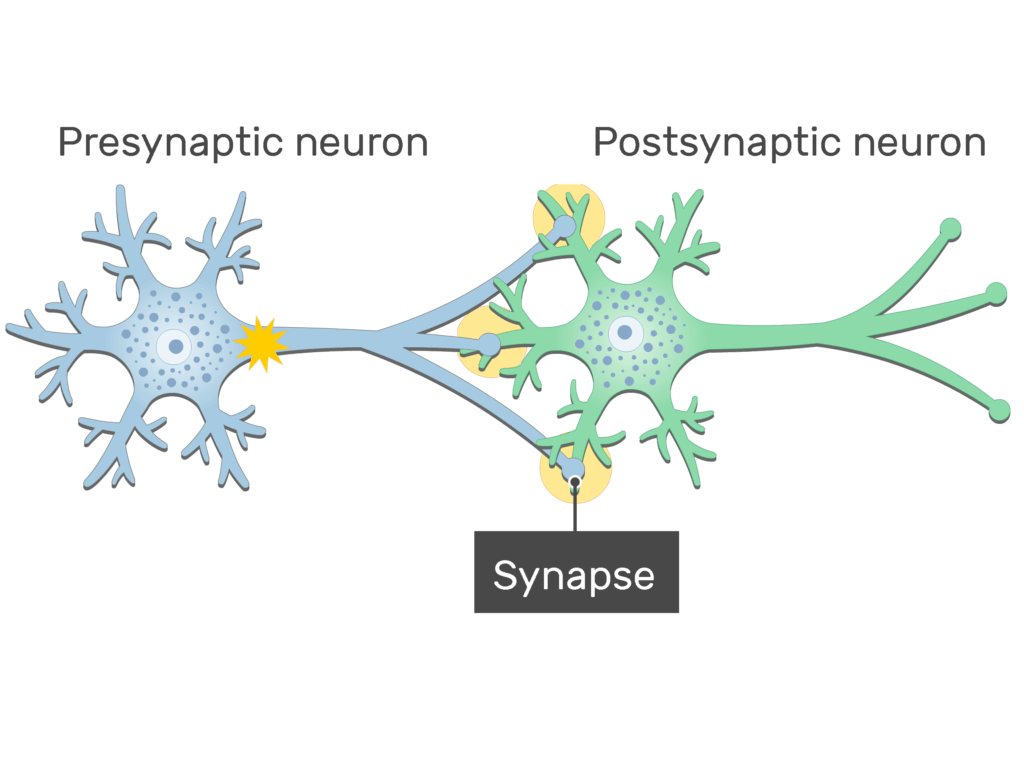
This labeled synapse diagram shows neurotransmitter-containing vesicles releasing chemical signals into the synaptic cleft, followed by binding at receptor sites on the postsynaptic membrane. It visually anchors the direction of information flow (presynaptic → postsynaptic) and highlights that receptor binding is what changes the postsynaptic cell’s likelihood of firing. Source
Neurotransmitters do not “carry thoughts” directly; instead, they alter neural signalling by changing postsynaptic activity, shaping sensation, movement, mood, and learning.
Excitatory vs inhibitory effects
What “excitatory” and “inhibitory” mean in AP Psych
Excitatory messages increase the chance the postsynaptic neuron will fire (often by promoting depolarisation).
Inhibitory messages decrease the chance the postsynaptic neuron will fire (often by promoting hyperpolarisation).
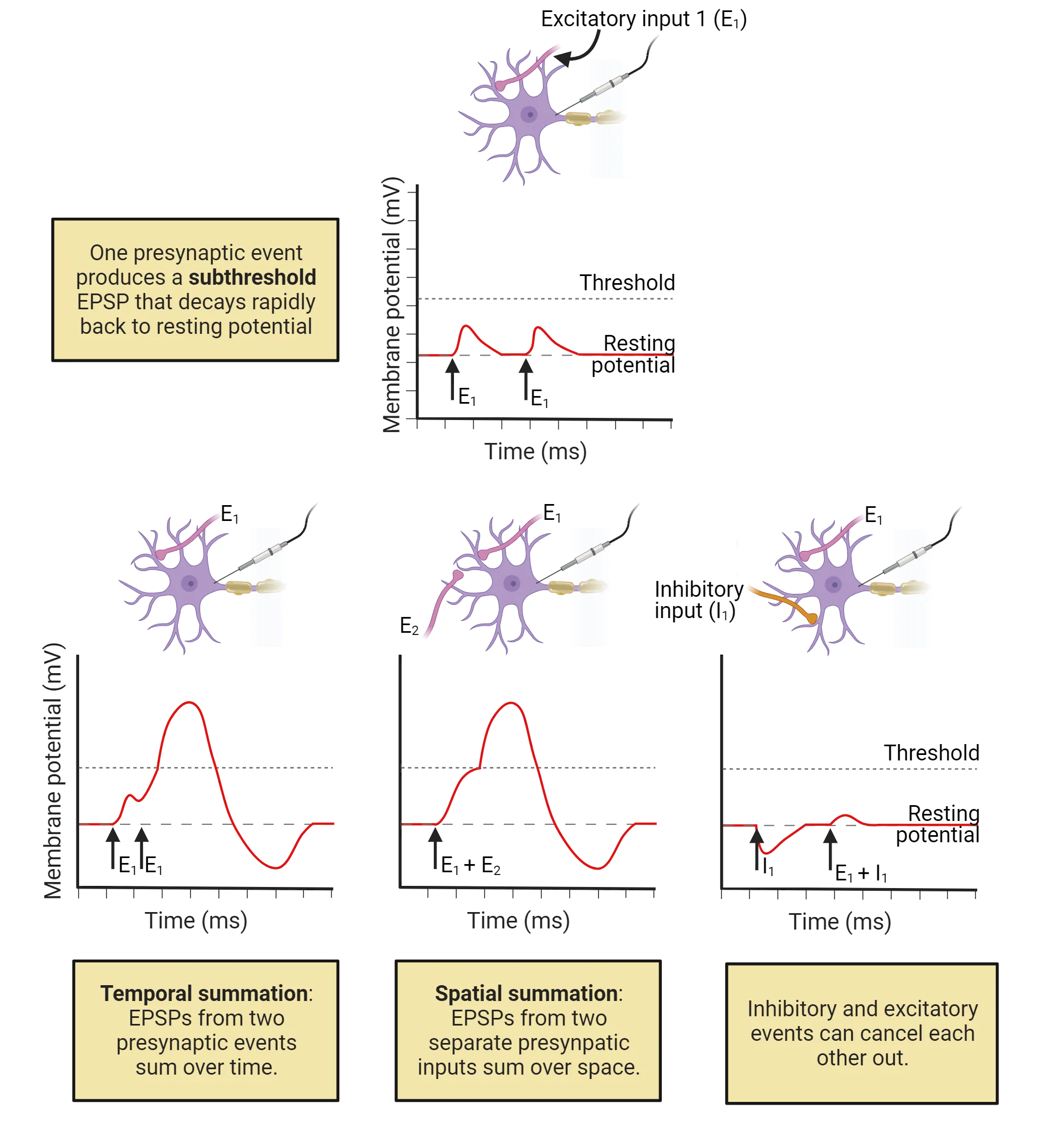
This figure contrasts excitatory postsynaptic potentials (EPSPs) and inhibitory postsynaptic potentials (IPSPs) using membrane-potential-over-time plots paired with simple neuron diagrams. It also illustrates temporal and spatial summation, showing how multiple small excitatory inputs can add together, and how inhibitory input can reduce or cancel excitation. Source
A key AP point: the same neurotransmitter can be excitatory or inhibitory depending on receptor type and the neural pathway.
Key neurotransmitters you must know
Acetylcholine (ACh)
Common roles: muscle action, learning, attention, and memory.
AP associations:
ACh-producing neuron deterioration is linked to Alzheimer’s disease.
At the neuromuscular junction, reduced effective ACh signalling can produce muscle weakness.
Dopamine
Common roles: movement, motivation, reward, and learning (especially reinforcement-related learning).
AP associations:
Undersupply in motor pathways is linked to Parkinson’s disease (tremors, decreased mobility).
Oversupply (or overactivity at certain receptors) is linked to schizophrenia-like symptoms in classic AP framing.
Serotonin
Common roles: mood regulation, sleep, and appetite.
AP associations:
Undersupply is commonly linked with depression (as a simplified exam-relevant relationship).
Because serotonin relates to sleep and appetite, dysregulation can affect both.
Norepinephrine (noradrenaline)
Common roles: alertness, arousal, and attention, especially in response to challenge.
AP associations:
Undersupply can be linked to depressed mood and reduced alertness.
Oversupply can be associated with anxiety-like hyperarousal (e.g., feeling keyed-up).
Glutamate
Primary role: the brain’s major excitatory neurotransmitter; strongly involved in learning and memory.
AP associations:
Oversupply can overstimulate the brain, contributing to migraines or seizures (via excessive excitation).
GABA (gamma-aminobutyric acid)
Primary role: the brain’s major inhibitory neurotransmitter; helps regulate neural firing and overall calm/stability in networks.
AP associations:
Undersupply is linked to seizures, tremors, and insomnia, reflecting too little inhibition.
Endorphins
Role: natural, morphine-like neurotransmitters involved in pain control and pleasure.
AP associations:
Released during stress and sometimes during vigorous exercise, helping reduce pain perception.
Low endorphin activity can be associated with increased pain sensitivity.
Substance P
Role: involved in pain perception, especially signalling that supports the experience of pain.
AP associations:
Higher activity in relevant pathways is associated with stronger pain signalling; lower activity can reduce pain transmission.
What to memorise for exam use
Neurotransmitters can send excitatory or inhibitory messages.
Know each named transmitter and its “headline” links:
ACh: muscle + memory (Alzheimer’s link)
Dopamine: movement + reward (Parkinson’s / schizophrenia links)
Serotonin: mood + sleep (depression link)
Norepinephrine: alertness/arousal (mood/anxiety links)
Glutamate: major excitatory (seizures/migraines if too much)
GABA: major inhibitory (seizures/insomnia if too little)
Endorphins: pain relief/pleasure
Substance P: pain signalling
Practice Questions
Explain the difference between an excitatory and an inhibitory neurotransmitter message. (1–3 marks)
1 mark: Excitatory messages increase likelihood of postsynaptic firing.
1 mark: Inhibitory messages decrease likelihood of postsynaptic firing.
1 mark: Correct synaptic framing (postsynaptic neuron/receptors) or mention of depolarisation vs hyperpolarisation.
Describe the roles of dopamine, serotonin, and GABA in behaviour and mental processes, including one problem associated with imbalance for each. (4–6 marks)
1 mark each (up to 3): Accurate basic role for dopamine (movement/reward), serotonin (mood/sleep/appetite), GABA (inhibition/calm).
1 mark each (up to 3): Accurate imbalance association for each (e.g., dopamine low Parkinson’s or high schizophrenia-like symptoms; serotonin low depression; GABA low seizures/insomnia/tremors).
Credit clear links between neurotransmitter, function, and effect; maximum 6 marks.
FAQ
Because postsynaptic cells express different receptor subtypes.
Some receptors open ion channels directly; others act through second-messenger systems, changing whether the net effect increases or decreases firing.
Main mechanisms include:
Reuptake into the presynaptic neuron via transporter proteins
Enzymatic breakdown in the synaptic cleft
Diffusion away from the synapse and uptake by glial cells
Ionotropic receptors are ligand-gated channels that change membrane potential quickly.
Metabotropic receptors activate $G$-proteins and intracellular cascades, producing slower, longer-lasting modulation of neuronal activity.
No.
They can be released during stress, pain, laughter, social bonding, and other intense physiological or emotional states, helping modulate pain and promote a sense of wellbeing depending on context and brain region.
Common approaches include:
PET imaging with radioligands to estimate receptor binding/availability
Indirect measures via metabolites in cerebrospinal fluid or blood (limited)
Pharmacological challenge studies that infer function from behavioural changes