AP Syllabus focus:
‘Psychoactive drugs may act as agonists, antagonists, or reuptake inhibitors to change neural firing and neurotransmitter activity.’
Psychoactive drugs influence thoughts, emotions, and behaviour by altering how neurons communicate at synapses. In AP Psychology, the emphasis is on how these drugs change neurotransmitter signalling and, in turn, neural firing patterns.
Where psychoactive drugs act in neural communication
Psychoactive drug: A chemical substance that alters perception, mood, cognition, or behaviour by changing activity in the brain.
Most psychoactive drugs affect synaptic transmission rather than “creating” new messages. They modify how strongly, how long, or how often existing neural signals occur.
Synapse: The junction where a sending neuron communicates with a receiving neuron, typically by releasing neurotransmitters into the synaptic cleft.
Common synaptic targets include:
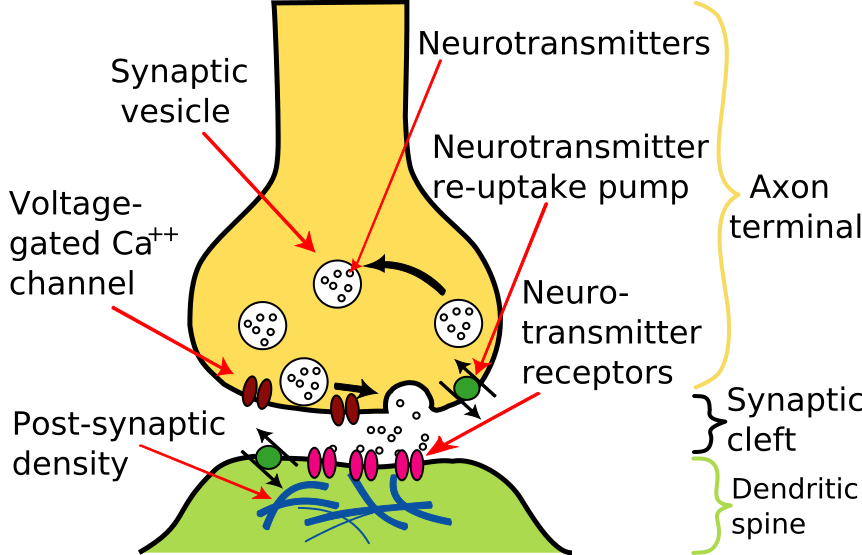
Diagram of a chemical synapse showing neurotransmitter-containing vesicles releasing into the synaptic cleft, binding to postsynaptic receptors, and being cleared. This directly maps the key “drug target” locations in synaptic transmission (release machinery, receptors, and removal processes). Source
Neurotransmitter release from the presynaptic neuron
Receptors on the postsynaptic neuron (binding sites that detect neurotransmitters)
Reuptake mechanisms that clear neurotransmitters from the synaptic cleft
Enzymatic breakdown (some drugs indirectly change how quickly neurotransmitters are degraded)
Agonists: increasing neurotransmitter effects
Agonist: A substance that increases a neurotransmitter’s action by mimicking it or boosting its availability at the synapse.
Agonists increase signalling, which can raise the probability that the postsynaptic neuron reaches threshold and fires an action potential.
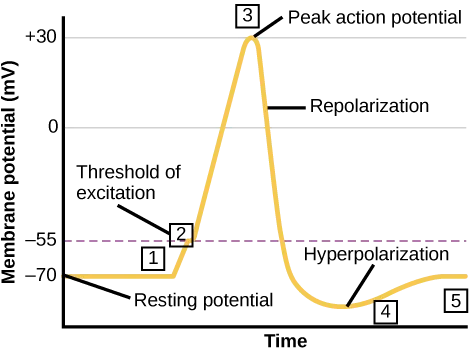
Action potential graph showing how membrane potential changes over time, including the threshold level required to trigger the spike. The labeled phases (depolarization, repolarization, and hyperpolarization) help connect synaptic excitation/inhibition to whether a neuron reaches threshold and fires. Source
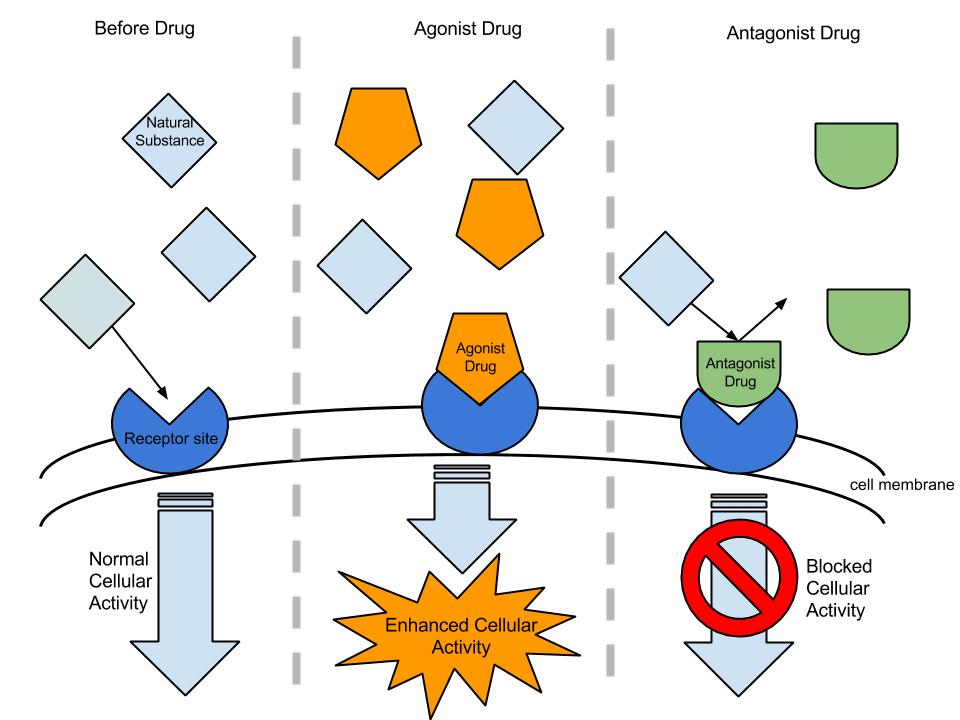
Receptor schematic contrasting an agonist (binds and activates the receptor) with an antagonist (binds without activating, preventing neurotransmitter action). This image reinforces that the core difference is receptor activation versus receptor blockade, which changes downstream postsynaptic signaling strength. Source
They can do this in multiple ways:
Mimicry: The drug binds to receptors and activates them like the neurotransmitter would.
Increased release: The drug promotes greater presynaptic release of neurotransmitter into the synaptic cleft.
Reduced clearance: The drug keeps neurotransmitters in the cleft longer by interfering with normal removal processes.
Agonist effects depend on whether the targeted neurotransmitter pathway is primarily excitatory (tends to increase firing) or inhibitory (tends to decrease firing). In either case, an agonist amplifies the pathway’s usual direction of influence.
Antagonists: decreasing neurotransmitter effects
Antagonist: A substance that decreases a neurotransmitter’s action by blocking receptors or reducing neurotransmitter availability.
Antagonists weaken synaptic signalling, often lowering the chance that the postsynaptic neuron will fire. Typical mechanisms include:
Receptor blockade: The drug binds to receptors without activating them, preventing neurotransmitters from binding effectively.
Reduced release: The drug decreases presynaptic neurotransmitter release.
Functional opposition: The drug indirectly counters a neurotransmitter’s effect by shifting signalling toward the opposite state (for example, reducing activity in a pathway that normally promotes arousal).
Because antagonists reduce effective neurotransmission, they can dampen processes linked to that neurotransmitter system (for instance, alertness, pain signalling, or motor activation), depending on the circuit involved.
Reuptake inhibitors: prolonging synaptic signalling
Reuptake inhibitor: A substance that blocks the presynaptic neuron’s reabsorption of neurotransmitters, increasing their presence in the synaptic cleft.
Reuptake is a major “off switch” for many neurotransmitters. When reuptake is inhibited:
Neurotransmitters remain available in the synaptic cleft longer
Receptors are stimulated for a longer duration
Postsynaptic effects are prolonged, altering ongoing patterns of neural firing
Reuptake inhibition does not necessarily increase the amount released initially; it primarily increases duration and effective concentration of neurotransmitter signalling in the cleft.
How these drug actions change neural firing
Drugs influence whether neurons fire more or less by shifting the balance of excitation and inhibition in neural networks:
If synaptic inputs become more excitatory overall, neurons are more likely to reach threshold and fire.
If synaptic inputs become more inhibitory overall, neurons are less likely to reach threshold and fire.
Many psychoactive effects reflect changes across entire circuits (multiple synapses), not a single neuron-to-neuron connection.
The same drug mechanism (agonist, antagonist, reuptake inhibitor) can produce different behavioural outcomes depending on:
Which neurotransmitter system is targeted
Where in the brain the affected synapses are located
The baseline level of activity in that pathway (state-dependent effects)
Limits of simple labels (agonist vs antagonist)
Although the agonist/antagonist framework is essential for AP Psychology, real drug effects can involve combinations of actions:
A drug may act like an agonist at one receptor type but an antagonist at another.
A drug may change signalling indirectly by altering presynaptic release while also affecting receptor responsiveness.
Net effects on behaviour depend on how altered neurotransmitter activity changes firing across connected neural networks.
Practice Questions
Explain what is meant by a reuptake inhibitor and how it affects neurotransmitter activity at the synapse. (2 marks)
1 mark: Defines reuptake inhibitor as blocking presynaptic reabsorption/transport of neurotransmitter.
1 mark: Explains it increases neurotransmitter presence in synaptic cleft and prolongs receptor stimulation/neural signalling.
Describe how psychoactive drugs can act as agonists and antagonists, and explain how each can change neural firing. (6 marks)
1 mark: Agonist defined as increasing neurotransmitter action (mimics or increases availability).
1 mark: Antagonist defined as decreasing neurotransmitter action (blocks receptors or reduces availability).
1 mark: Agonists can mimic neurotransmitter by binding to and activating receptors.
1 mark: Antagonists can block receptors, preventing neurotransmitter binding/activation.
1 mark: Links agonist action to increased/decreased likelihood of firing depending on excitatory vs inhibitory pathway (must reference threshold/firing likelihood).
1 mark: Links antagonist action to reduced synaptic effect and reduced/increased likelihood of firing depending on excitatory vs inhibitory pathway.
FAQ
Only certain molecules cross the blood–brain barrier efficiently.
Key factors include:
Lipid solubility (more lipid-soluble drugs cross more easily)
Molecular size
Transport proteins that move substances in or out of the brain
This is why some drugs have strong central effects while others mostly act in the body.
A partial agonist activates a receptor but produces a smaller effect than the neurotransmitter (or a full agonist).
In practice, it can:
Increase signalling when natural neurotransmitter levels are low
Decrease overall signalling by occupying receptors when neurotransmitter levels are high
So it may stabilise activity rather than simply increasing it.
Neurotransmitters act on multiple receptor subtypes in different brain regions.
Different drugs may:
Prefer different receptor subtypes
Reach different regions at different concentrations
Activate or block receptors with different strengths
So “affects serotonin” (for example) does not guarantee the same behavioural outcome.
Transporter blockers mainly prolong signalling by keeping neurotransmitters in the synaptic cleft longer.
Release-promoters increase the amount entering the synaptic cleft in the first place.
These differences can change:
Timing (onset/offset)
Intensity of synaptic effects
Patterns of downstream neural activation
Time course depends on:
Route of administration (inhaled/injected/oral)
Distribution to the brain and receptor binding speed
Metabolism (often liver enzymes) and excretion
Whether the drug or its metabolites remain active
Faster onset is often associated with a stronger immediate subjective effect, but duration depends heavily on metabolism.