AP Syllabus focus:
‘The brain stem, including the medulla, generally controls basic functions such as breathing and heart rate.’
The brain stem sits at the base of the brain and keeps the body alive by running automatic functions. In AP Psychology, it’s emphasized as the control center for vital survival processes.
Core idea: survival functions first
The brain stem is the most evolutionarily old region of the brain and serves as a “life-support” system.

Sagittal-view diagram of the human brainstem highlighting the midbrain, pons, medulla oblongata, and spinal cord. Use it to anchor where the medulla sits within the brain stem before linking that location to breathing and heart-rate regulation. Source
It links the spinal cord to higher brain areas and continuously regulates basic bodily states without conscious effort.
Brain stem: The base of the brain (including structures such as the medulla) that supports basic life functions and relays information between the brain and spinal cord.
The medulla’s key role
The medulla (medulla oblongata) is the brain-stem structure most directly tied to the syllabus emphasis on breathing and heart rate. It contains networks that help maintain steady internal conditions by adjusting the body’s output moment-to-moment.
Medulla: A brain-stem structure that regulates vital autonomic functions, especially breathing and cardiovascular activity (e.g., heart rate).
Breathing control (automatic regulation)
Breathing is usually automatic, meaning you do not need to think about each breath.
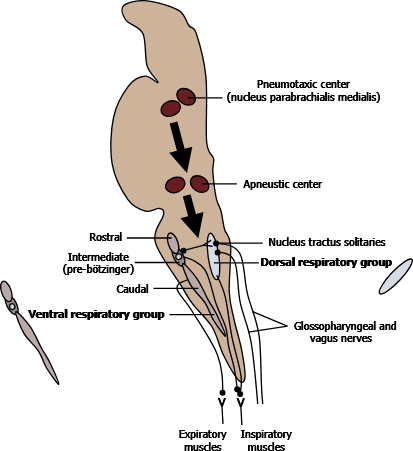
Schematic of the brainstem respiratory network showing how pontine centers interact with medullary respiratory groups (e.g., dorsal and ventral respiratory groups) to shape the breathing rhythm. This helps connect the AP-level idea (“automatic breathing”) to the underlying control architecture that generates and adjusts the pattern over time. Source
The medulla helps:
Maintain a baseline breathing rhythm
Adjust breathing rate in response to internal demands (e.g., increased need for oxygen)
Coordinate breathing-related muscle patterns so inhalation and exhalation are smooth and continuous
Although you can voluntarily hold your breath briefly, medulla-driven control is powerful and typically overrides conscious control when survival is at risk.
Heart rate and blood pressure (cardiovascular regulation)
The medulla supports cardiovascular stability by helping regulate:
Heart rate (speeding up or slowing down the heartbeat as needed)
Blood vessel tone (constriction vs. dilation), which influences blood pressure
Rapid adjustments during changes such as standing up, exertion, or acute stress
This regulation is essential for keeping oxygenated blood flowing to the brain and other organs.
Other brain-stem functions (within the “basic functions” theme)
Beyond breathing and heart rate, the brain stem contributes to other automatic processes that protect survival, such as:
Swallowing and gagging coordination
Coughing and sneezing reflex patterns
Vomiting responses that protect against toxins
These functions are “low-level” in the sense that they are fast, automatic, and necessary for maintaining life.
Why damage is so serious
Because the brain stem governs vital functions, damage can be catastrophic. Injury or disruption affecting the medulla may lead to:
Dangerous breathing irregularities or respiratory failure
Severe heart-rate and blood-pressure instability
Loss of protective reflexes that prevent choking or aspiration
In AP Psychology terms, this is why the brain stem is often described as essential for basic functions such as breathing and heart rate, and why it is strongly associated with survival.
Practice Questions
State two basic functions generally controlled by the brain stem (including the medulla). (1–3 marks)
Breathing (1)
Heart rate / cardiovascular regulation (1)
Explain why damage to the medulla can be life-threatening. Refer to at least two functions in your answer. (4–6 marks)
Identifies the medulla as part of the brain stem (1)
Explains its role in breathing regulation (1)
Links breathing disruption to risk of respiratory failure / inadequate oxygenation (1)
Explains its role in heart rate and/or blood pressure regulation (1)
Links cardiovascular disruption to organ/brain oxygen shortage or collapse (1)
Uses clear causal explanation of life-threatening consequences (1)
FAQ
It influences cardiac activity through brain-stem control pathways that alter signals travelling via autonomic nerves.
This shifts the balance of inputs that speed up or slow down the heart, depending on the body’s needs.
Specialised neuron clusters in the medulla help generate rhythmic respiratory patterns.
Different subcircuits contribute to timing, transitions between inhalation/exhalation, and adapting the rhythm to metabolic demands.
Voluntary control from higher brain areas can temporarily override automatic rhythms.
As $CO_2$ rises and blood chemistry changes, automatic brain-stem drive becomes harder to suppress, limiting breath-holding.
Many protective reflex patterns rely on brain-stem circuitry that rapidly coordinates muscles in the throat, chest, and airways.
This design prioritises speed and reliability over conscious decision-making.
Examples include strokes affecting brain-stem blood supply, traumatic brain injury, and conditions causing swelling that compresses the brain stem.
Because vital control centres are densely packed, small lesions can have severe effects.