AP Syllabus focus:
‘The parietal lobes process touch and organize information, while the frontal lobes support language, higher-order thinking, executive functioning, and motor control.’
The parietal and frontal lobes sit behind and in front of the brain’s central fissure, respectively.
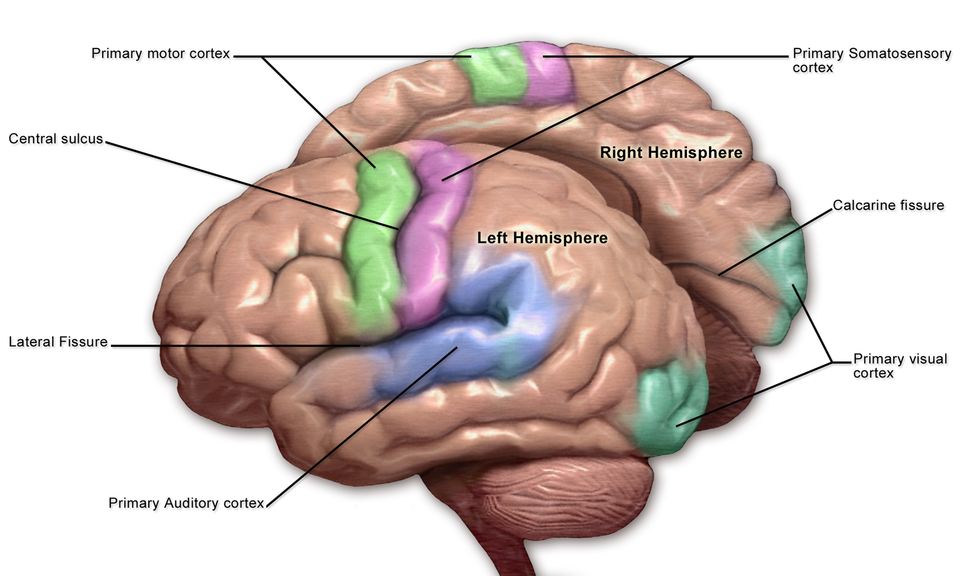
This diagram locates the primary somatosensory cortex (postcentral gyrus) and primary motor cortex (precentral gyrus) on opposite sides of the central sulcus. It visually anchors the idea that parietal regions specialize in incoming body sensation, while frontal regions specialize in initiating voluntary movement. The labeled lobes also help connect these functional roles to their broader cortical locations. Source
Together they support how you sense the body, organize incoming information, plan actions, and control voluntary movement and speech.
Where these lobes are
Parietal lobes: upper rear region of the cerebral cortex, just behind the frontal lobes.
Frontal lobes: front region of the cerebral cortex, extending back to the central fissure.
Parietal lobes: processing touch and organising information
The parietal lobes are central to somatosensation (touch-based input) and to integrating sensations into coherent perceptions, especially for guiding attention and action.
Somatosensation: The perception of bodily sensations such as touch, pressure, temperature, and pain, arising from receptors in skin, muscles, and joints.
Primary somatosensory cortex (touch processing)
Located on the postcentral gyrus of each parietal lobe, the primary somatosensory cortex processes incoming touch information from the body.
Inputs are typically contralateral (left parietal receives more from the right side of the body, and vice versa).
Different body regions occupy different amounts of cortical space, reflecting sensitivity (e.g., hands and lips take up more area than the back).
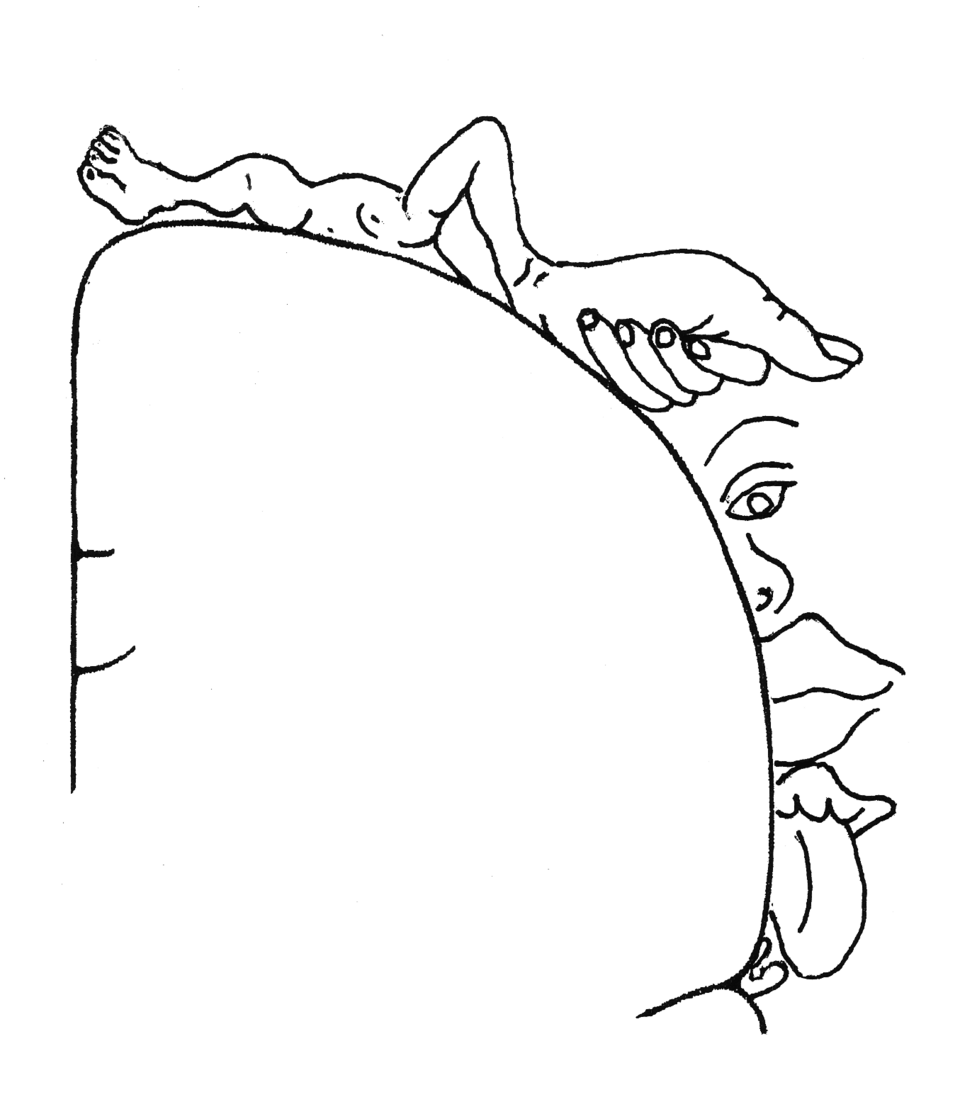
This sensory homunculus depicts the somatotopic map in the primary somatosensory cortex, where adjacent body areas are represented in an ordered way. The exaggerated hands, lips, and face illustrate that cortical “real estate” reflects receptor density and tactile acuity rather than physical body size. Use it to remember why fine-touch regions dominate the somatosensory strip. Source
Organising information (integration and spatial organisation)
Beyond basic touch detection, parietal regions help organize information by combining sensory signals and mapping them to the body and nearby space.
Integration: combining touch with visual and proprioceptive-like cues to support coordinated behaviour (e.g., reaching accurately).
Spatial attention: prioritising what to process in the environment; damage can disrupt what a person notices and responds to.
Interpretation of sensory input: supporting recognition of objects by feel and keeping track of where stimuli occur on the body.
Association areas: Regions of the cerebral cortex that integrate and interpret information rather than directly processing basic sensory input or producing primary motor output.
Frontal lobes: language, higher-order thinking, executive functioning, and motor control
The frontal lobes help convert goals into behaviour: deciding what matters, selecting responses, inhibiting impulses, and initiating voluntary movement.
Motor control (primary motor cortex)
The primary motor cortex sits on the precentral gyrus in the frontal lobe and controls voluntary movement.
Control is generally contralateral (left motor cortex controls right-side movements).
Fine motor areas (hands, face) take up disproportionate cortical space due to precision demands.
Damage can impair initiation, coordination, or strength of voluntary actions, depending on the site and extent.
Executive functioning (planning and self-control)
A major portion of the frontal lobes, especially the prefrontal cortex, supports executive functioning—the set of control processes that manage thoughts and actions when pursuing goals.
Inhibition: resisting impulses and delaying gratification.
Working with rules: maintaining task goals, switching strategies, and monitoring errors.
Judgement and decision-making: weighing outcomes, risk, and context.
Personality and social behaviour: regulating emotional expression and behaviour to match situational norms.
Higher-order thinking (reasoning and problem solving)
Frontal networks contribute to higher-order thinking, including:
abstract reasoning and mental flexibility
prioritising information and sustaining attention
organising behaviour over time (sequencing steps toward a goal)
Language in the frontal lobes (speech production)
Frontal regions support language, particularly speech production (commonly linked to Broca’s area in many individuals).
When frontal language regions are disrupted, speech may become slow, effortful, or grammatically simplified, while comprehension can be relatively stronger than production.
Practice Questions
Explain one role of the parietal lobes in behaviour. (2 marks)
1 mark: Identifies a correct parietal function (e.g., processing touch / organising sensory information).
1 mark: Links it to behaviour (e.g., recognising objects by touch, locating touch on the body, guiding reaching).
A patient has difficulty planning tasks, inhibiting rude comments, and initiating voluntary movements with their right hand. Using knowledge of the frontal lobes, explain these difficulties. (6 marks)
1 mark: Links planning/goal management to frontal lobe function (executive functioning).
1 mark: Explains inhibition/impulse control as a prefrontal function.
1 mark: Mentions the primary motor cortex as responsible for voluntary movement.
1 mark: Notes contralateral control (left frontal motor regions affect right-hand movement).
1 mark: Applies to the scenario (rude comments = reduced social regulation; task planning impaired).
1 mark: Applies to the scenario (right-hand initiation difficulty indicates left frontal/motor involvement).
FAQ
They help allocate attention to locations on the body and in nearby space.
Damage can bias attention away from one side, making grooming, eating, or navigating less accurate.
Cortical space reflects functional demand, not physical size.
Areas requiring fine discrimination or precise control recruit more neurons, producing greater representation.
They are a set of related control processes.
Commonly discussed components include inhibition, cognitive flexibility, planning, and monitoring performance.
The precentral gyrus is primarily motor output (frontal lobe).
The postcentral gyrus is primarily touch input (parietal lobe).
Standard tests may miss real-world regulation demands.
Frontal damage can especially disrupt social judgement, motivation, and impulse control—features that shape personality and daily functioning.