AP Syllabus focus:
‘Split-brain studies use contralateral visual-field presentation to test hemispheric specialization; language is usually left-lateralized in Broca's and Wernicke's areas, and damage can cause aphasia.’
Split-brain research provides some of the clearest evidence that the two cerebral hemispheres specialise in different functions. In AP Psychology, it is mainly used to demonstrate contralateral processing and language lateralisation.
Split-brain research: what it tests
Split-brain findings come primarily from people who have had the corpus callosum (major fibre tract connecting the hemispheres) severed, which reduces direct information sharing between hemispheres.
Split-brain patient: a person whose corpus callosum has been cut or is nonfunctional, limiting communication between the left and right cerebral hemispheres.
With limited interhemispheric transfer, researchers can present information to one hemisphere at a time and observe what that hemisphere can do independently.
Contralateral visual-field presentation
A key method in split-brain studies is contralateral visual-field presentation, which relies on the fact that each hemisphere initially receives visual input from the opposite (contralateral) visual field.
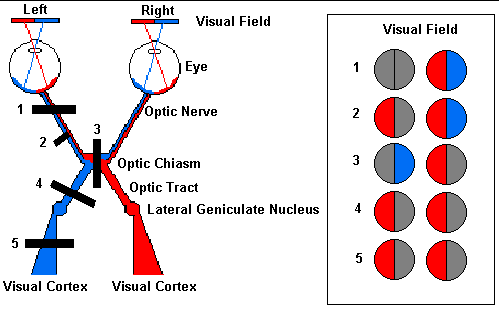
This diagram traces visual information from each eye through the optic chiasm and into the left vs. right visual cortex. It makes the contralateral mapping explicit: stimuli in the right visual field project to the left hemisphere, and stimuli in the left visual field project to the right hemisphere. This is the anatomical logic that lets split-brain experiments “isolate” one hemisphere by briefly presenting stimuli to one visual field. Source
Stimuli shown to the right visual field are first processed by the left hemisphere
Stimuli shown to the left visual field are first processed by the right hemisphere
In split-brain patients, the hemisphere that first receives the information may not be able to send it to the other hemisphere for verbal report or integrated response
What “hemispheric specialization” looks like
When the hemispheres cannot easily share information, behaviour can reveal distinct capacities.
Common patterns researchers test for include:
Verbal reporting versus nonverbal responding (e.g., pointing, selecting an object)
Differences in how the hemispheres handle language-like versus spatial/visual information
Evidence that the hemispheres can initiate partly independent responses when presented with competing information
Language lateralization in split-brain research
The syllabus emphasis is that language is usually left-lateralized, meaning the left hemisphere is more specialised for producing and comprehending speech in most people.
In contralateral visual-field tasks, this often appears as:
Information delivered to the right visual field (left hemisphere) can be named or described more easily
Information delivered to the left visual field (right hemisphere) may be harder to name aloud, even when the person can show awareness through a nonverbal response (for example, selecting a matching object)
Broca’s area and Wernicke’s area
Two classic left-hemisphere language areas are central to AP Psychology explanations of lateralisation:
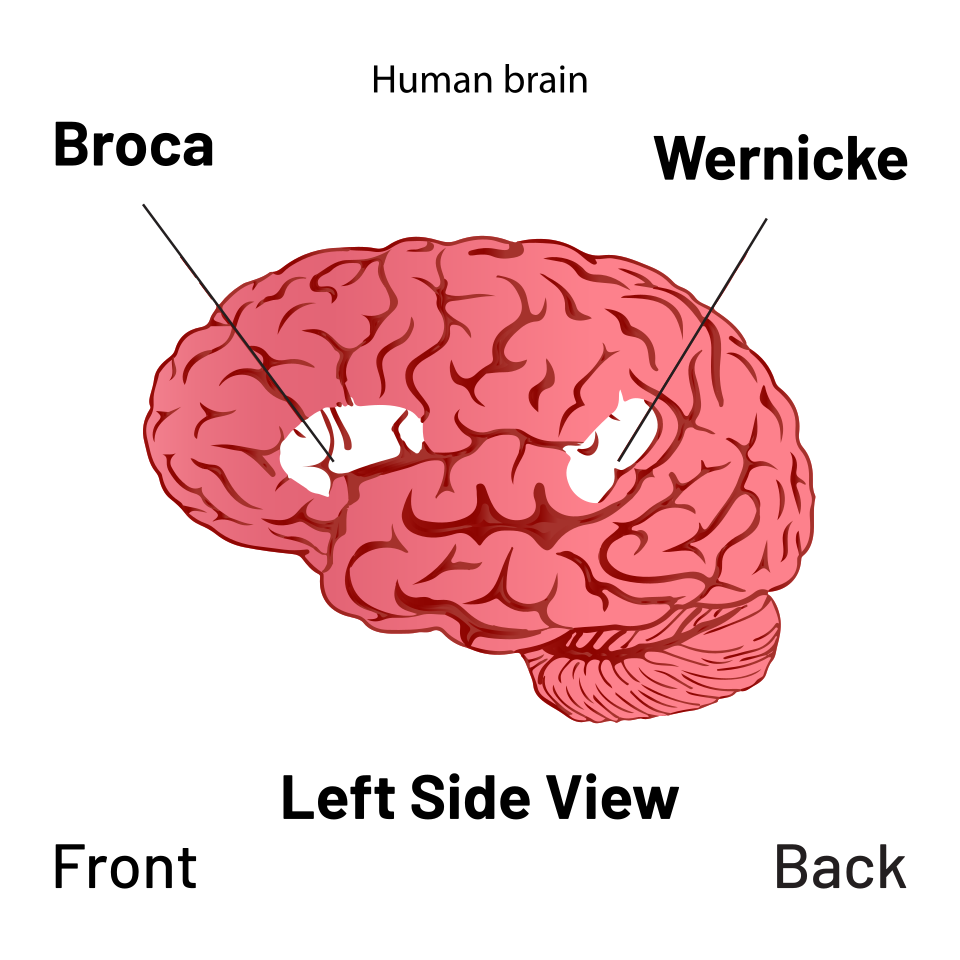
This labeled lateral-brain diagram locates Broca’s area (linked to speech production) and Wernicke’s area (linked to language comprehension) in the left hemisphere. By visually separating these regions, the figure reinforces the idea that “language” is not a single brain module but a set of specialized components. It also helps connect lesion location to different aphasia profiles (expressive vs. receptive impairments). Source
Broca’s area (typically left frontal lobe): strongly associated with speech production and fluent language output
Wernicke’s area (typically left temporal lobe): strongly associated with language comprehension and meaningful language processing
Damage to either area can disrupt language in different ways, supporting the idea that language is not only left-lateralised, but also functionally specialised within the left hemisphere.
Aphasia as evidence of lateralisation
The specification highlights that damage to these language areas can cause aphasia, a language impairment that can affect production, comprehension, or both.
Aphasia: impairment of language ability (speaking, understanding, reading, and/or writing) caused by brain damage, often in left-hemisphere language regions.
Aphasias are useful evidence for lateralisation because they show that injury to particular (often left-hemisphere) regions produces predictable language deficits, rather than general loss of intelligence or motivation.
What split-brain research can and cannot show
Split-brain studies are powerful because they provide relatively direct behavioural evidence that the hemispheres can process information differently when communication is reduced.
At the same time, interpretation should be careful:
Hemispheric specialisation is usually a matter of degree, not an absolute “one side only” rule
Findings depend on how information is presented (especially ensuring it reaches only one visual field at first)
“Usually left-lateralised” allows for individual variation, but the AP focus remains the typical pattern involving Broca’s and Wernicke’s areas and aphasia following damage
Practice Questions
Explain how contralateral visual-field presentation is used in split-brain research to test hemispheric specialisation. (2 marks)
1 mark: States that information in one visual field is processed first by the opposite hemisphere (left visual field → right hemisphere; right visual field → left hemisphere).
1 mark: Explains that in split-brain patients reduced communication means responses reveal what the receiving hemisphere can do independently (e.g., verbal report vs nonverbal selection).
Discuss what split-brain research suggests about language lateralisation, including reference to Broca’s area, Wernicke’s area, and aphasia. (6 marks)
1 mark: States that language is usually left-lateralised.
1 mark: Links contralateral visual-field input to language performance (right visual field/left hemisphere tends to support naming).
1 mark: Identifies Broca’s area as primarily involved in speech production.
1 mark: Identifies Wernicke’s area as primarily involved in language comprehension.
1 mark: Defines aphasia as a language impairment due to brain damage.
1 mark: Explains that damage to left-hemisphere language areas causing aphasia supports lateralisation/specialisation rather than a general deficit.
FAQ
They use very brief presentations and fixation controls so participants keep their gaze centred.
Common controls include:
Instructing fixation on a central point
Monitoring eye movements
Discarding trials where fixation is lost
True split-brain disconnection is rare, so samples are limited.
This means:
Rich, detailed individual data are possible
Generalising requires caution because individuals can differ in baseline abilities and outcomes
Often yes, but the degree of lateralisation can vary with factors such as age of acquisition and proficiency.
Some bilinguals show more distributed activation across hemispheres for certain language tasks, depending on the method and language demands.
Prosody is often more right-hemisphere supported than literal word meaning.
This can lead to dissociations where a person understands words but struggles with emotional tone (or vice versa), depending on the neural systems affected.
Key issues include informed consent, privacy, and avoiding overinterpretation.
Researchers must:
Ensure participants understand tasks and risks
Protect sensitive medical information
Present findings without stigmatising language about ability or identity