AP Syllabus focus:
‘The reticular activating system and reward center influence alertness, eye movement, some voluntary movement, and some learning, cognition, and emotion.’
These structures help explain why the brain can rapidly shift between sleepiness and focus, and why some experiences feel rewarding enough to repeat. In AP Psychology, they connect arousal, attention, motivation, and reinforcement.
Reticular Activating System (RAS)
What it is and where it acts
The reticular activating system (RAS) is a functional network within the brain stem that regulates cortical arousal.
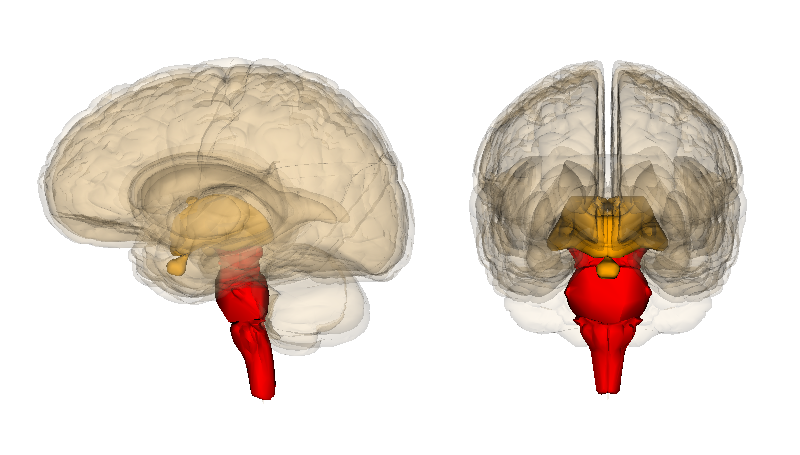
Labeled midsagittal brain image identifying major brainstem divisions (midbrain, pons, medulla) and helping locate where brainstem-based arousal networks reside. This context image is useful for connecting the RAS concept to concrete neuroanatomical landmarks before you move into pathway-level details. Source
It is often discussed as part of the broader reticular formation, which runs through the core of the brain stem and communicates with higher brain regions to control alertness.
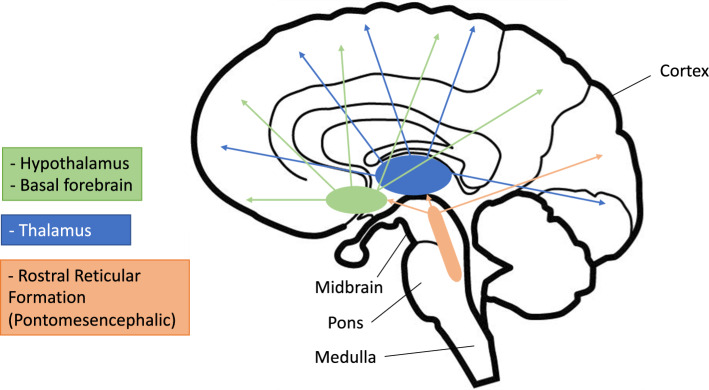
Schematic diagram of the reticular activating system (RAS) showing its brainstem origins and key ascending routes through the thalamus and hypothalamus/basal forebrain to broadly activate the cerebral cortex. This visual reinforces how the RAS supports global cortical arousal (wakefulness/alertness) by modulating thalamocortical and forebrain pathways. Source
Reticular activating system (RAS): A brain-stem network that screens incoming sensory information and controls arousal/alertness by activating the cerebral cortex.
Core functions emphasised in AP Psychology
The RAS helps explain the syllabus point that it influences alertness and some learning, cognition, and emotion:
Alertness and arousal
Promotes wakefulness and mental readiness (e.g., shifting from drowsy to attentive)
Helps sustain attention by increasing overall cortical activation
Selective attention (“filtering”)
Screens repetitive or low-priority sensory input to reduce overload
Flags salient or novel stimuli (e.g., a sudden loud sound) to increase arousal
Learning, cognition, and emotion (indirectly)
By regulating arousal, the RAS changes how effectively the cortex can process, encode, and respond to information
Arousal level can influence emotional reactivity and cognitive performance (too low or too high can impair focus)
Eye movement and motor-related roles
The syllabus also highlights eye movement and some voluntary movement. In AP Psychology terms, the RAS is linked to:
Eye movement control and visual orienting
Supports rapid shifts in attention that coordinate with eye movements (e.g., orienting toward a stimulus)
Some voluntary movement (via brain-stem motor coordination pathways)
Helps set overall readiness for movement and responsiveness, rather than “planning” complex actions
What disruption can look like
Because the RAS is central to arousal, disruption can produce severe changes in consciousness:
Damage or suppression can contribute to coma-like states (very low arousal)
Depressing RAS activity is one mechanism by which general anaesthesia reduces consciousness
Reward Center
What “reward center” means in AP Psychology
The reward center refers to a set of interconnected brain regions that create the subjective feeling of reward and drive reinforcement. Many AP Psychology courses emphasise dopamine-based pathways, especially connections involving the ventral tegmental area (VTA) and nucleus accumbens.
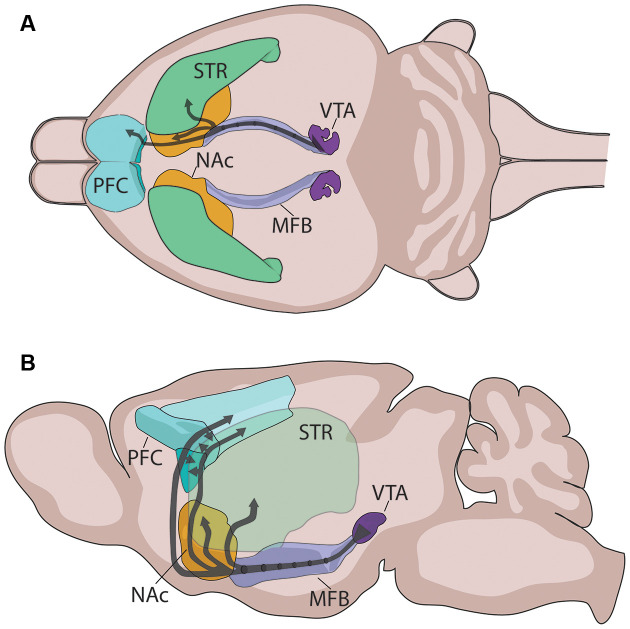
Diagram of the mesocorticolimbic dopamine pathway, highlighting dopaminergic cell bodies in the VTA and projections traveling via the medial forebrain bundle to the nucleus accumbens (NAc) and prefrontal cortex (PFC). It helps link “reward” to a specific circuit architecture that supports reinforcement learning, motivation, and value-based decision-making. Source
Reward center: A network of brain regions (often involving dopamine pathways such as VTA → nucleus accumbens) that reinforces behaviour by producing feelings of pleasure, motivation, and “wanting.”
A key chemical messenger in this system is dopamine, which is strongly associated with reinforcement and motivated behaviour.
Functions tied to the syllabus wording
The reward center supports the syllabus claim that it affects some learning, cognition, and emotion:
Learning (reinforcement)
Strengthens behaviours followed by rewarding outcomes, making them more likely to recur
Helps form associations between cues and rewards (reward prediction)
Cognition (decision-making and motivation)
Biases attention and effort toward high-value goals
Supports prioritising behaviours that previously produced reward
Emotion (positive affect and incentive salience)
Contributes to pleasure and excitement
Can amplify emotional responses to reward-related cues
Reward, repetition, and risk
Activation of reward circuitry increases the likelihood of repetition:
Natural rewards (food, social approval) can reinforce adaptive behaviours
Strong artificial activation (e.g., via highly reinforcing experiences) can promote compulsive patterns by over-prioritising reward seeking relative to long-term goals
Practice Questions
Outline one function of the reticular activating system (RAS) and one function of the brain’s reward centre. (2 marks)
1 mark: Correct function of RAS (e.g., regulates arousal/alertness; filters sensory input to maintain attention; supports wakefulness).
1 mark: Correct function of reward centre (e.g., reinforces behaviour via dopamine pathways; increases motivation/‘wanting’; produces feelings of reward/pleasure that promote repetition).
Explain how the reticular activating system and the reward centre can jointly influence learning and attention. Use clear psychological terminology. (6 marks)
1 mark: RAS described as controlling arousal/alertness (cortical activation).
1 mark: RAS described as filtering/selection of sensory information (selective attention).
1 mark: Reward centre described as reinforcing behaviour (reward-based learning).
1 mark: Reference to dopamine pathway involvement in reward/reinforcement.
1 mark: Links arousal/attention to improved (or impaired) cognitive processing/learning (e.g., sufficient arousal supports encoding).
1 mark: Integrates both systems (e.g., reward cues increase salience/attention while RAS supports alertness needed to learn the association).
FAQ
It is best understood as a network within the brain stem rather than one discrete “nucleus”.
Different components contribute to arousal and attentional filtering through widespread connections to the cortex.
Reward circuitry can assign incentive value to cues, producing motivation to seek outcomes.
This cue-driven “wanting” can be partially separable from moment-to-moment pleasure, depending on which pathways are most active.
Common approaches include neuroimaging during reward tasks and comparing responses to gains, losses, and predictive cues.
Researchers often examine how activity changes with expectation, uncertainty, and reinforcement history.
Yes—reward-related cues can influence attention and choice even when processed quickly or with limited awareness.
This is often tested using brief presentations of cues and measuring subsequent preferences or reaction times.
Yes. Baseline arousal and reward sensitivity vary across people due to genetic, developmental, and experiential factors.
Differences can appear as stronger cue-reactivity, higher novelty seeking, or needing more stimulation to feel engaged.