AP Syllabus focus:
‘The cerebellum generally controls coordination of muscle movement, balance, and some forms of procedural learning.’
The cerebellum is essential for smooth, well-timed movement and stable posture. In AP Psychology, it is also a key brain structure for building certain automatic skills through procedural learning.
Core idea: what the cerebellum does
The cerebellum (Latin for “little brain”) sits at the back of the brain, underneath the occipital lobes.
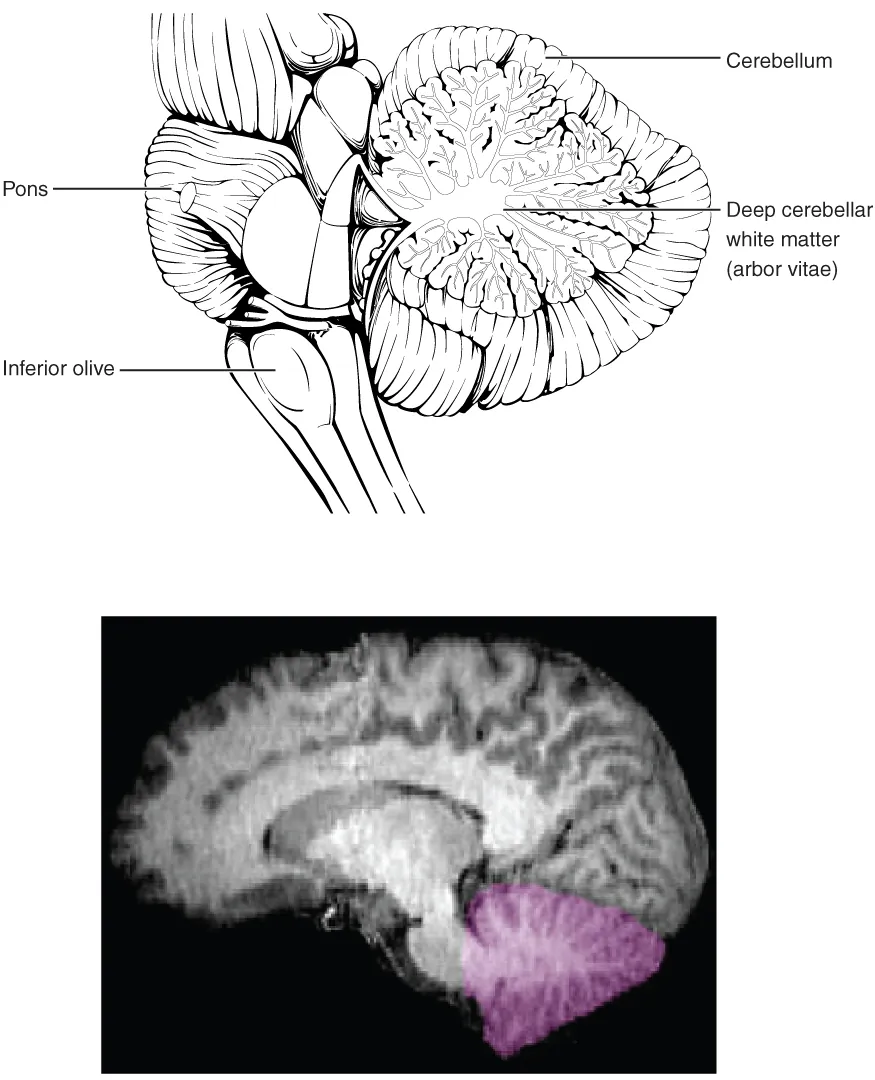
Labeled lateral view showing the cerebellum’s position on the posterior brainstem (with the pons and inferior olive labeled) and the cerebellar white matter (arbor vitae). This kind of orientation diagram helps you connect the cerebellum’s anatomy to its role in continuously refining motor commands using incoming sensory feedback. Source
Cerebellum: A hindbrain structure that fine-tunes and coordinates movement, helps maintain balance and posture, and supports learning of some motor skills.
Rather than initiating most movements, the cerebellum improves their precision and timing by continuously comparing intended actions with actual performance.
Coordination of muscle movement
Coordinated movement requires many muscles to activate in the correct sequence, with the right force, and at the right time. The cerebellum supports this by:
Integrating sensory feedback (e.g., information from vision and body position) with motor commands
Smoothing motor output so actions are fluid rather than jerky
Calibrating force and timing (e.g., reaching, writing, speaking clearly)
Supporting error correction, adjusting movements when outcomes differ from the goal
A helpful way to frame this is that the cerebellum helps movements become automatic and efficient with practice, freeing attention for other tasks.
Balance and posture
Balance depends on keeping the body’s centre of mass controlled as you stand, walk, or turn. The cerebellum contributes by:
Coordinating reflex-like adjustments in trunk and limb muscles
Using ongoing sensory inputs to stabilise the body when conditions change (e.g., uneven ground)
Supporting postural control, so movements do not destabilise you
When cerebellar function is compromised, people often show problems maintaining steady posture or coordinating rapid changes in movement.
Cerebellum and procedural learning
Procedural learning is learning “how” to do something through repetition, often without being able to fully verbalise the rule system behind it.
Procedural learning: Long-term learning of skills and habits through practice, leading to actions that can be performed automatically (e.g., motor skills).
Between early practice and skilled performance, behaviour often shifts from attention-demanding to automatic. The cerebellum helps build and refine these motor routines by gradually improving timing and reducing errors across repeated attempts.
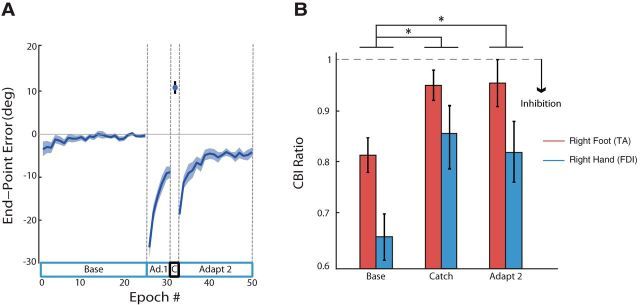
Graph of end-point movement error across trials, showing a jump in error when a visuomotor perturbation is introduced followed by gradual error reduction with practice (adaptation), plus characteristic changes during catch trials. It visually models cerebellum-linked procedural learning as an iterative, feedback-driven calibration process that makes performance smoother and more accurate over repeated attempts. Source
What “some forms” means (AP emphasis)
In AP Psychology, the cerebellum is most strongly linked to motor-based procedural learning, such as:
Learning and refining sports movements (e.g., a tennis serve)
Developing hand–eye coordination skills (e.g., typing accuracy and rhythm)
Improving speech motor patterns (e.g., fluent articulation)
Not every learned behaviour is cerebellum-dependent; the AP focus is that the cerebellum is especially important when learning requires precise timing and coordination.
Evidence you should be able to describe
Students should be able to connect cerebellar function to observable behaviour:
Practice effects: repeated performance becomes smoother and more consistent as cerebellar circuits fine-tune the action.
Cerebellar damage: can impair coordination and balance and can make it harder to learn or perfect certain motor skills, even when motivation and basic strength are intact.
Common outcomes of cerebellar disruption (behavioural signs)
Cerebellar impairment does not usually eliminate the desire to move; it typically degrades movement quality. Signs often include:
Ataxia: uncoordinated movement (e.g., staggering gait, clumsy reaching)
Intention tremor: shaking that worsens during goal-directed movement
Difficulty with rapid alternating movements (poor motor timing)
Balance instability, especially when sensory conditions change
These patterns fit the AP claim that the cerebellum “generally controls coordination of muscle movement, balance, and some forms of procedural learning,” because disruption most clearly affects those domains.
Practice Questions
Describe one role of the cerebellum in behaviour. (2 marks)
1 mark: Identifies a correct role (e.g., coordination of movement, balance, posture, or motor skill learning).
1 mark: Provides accurate description linked to behaviour (e.g., smooth timing of movements; maintaining stability while walking).
Explain how cerebellar functioning can contribute to learning a new motor skill, and describe what might happen if the cerebellum is damaged. (6 marks)
1 mark: Links cerebellum to coordination/timing of muscle activity.
1 mark: Explains use of feedback/error correction to refine movements with practice.
1 mark: Connects this refinement to procedural learning/automaticity.
1 mark: Predicts a balance/posture problem from damage.
1 mark: Predicts impaired coordination (e.g., ataxia, jerky movements) from damage.
1 mark: Applies to motor skill learning (e.g., slower improvement, less precision despite practice).
FAQ
Many accounts emphasise cerebellar error signals and synaptic plasticity (e.g., long-term depression at Purkinje cell synapses) that gradually recalibrate motor output across repetitions.
Alcohol can depress cerebellar processing, producing poor balance, widened gait, and slowed correction of movement errors, which resemble transient ataxia-like effects.
Research suggests cerebellar networks can contribute to some cognitive timing and prediction processes, sometimes described as “cerebellar cognitive affective” involvement, though this is beyond core AP emphasis.
The cerebellum matures over a long period; improvements in balance and fine motor control across childhood are consistent with ongoing refinement of cerebellar circuits.
Functional methods (e.g., fMRI) can show cerebellar activation during motor adaptation tasks, while structural imaging can link reduced cerebellar volume to coordination difficulties.