AP Syllabus focus:
‘The cerebral cortex has two hemispheres and includes the limbic system, corpus callosum, and the lobes of the cortex.’
The cerebral cortex is the brain’s outer layer responsible for complex information processing. Understanding how its hemispheres coordinate, and how the limbic system shapes emotion and memory, is essential for linking brain structure to behaviour.
Cerebral Cortex: Structure and Organisation
Cerebral cortex: the folded outer layer of the cerebrum that supports higher mental functions, including perception, cognition, and voluntary action.
The cortex is highly convoluted (gyri and sulci), increasing surface area and neural capacity. It is organised into specialised regions that process different kinds of information, while working in coordinated networks.
Lobes of the Cortex (High-Utility Overview)
The cortex is commonly divided into four lobes in each hemisphere:
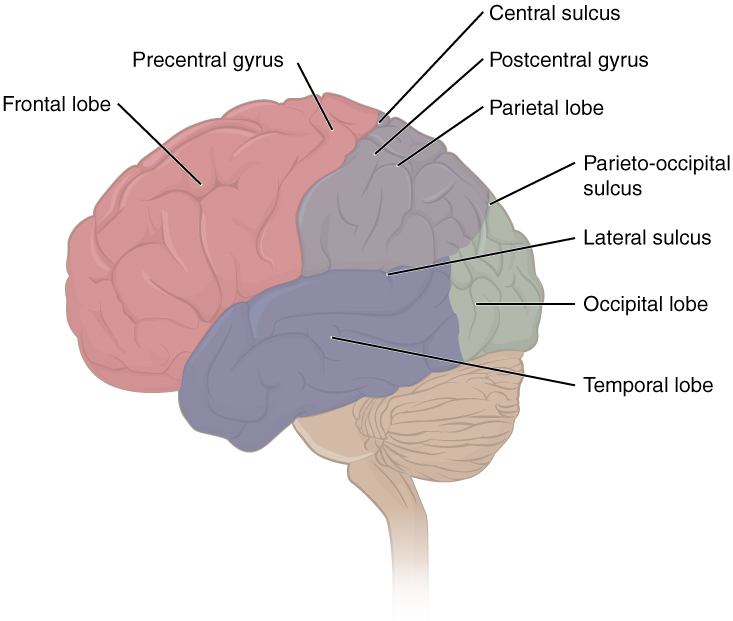
This labeled lateral-view diagram shows how the cerebral cortex is subdivided into the frontal, parietal, temporal, and occipital lobes. It also marks major boundaries (e.g., the central sulcus) that separate motor-related and sensory-related cortical regions, reinforcing the idea of functional specialization within a continuous cortical sheet. Source
Frontal lobe
Parietal lobe
Temporal lobe
Occipital lobe
AP Psychology expects you to recognise that lobes reflect functional specialisation and that many behaviours depend on distributed processing across multiple regions.
Hemispheres of the Cerebral Cortex
Hemispheres: the left and right halves of the cerebral cortex that show partial specialisation but typically work together as an integrated system.
Although the hemispheres can show lateralisation (some functions are more dominant in one hemisphere), most everyday tasks require both hemispheres and continuous communication.
Contralateral Control and Integration
A key organisational feature is contralateral processing:
The left hemisphere primarily controls and receives sensory input from the right side of the body/visual field.
The right hemisphere primarily controls and receives sensory input from the left side.
This contralateral pattern helps explain why damage to one hemisphere can affect sensation or movement on the opposite side, while leaving other capacities relatively intact.
Corpus Callosum: Connecting the Hemispheres
Corpus callosum: a thick bundle of nerve fibres that connects the left and right hemispheres, enabling interhemispheric communication.
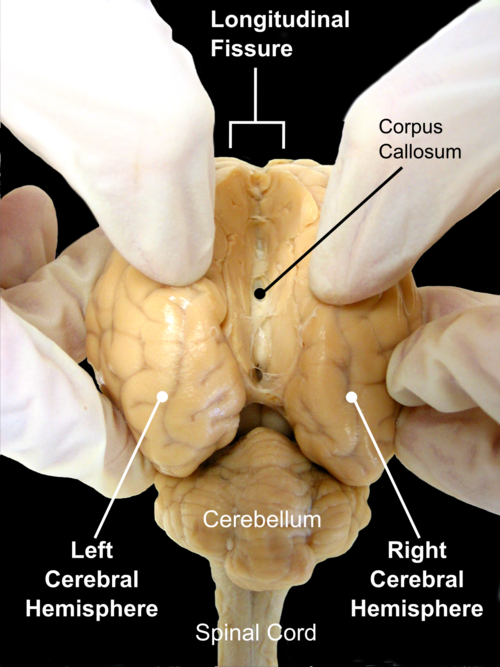
This labeled dissection image highlights the corpus callosum as a prominent white-matter bridge between the left and right cerebral hemispheres. Seeing the structure in situ helps connect the concept of “interhemispheric communication” to a concrete anatomical landmark rather than an abstract pathway. Source
The corpus callosum supports:
Coordination of perception and movement across both sides of the body
Sharing information between specialised cortical areas in each hemisphere
A unified experience of the world despite partial hemispheric specialisation
Without efficient communication, tasks that require integrating different types of information (e.g., language with spatial context) can be slower or disrupted.
Limbic System: Emotion, Motivation, and Memory
Limbic system: a set of interconnected brain structures involved in emotion, motivation, and memory formation.
The limbic system sits beneath cortical areas and interacts closely with them, shaping how we assign emotional significance and how strongly experiences are encoded into memory.
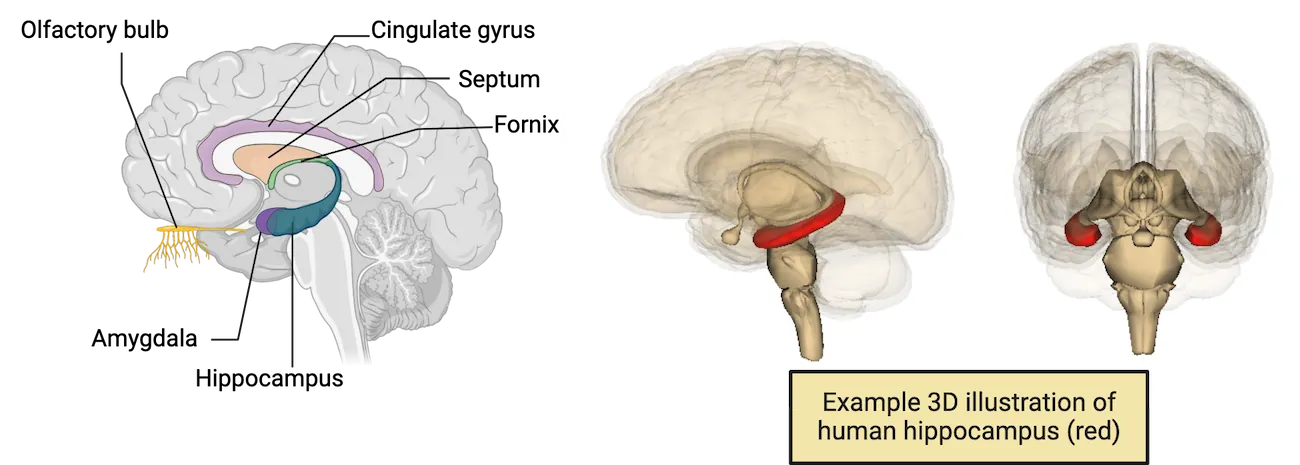
This figure depicts the limbic system beneath the cerebral cortex and includes a 3D highlight of the bilateral hippocampi. It provides a spatial map for where key emotion–memory structures sit relative to the cortex, supporting the idea that emotion and memory processes are deeply integrated with higher cortical processing. Source
Core Limbic Structures (Commonly Tested)
Amygdala: supports processing of emotion, especially fear and threat-related cues, and influences emotional learning.
Hippocampus: crucial for forming and organising new explicit memories (facts and events) for long-term storage.
Hypothalamus: regulates drives and internal states (e.g., hunger, thirst) and helps coordinate motivated behaviour.
Cortex–Limbic Interaction
Cortical regions contribute to interpretation and regulation of emotional responses, while limbic activity can bias:
Attention (what stands out as important)
Decision-making (approach/avoid tendencies)
Memory strength (emotionally charged events are often remembered more vividly)
These interactions show why behaviour is rarely “purely cognitive” or “purely emotional”: the cerebral cortex and limbic system operate as linked systems that jointly shape thoughts, feelings, and actions.
Practice Questions
Describe the role of the corpus callosum in the cerebral cortex. (3 marks)
1 mark: Identifies that the corpus callosum connects the left and right hemispheres.
1 mark: Explains it enables communication/information transfer between hemispheres.
1 mark: Applies to integrated functioning (e.g., coordinating perception and action across both sides).
Explain how the cerebral cortex’s hemispheres and the limbic system can work together to influence behaviour. (6 marks)
1 mark: States that the cortex is divided into two hemispheres with partial specialisation.
1 mark: Describes contralateral organisation (each hemisphere primarily processes the opposite side).
1 mark: Explains the corpus callosum enables interhemispheric integration.
1 mark: Identifies the limbic system as involved in emotion/motivation/memory.
1 mark: Correctly describes one limbic structure (amygdala or hippocampus or hypothalamus) and its role.
1 mark: Explains interaction: emotional/motivational signals from limbic structures influence attention/decisions/memory while cortical processing can interpret/regulate responses.
FAQ
It myelinates across childhood/adolescence, improving speed of interhemispheric signalling. This supports better coordination on tasks requiring bilateral integration, such as complex bimanual motor skills.
Yes. Lateralisation varies with handedness, development, and task demands. Many abilities show graded dominance rather than strict “left vs right” separation.
The limbic system is a network. Individual structures (e.g., amygdala, hippocampus) have distinct roles, but behaviour emerges from their interaction with each other and with cortical circuits.
High arousal can prioritise central details via limbic modulation, but it may reduce encoding of peripheral information by narrowing attention and shifting cognitive resources.
They consider connectivity, shared functions (emotion/motivation/memory), and evidence from lesion, stimulation, and imaging studies—recognising boundaries are theory-dependent rather than absolute.