AP Syllabus focus:
‘Rods detect shape and movement in low light, and color vision is explained by trichromatic and opponent-process theories involving cones and ganglion cells.’
Vision begins when light is transduced into neural signals by retinal photoreceptors.
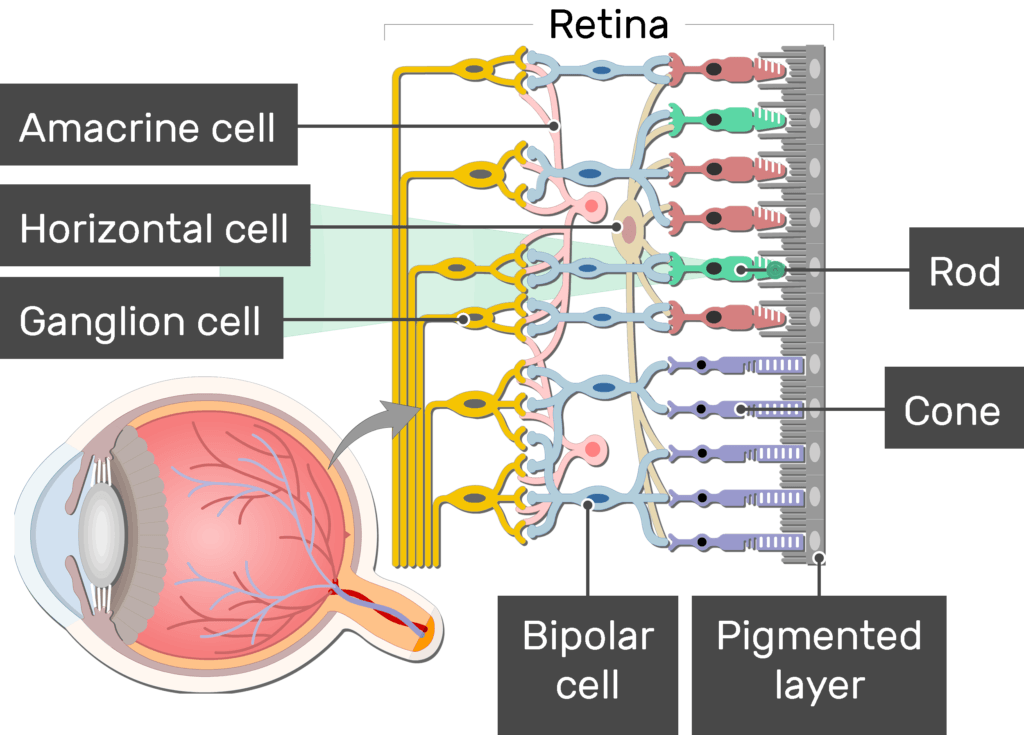
Labeled schematic of the retina showing how rods and cones pass signals through bipolar cells to ganglion cells (the retina’s output neurons), with horizontal and amacrine cells providing lateral interactions. This helps connect “photoreceptors transduce light” to the idea that later retinal stages integrate and reshape those signals before they leave the eye via ganglion-cell axons. Source
AP Psychology emphasizes how rods and cones differ, and how trichromatic and opponent-process theories explain color perception.
Photoreceptors: rods vs. cones
Photoreceptors convert (transduce) light energy into neural activity that can be processed by the visual system.
Rods: Retinal photoreceptors specialised for low-light sensitivity; they support shape, movement, and peripheral vision but provide little detail and no colour.
Rods are highly light-sensitive, making them crucial in dim conditions, but their output is relatively coarse.
Cones: Retinal photoreceptors specialised for colour vision and fine detail; they function best in bright light and support high-acuity vision.
Cones are less sensitive than rods, but they provide sharper spatial information and are the basis of colour experience.
What rods are best at (shape and movement in low light)
Dim illumination (scotopic vision): rods respond when light levels are too low for cones to function well.
Motion detection: rods are effective at signalling changes over time, supporting sensitivity to movement.
Broad spatial sampling: rod pathways tend to prioritise sensitivity over detail, helping detect forms and edges rather than fine texture.
What cones are best at (colour and detail in good light)
Bright illumination (photopic vision): cones require more light to respond strongly.
High acuity: cones support sharp perception of contours and small features.
Colour coding: cones come in different types, each tuned to different wavelengths of light, enabling comparison-based colour perception.
Trichromatic theory (Young–Helmholtz): colour from three cone types
Trichromatic theory proposes that colour perception begins with three kinds of cones, each most responsive to a different portion of the visible spectrum (often summarised as short-, medium-, and long-wavelength sensitivity).
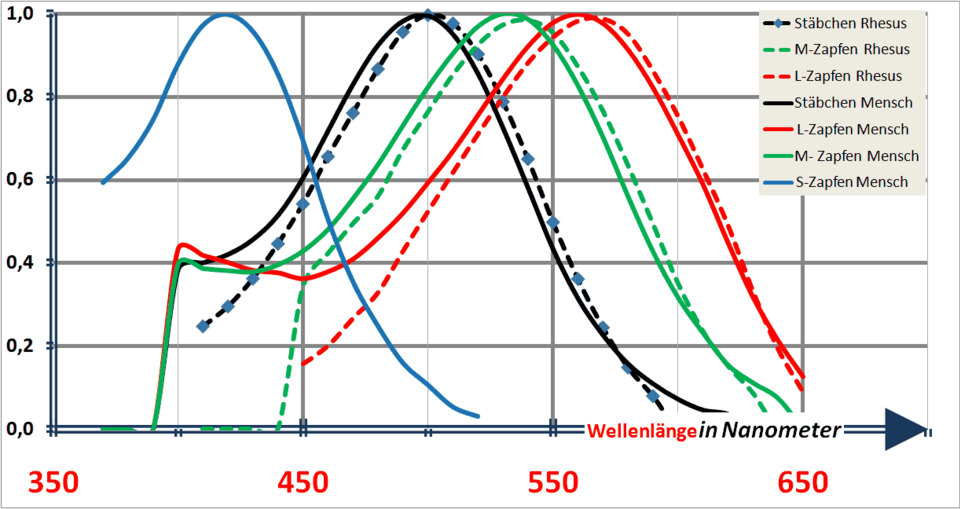
Spectral absorbance curves for rod photopigment and the three cone classes, illustrating why trichromatic theory starts with three cone types that respond best to different wavelength ranges. The overlap between curves visually reinforces the notes’ point that perceived color depends on patterns of relative activity across cones—not a one-to-one “wavelength label.” Source
The brain infers colour by comparing the relative activity across these cone types.
A given wavelength does not “label” a colour by itself; instead, perceived colour reflects the pattern of cone activation.
This helps explain why many colours can be produced by mixing a small set of primary lights: different mixtures can create similar cone-activity patterns.
Opponent-process theory: colour as opposing pairs
Opponent-process theory proposes that colour is encoded in opposing channels, which makes certain colour combinations psychologically “impossible” (e.g., reddish-green) and explains aftereffects.
Opponent-process theory: A theory of colour vision proposing that the visual system processes colour through opponent pairs (commonly red–green, blue–yellow, and black–white), where activation of one member inhibits the other.
Role of ganglion cells in opponent processing
Opponent coding is closely associated with retinal output pathways that compare signals before sending information onward.
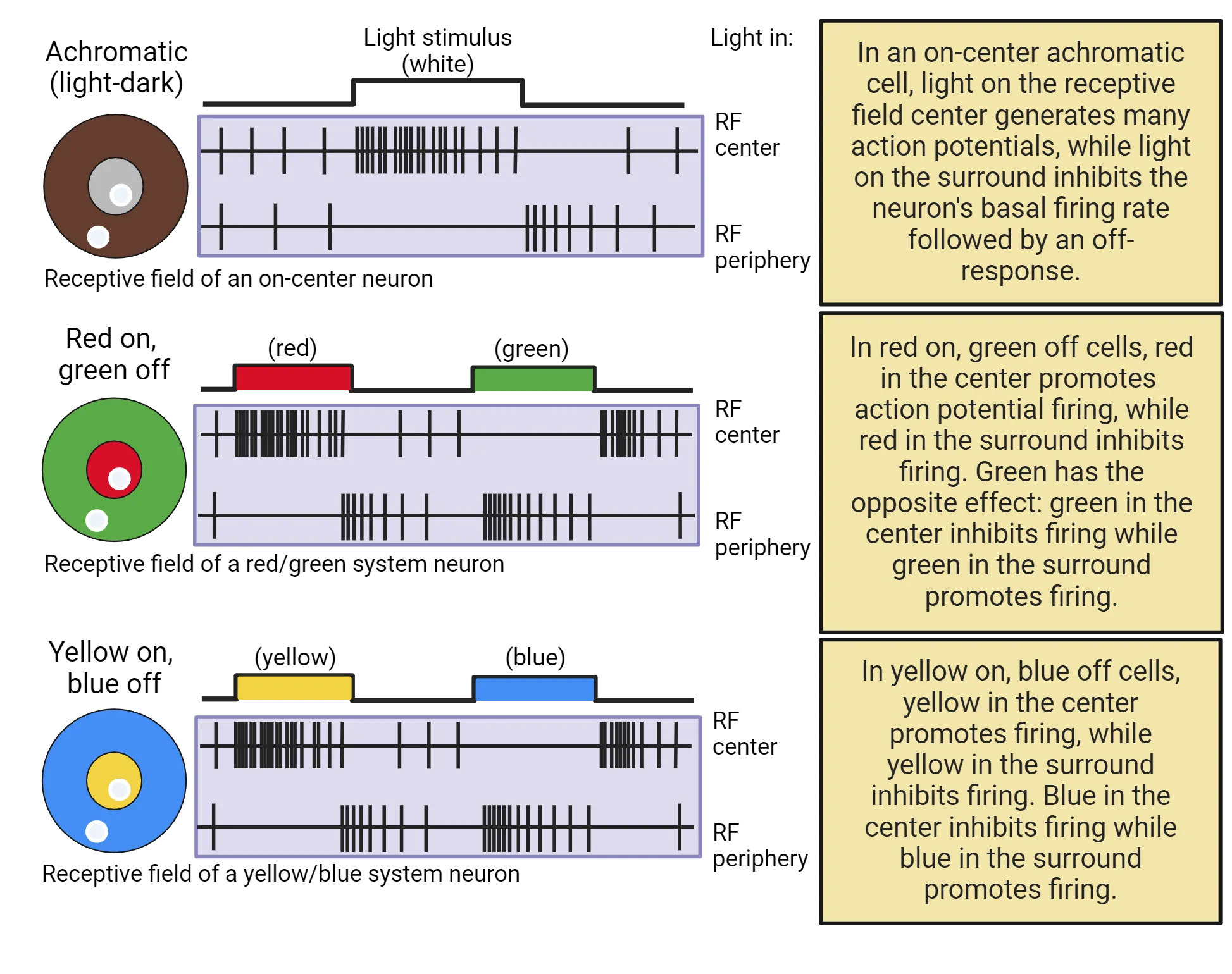
Diagram of achromatic and color-opponent ganglion-cell receptive fields (e.g., red-on/green-off and yellow-on/blue-off) alongside example spike trains. It makes the key opponent-process idea concrete: increasing activity for one pole of a channel is paired with suppression of the opponent pole, supporting contrast and explaining classic aftereffects.
Ganglion cells: Retinal neurons whose axons form the output of the retina; they integrate photoreceptor-driven input and transmit visual information in patterns (including opponent signals).
In opponent channels:
Increased activity in one direction of the channel (e.g., “red”) suppresses the paired direction (e.g., “green”).
This organisation supports efficient signalling of contrast (both luminance and chromatic), which is central to perceiving boundaries and stable colour relationships.
How the two theories fit together
The theories are best understood as describing different levels of processing:
Trichromatic theory: explains initial encoding at the cone level (three cone classes).
Opponent-process theory: explains later comparisons that organise colour into opponent channels, prominently involving ganglion-cell circuitry.
Together they account for core AP Psychology ideas: rods specialise in shape and movement in low light, while colour perception depends on cones and is explained by both trichromatic and opponent-process mechanisms.
Practice Questions
Outline one difference between rods and cones. (2 marks)
Rods are specialised for low-light sensitivity and support shape/movement (1).
Cones are specialised for colour and fine detail in brighter light (1).
Describe how trichromatic and opponent-process theories explain colour perception, referring to cones and ganglion cells. (6 marks)
Trichromatic theory: three cone types respond to different wavelengths; colour comes from relative cone activity (2).
Opponent-process theory: colour encoded in opposing pairs (e.g., red–green, blue–yellow; plus black–white) (2).
Ganglion cells transmit/organise opponent signals by comparing inputs (inhibitory opposition) (2).
FAQ
Peripheral retina typically has a higher proportion of rods, which are more sensitive in dim light. In low illumination, rod-dominated regions detect faint shapes and movement more effectively than cone-dominated regions.
Dark adaptation is the gradual improvement in sensitivity after entering darkness. Key contributors include photopigment “regeneration” after light exposure and shifts toward rod-dominant signalling as cones become less informative.
Metamerism occurs when different wavelength mixtures produce the same cone-activation pattern, so they look identical. This is why different light spectra can appear as the same “colour” to human observers.
Rarely, genetic variation can produce an additional cone photopigment (often discussed as tetrachromacy). Whether it yields noticeably richer colour perception depends on neural wiring that can use the extra signal.
Displays use small red, green, and blue emitters. By varying their intensities, they create cone-activation ratios that the visual system interprets as different colours, consistent with trichromatic coding.