AP Syllabus focus:
‘Smell, taste, and touch rely on body and brain structures; smell bypasses the thalamus first, pheromones send chemical messages, taste includes six basic qualities, receptor differences affect sensitivity, and smell shapes flavor.’
Chemical senses (smell and taste) convert molecules into neural signals that influence perception, emotion, and behavior. Touch converts physical contact into brain activity, with receptor differences shaping sensitivity across the body and cortex.
Chemical Senses: Smell (Olfaction)
Olfaction: The sense of smell; the detection of airborne chemicals by receptors in the nasal cavity that send signals to the brain.
How smell is detected and transduced
Odorants (airborne molecules) enter the nasal cavity and dissolve in mucus.
They bind to olfactory receptor neurons in the olfactory epithelium.
Receptors transduce chemical binding into neural activity that travels along the olfactory nerve to the brain.
Smell and the brain: “bypasses the thalamus first”
A key AP Psychology emphasis is that smell has an atypical routing compared with many other senses:
Signals reach the olfactory bulb and then project to primary olfactory regions without first relaying through the thalamus.
This distinctive pathway helps explain why smells can feel immediate and strongly tied to affect and memory, due to close connections with limbic structures (commonly including the amygdala and hippocampal regions).
Pheromones: chemical messages
Pheromones are chemicals released by an organism that can influence the behavior or physiology of other members of the same species.
In many animals, pheromones play clear roles in mating, territoriality, and social signaling.
In humans, pheromone effects are debated; AP-level understanding focuses on the concept that chemical cues can function as social signals, even if specific mechanisms and effect sizes may be uncertain.
Pheromones: Chemical signals released by an organism that can affect the behaviour or physiology of other organisms of the same species.
Chemical Senses: Taste (Gustation)
Gustation: The sense of taste; the detection of dissolved chemicals by receptors in taste buds that send signals to the brain.
The six basic taste qualities
AP Psychology commonly treats taste as having six basic qualities:
Sweet
Sour
Salty
Bitter
Umami (savory)
Fat (sometimes called oleogustus in research contexts)
These qualities reflect different receptor mechanisms and help the body evaluate potential nutrients and toxins (for example, bitterness often signals possible toxicity).
Taste structures and pathway
Receptors are located in taste buds, clustered within papillae on the tongue (and also found in parts of the palate and throat).
Taste information travels via cranial nerves to the brainstem, then typically relays through the thalamus to gustatory cortex (often described in/near the insula and frontal operculum).
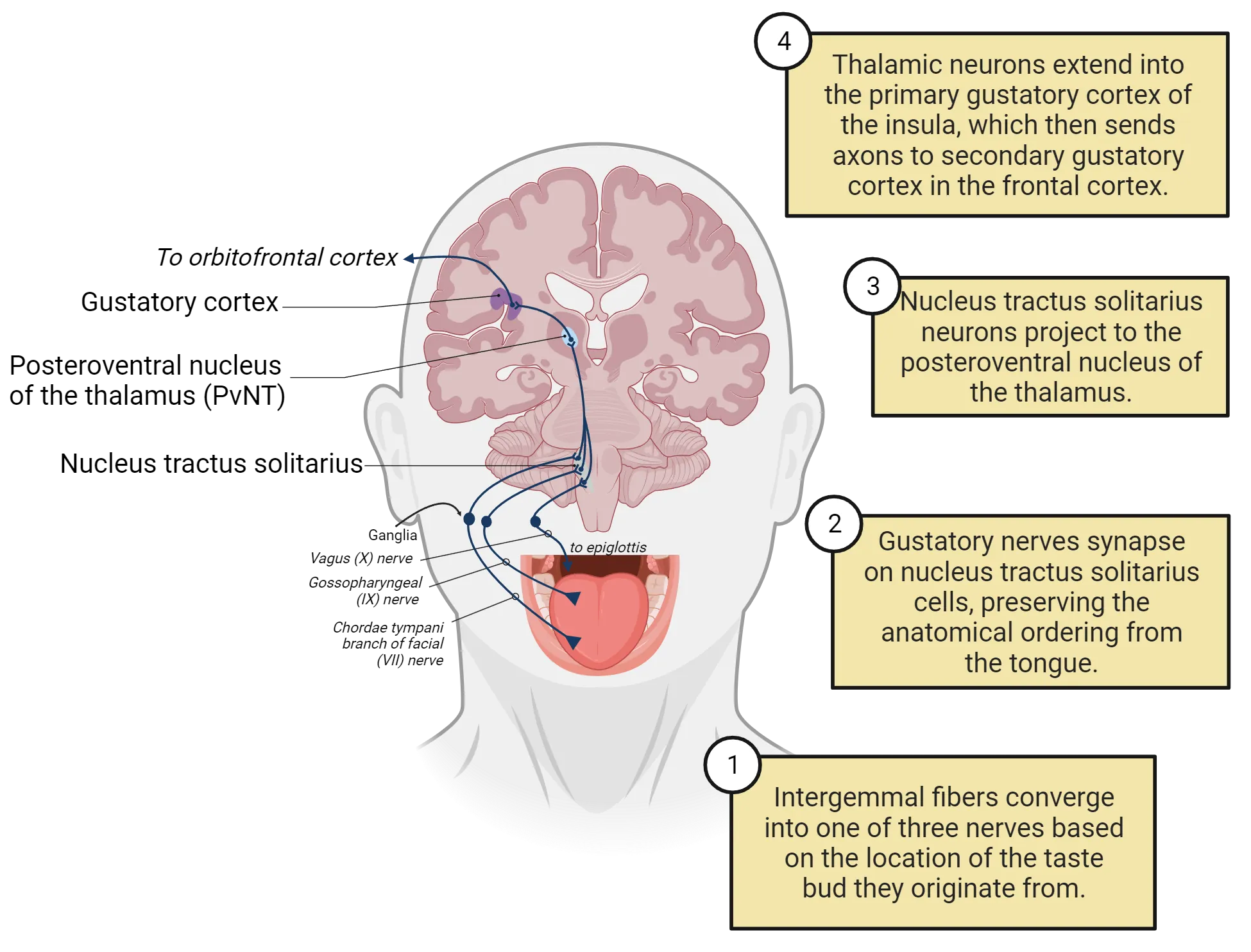
Diagram of the gustatory (taste) pathway from peripheral taste receptors to cortex. It highlights the cranial nerves carrying taste information to the brainstem (nucleus tractus solitarius), the thalamic relay, and the projection to gustatory cortex (commonly described around the insula/operculum). Source
Smell Shapes Flavor (Sensory Integration)
“Flavor” is not identical to taste. Much of what people call taste is actually smell.
Retronasal olfaction: when chewing and swallowing push volatile molecules up behind the palate into the nasal cavity, engaging olfactory receptors.
When olfaction is reduced (e.g., congestion), people often report food as “tasteless,” even though basic taste qualities (sweet, salty, etc.) remain available.
Flavor perception also incorporates texture, temperature, and irritation cues; however, the AP emphasis here is that smell strongly shapes flavor by contributing complex identity information (e.g., distinguishing apple from pear).
Touch (Somatosensation): Body and Brain Structures
Somatosensation: The body senses, including touch/pressure, vibration, texture, and temperature, detected by receptors in the skin and represented in the brain.
Skin receptors and what they detect
Touch relies on specialized receptors in the skin that transduce mechanical energy:
Mechanoreceptors support sensations such as pressure, vibration, stretch, and fine texture.
Commonly cited types include receptors most sensitive to:
Light touch and flutter
Steady pressure and edges
Deep pressure and vibration
Skin stretch
Touch signals are carried by sensory (afferent) neurons into the spinal cord and up to the brain, typically relaying through the thalamus and then to the primary somatosensory cortex in the parietal lobe (postcentral gyrus).
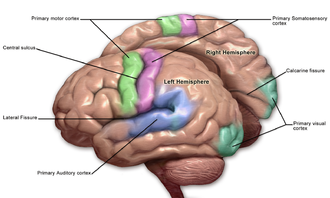
Labeled brain diagram locating the primary somatosensory cortex (S1) on the postcentral gyrus of the parietal lobe. This provides an anatomical anchor for where touch information is represented after thalamic relay, helping connect peripheral receptors to cortical processing. Source
Receptor differences affect sensitivity
Sensitivity is not uniform across the body because of differences in:
Receptor density: Areas like fingertips and lips have many receptors per unit area, supporting finer discrimination.
Receptive field size: Smaller receptive fields allow more precise localization of touch.
Cortical representation: Body regions with higher sensitivity occupy more area in the somatosensory cortex (often described as cortical “magnification”).
These factors help explain why the same physical stimulus can feel subtle in one location (e.g., forearm) but highly detailed in another (e.g., fingertips).
Practice Questions
Explain one way in which olfaction differs from many other senses in its pathway to the brain. (2 marks)
1 mark: States that smell information does not first relay through the thalamus.
1 mark: Correctly names an early structure (e.g., olfactory bulb) or indicates a more direct route to olfactory/limbic areas.
Describe how taste and smell contribute to flavour perception, and include: (i) the six basic taste qualities, (ii) how smell can reach the brain without first passing through the thalamus, and (iii) one reason sensitivity to touch varies across body regions. (6 marks)
(Any six well-developed points, max 6):
1 mark: Identifies that flavour is a combination of gustation and olfaction (not taste alone).
1 mark: Explains retronasal olfaction (odours from food reaching olfactory receptors during eating).
1 mark: Correctly lists at least four of the six basic tastes; 2 marks for all six (sweet, sour, salty, bitter, umami, fat) (cap at 2 marks total for listing).
1 mark: States that olfaction bypasses the thalamus first (no initial thalamic relay).
1 mark: Gives one correct touch-sensitivity factor: receptor density, receptive field size, and/or cortical representation differences.
FAQ
Yes; “supertasting” usually refers to heightened sensitivity to certain bitter compounds.
It is linked to:
Genetic variation in bitter receptors (e.g., TAS2R genes)
Higher density of fungiform papillae in some individuals
This can influence food preferences (e.g., stronger dislike of bitter vegetables) and may shape dietary patterns.
Olfactory perception often shows rapid adaptation.
Contributors include:
Peripheral receptor adaptation (receptors responding less over time)
Central habituation (the brain reduces attention to constant, non-informative stimuli)
This is one reason background odours fade from awareness while novel smells stand out.
Evidence is mixed.
Some studies suggest that human body odours can:
Bias social judgments (e.g., perceived pleasantness)
Relate to synchronised physiological effects in limited contexts
However, identifying a specific human pheromone with a dedicated, reliable behavioural effect is difficult, and findings vary across studies.
Different qualities rely on different transduction mechanisms.
Common distinctions include:
Ion channels for salty and sour (direct effects of ions)
G-protein-coupled receptors for sweet, bitter, and umami (slower, receptor-mediated cascades)
These differences help explain why tastes vary in onset, intensity, and lingering aftereffects.
Yes; repeated use can refine tactile discrimination.
Mechanisms may include:
Improved attentional strategies (better focusing on relevant tactile cues)
Experience-related changes in cortical representation (more efficient processing for frequently used skin areas)
Examples include musicians or Braille readers showing enhanced fingertip discrimination relative to controls.