AP Syllabus focus:
‘Sensation detects stimuli above threshold; absolute threshold, just-noticeable difference, Weber's law, and sensory adaptation explain sensitivity and change detection.’
Sensation begins with detecting energy from the environment and deciding whether it is strong enough to notice or different enough to matter. Psychologists measure these limits to explain everyday sensitivity and missed changes.
Detecting Stimuli: Thresholds and Sensitivity
Sensation and “above threshold”
Sensation: the process by which sensory receptors and the nervous system detect and represent stimulus energies from the environment.
A stimulus must exceed some minimum intensity to be detected reliably.
“Above threshold” does not mean “always noticed”; detection varies with factors like attention, fatigue, expectations, and competing background stimulation.
Absolute threshold (minimum detection)
Absolute threshold: the minimum stimulus intensity needed to detect a stimulus 50% of the time.
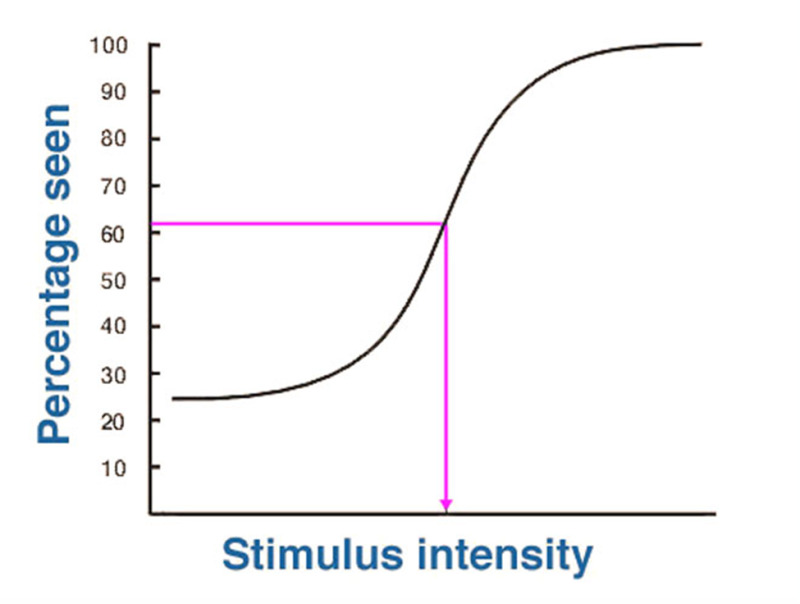
This psychometric function plots performance as a function of stimulus intensity, producing the characteristic S-shaped curve used in threshold research. The curve emphasizes that detection is probabilistic across intensities (performance rises gradually rather than switching instantly), which is why threshold definitions rely on a chosen criterion point on the curve. Source
Key implications for AP Psychology:
Absolute thresholds are probabilistic, not fixed “on/off” points.
The 50% criterion reflects normal variability in neural firing and moment-to-moment changes in alertness.
Detection can improve with practice in some tasks, but biological limits still constrain sensitivity.
Detecting Change: Difference Thresholds and JNDs
Just-noticeable difference (JND)
Just-noticeable difference (JND): the smallest detectable difference between two stimuli, detected 50% of the time.
The JND captures change detection: noticing a dimmer light, a slightly louder tone, or a small increase in weight. Perception of “difference” depends on both the size of the change and the starting intensity of the original stimulus.
Common influences on JND size include:
Stimulus intensity (stronger baseline intensities usually require larger changes)
Sensory modality (some senses discriminate changes more precisely than others)
Context (background noise/light can make changes harder to detect)
Weber’s law (proportional change)
Weber’s law: the principle that the size of a JND is a constant proportion of the original stimulus intensity.
Weber’s law explains why adding one candle to a dark room is noticeable, but adding one candle to a brightly lit room is not: the same physical change can feel different depending on the baseline.
Weber’s law is often expressed as a ratio.
= change in stimulus intensity required for a JND (same units as )
= initial stimulus intensity (e.g., luminance, weight, sound pressure)
Sensory Adaptation: When Constant Stimulation Fades
Reduced sensitivity over time
Sensory adaptation: decreased sensitivity to a constant, unchanging stimulus over time.
Sensory adaptation helps the nervous system prioritise novel or changing information.
With constant input (e.g., a persistent odour), receptor responses can diminish, making the stimulus less noticeable.
Adaptation supports efficient attention by reducing responsiveness to “background” stimulation that is unlikely to signal new information.
Sensory adaptation connects directly to thresholds:
A constant stimulus may start above absolute threshold but become less noticeable as sensitivity drops.
Adaptation can make small changes harder or easier to detect depending on whether the change introduces contrast against the adapted baseline.
Practice Questions
Define the absolute threshold and state what the “50% of the time” criterion means. (2 marks)
1 mark: Absolute threshold is the minimum stimulus intensity needed to detect a stimulus.
1 mark: “50% of the time” means detection is reliable only in about half of presentations due to variability (not always noticed).
Explain how the just-noticeable difference (JND) and Weber’s law describe change detection, and outline how sensory adaptation can affect noticing changes in a constant stimulus. (6 marks)
1 mark: JND defined as the smallest detectable difference between two stimuli (about 50% of the time).
1 mark: JND is about detecting change rather than simple presence/absence.
1 mark: Weber’s law described as proportionality between JND and initial intensity.
1 mark: Correct relationship stated (larger baseline intensity → larger change needed).
1 mark: Sensory adaptation defined as reduced sensitivity to constant stimulation over time.
1 mark: Clear link to change detection (adaptation can reduce noticing an unchanging stimulus and alter sensitivity to subsequent changes/contrast).
FAQ
The 50% rule captures the fact that detection varies from trial to trial.
Neural activity includes random “noise,” and attention fluctuates, so a strict 100% rule would depend too heavily on luck, fatigue, and guessing.
Yes, because receptor types and neural coding differ by modality.
Thresholds are also shaped by the stimulus dimension being tested (e.g., frequency vs intensity in hearing) and by environmental conditions (e.g., background illumination).
Weber’s law is an approximation.
It can be less accurate at extremely low intensities (near absolute threshold) or extremely high intensities, where receptors may saturate or compress signals.
Both can contribute.
Peripheral adaptation: receptor responses diminish with constant input.
Central adaptation: the brain reallocates attention and reduces responsiveness to uninformative input.
Yes.
If an important stimulus is constant (e.g., a faint smell indicating danger), adaptation may reduce awareness over time, making gradual risks harder to notice without deliberate attention or a changing signal.