AP Syllabus focus:
‘Sound varies in pitch and loudness; pitch theories, sound localization, and types of hearing loss explain auditory experience.’
Hearing converts physical sound waves into neural signals the brain interprets as meaningful auditory experience. AP Psychology emphasises how pitch and loudness are coded, how we locate sounds in space, and how hearing can be impaired.
Sound as a Physical Stimulus
Sound is a pattern of pressure changes travelling through a medium (usually air). The auditory system detects these waves and translates them into brain activity.
Pitch and Loudness Basics
Pitch: The perceived highness or lowness of a sound, primarily related to sound wave frequency.
Pitch is most closely tied to frequency (measured in hertz, Hz, cycles per second). A higher frequency is typically heard as a higher pitch.
Loudness: The perceived intensity (volume) of a sound, primarily related to sound wave amplitude.
Loudness is most closely tied to amplitude (wave height). The same physical intensity can be perceived as louder or quieter depending on context and individual sensitivity, but amplitude is the core stimulus dimension.
From Ear to Brain: Core Pathway (Overview)
Audition depends on coordinated mechanical and neural steps that preserve information about pitch and loudness.
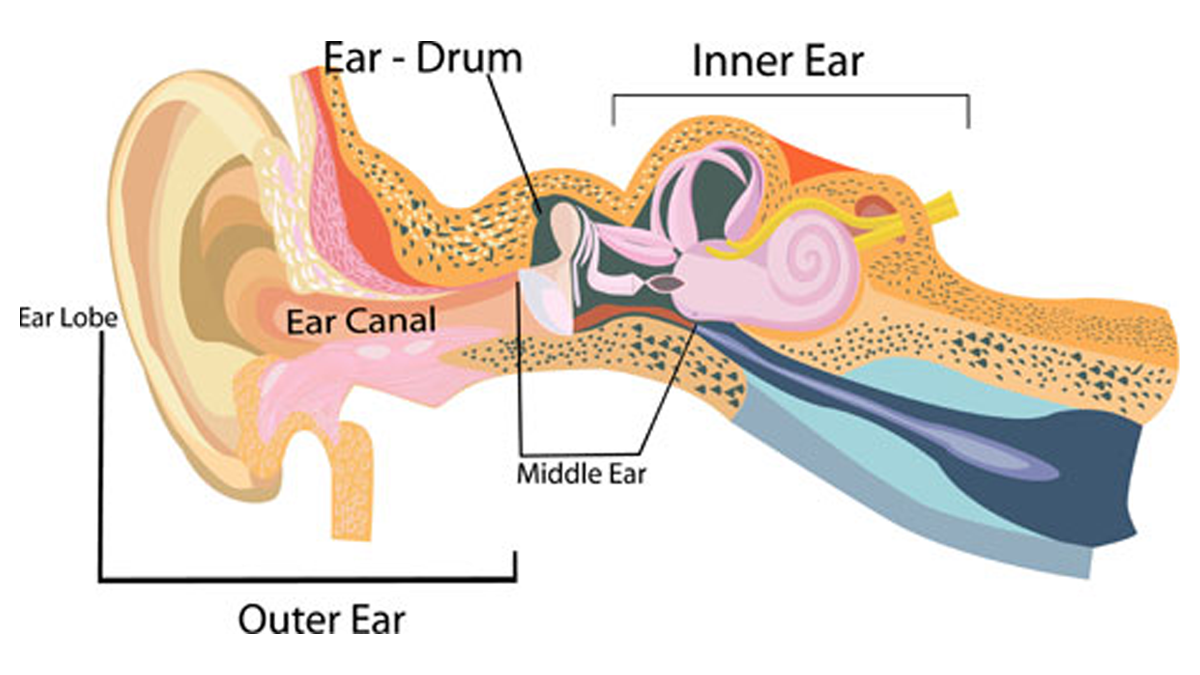
Diagram of the outer, middle, and inner ear (including the cochlea), showing the major structures that transmit sound energy toward the inner ear. This supports the idea that hearing begins as a mechanical process (sound conduction) and then transitions to neural signaling after cochlear transduction. Source
Outer ear (pinna and ear canal) funnels sound toward the eardrum.
Middle ear transfers vibration via the ossicles (tiny bones) to the inner ear; this amplification helps overcome the fluid resistance of the cochlea.
Inner ear contains the cochlea, where vibration becomes neural activity.
In the cochlea, vibrations move the basilar membrane and bend hair cells, leading to neural impulses in the auditory nerve.
Signals ultimately reach the brain areas that support auditory perception; AP Psychology focuses less on naming each relay and more on how information is encoded.
Coding Pitch: Major Theories
Because pitch varies widely across sounds, psychologists use multiple complementary explanations for how pitch is represented in the auditory system.
Place Theory (Where coding)
Place theory explains pitch by where the basilar membrane vibrates most.
Different sound frequencies produce peak movement at different locations along the basilar membrane.
Hair cells at that location fire more, creating a place code for pitch.
This theory is especially useful for explaining higher-pitched sounds (where the location differences are more distinct).
Frequency Theory (Rate coding)
Frequency theory explains pitch by how fast auditory neurons fire.
The firing rate of the auditory nerve matches (or reflects) the sound wave frequency.
This works best for lower frequencies, where neurons can more closely synchronise their firing to the wave pattern.
Volley Principle (Extending frequency coding)
For many mid-range frequencies, single neurons cannot fire quickly enough to match the wave frequency. The volley principle explains that:
Groups of neurons take turns firing in synchrony with the sound wave.
The combined activity (a “volley” pattern) can represent higher frequencies than any one neuron could alone.
In AP terms, pitch perception is often best understood as using both place and timing/rate information, depending on frequency.
Coding Loudness
Loudness depends on how strongly the auditory system is driven by a sound.
Greater amplitude produces greater movement of cochlear structures.
This typically leads to:
Higher firing rates in auditory neurons, and/or
Recruitment of more neurons (more hair cells and nerve fibres responding)
Perceived loudness also relates to how the brain integrates neural activity over time, but the key syllabus point is the amplitude–intensity link.
Sound Localisation (Finding Where Sound Comes From)
Sound localisation depends on comparing the sound arriving at the two ears and using cues shaped by the head and outer ear.
Duplex-theory figure showing how a sound source off to one side produces an interaural time difference (ITD) and an interaural level/intensity difference (ILD/IID) at the two ears. The image helps you connect the physical geometry of the head (path length and head shadow) to the two main binaural localisation cues emphasized in AP Psychology. Source
Binaural cues (two-ear comparisons)
These cues are strongest when both ears receive input.
Interaural time difference (ITD): the slight difference in arrival time between ears; especially informative for low-frequency sounds.
Interaural intensity (level) difference (IID/ILD): the difference in loudness at each ear due to the head casting a “sound shadow”; especially informative for high-frequency sounds.
Monaural cues (one-ear information)
Even with one ear, the auditory system can use:
Spectral cues created by the pinna (outer ear), which filters frequencies differently depending on sound direction
These cues help with elevation (above vs below) and front/back distinctions.
Localisation is therefore a perception problem: the brain infers location by integrating timing, intensity, and filtering patterns.
Types of Hearing Loss
AP Psychology commonly distinguishes hearing loss by where the breakdown occurs and what kinds of sounds are most affected.
Conductive Hearing Loss (Sound transmission problem)
Conductive hearing loss: Reduced hearing caused by damage or blockage in the outer or middle ear that prevents sound from being efficiently conducted to the cochlea.
This type can involve issues such as impaired vibration transfer (eardrum/ossicles) or blockage. It often reduces overall loudness (sounds seem muffled) because the signal is not effectively delivered to the inner ear.
Sensorineural Hearing Loss (Transduction or nerve problem)
Sensorineural hearing loss: Reduced hearing caused by damage to the inner ear hair cells or the auditory nerve, reducing the conversion of vibration into neural signals.
Sensorineural loss commonly affects clarity and the ability to detect certain pitches, depending on which hair cells are damaged. Because hair cells do not reliably regenerate, this loss is often permanent.
Mixed patterns and functional impact
Some people show mixed hearing loss (both conductive and sensorineural components). In all cases, hearing loss can change how pitch and loudness cues are received, which can also impair sound localisation (for example, weakened binaural comparisons).
Practice Questions
Explain the difference between place theory and frequency theory of pitch perception. (3 marks)
1 mark: Identifies place theory as coding pitch by the location of maximum vibration on the basilar membrane.
1 mark: Identifies frequency theory as coding pitch by the rate/timing of auditory nerve firing.
1 mark: Clear contrast between “where” (place) vs “how fast” (frequency), or notes that each is more effective at different frequency ranges.
Describe how humans localise sounds and explain how different types of hearing loss could disrupt localisation. (6 marks)
1 mark: Describes interaural time differences (ITDs) as a localisation cue.
1 mark: Describes interaural intensity/level differences (IIDs/ILDs) as a localisation cue.
1 mark: Mentions monaural spectral/pinna cues (or filtering cues) for direction/elevation.
1 mark: Explains conductive hearing loss as an outer/middle ear transmission problem.
1 mark: Explains sensorineural hearing loss as inner ear hair cell/auditory nerve damage.
1 mark: Links hearing loss to impaired localisation (e.g., reduced input to one ear weakens binaural comparisons; distorted frequency information disrupts cues).
FAQ
Audiograms plot hearing sensitivity across frequencies.
Because the cochlea is tonotopically organised (different places respond best to different frequencies), frequency-specific deficits on an audiogram can suggest which cochlear regions (and corresponding hair cells) are most affected.
Speech perception relies on rapid changes in frequency and timing cues.
Difficulty can arise from reduced temporal precision (timing information) or reduced frequency resolution, making consonants and speech in background noise especially challenging even when tones are detectable.
A cochlear implant bypasses damaged hair cells by electrically stimulating the auditory nerve.
It provides a coarse frequency representation via electrode channels, so pitch and timbre can be less detailed than typical hearing, and users often require substantial adaptation and training.
Noise adds competing signals that blur ITD and IID cues.
Reverberation (echoes) can also introduce multiple delayed versions of the sound, making the “true” onset timing and intensity differences harder for the brain to isolate.
Tinnitus is the perception of sound (often ringing) without an external source.
It is commonly associated with cochlear hair cell damage and may reflect changes in central auditory processing, where the brain increases neural gain or reorganises activity after reduced input.