IB Syllabus focus: 'Localization of brain function developed from research into language and helps explain human behaviour and cognition.'
Localization of function is a central idea in biological psychology. It proposes that specific brain regions carry out particular tasks, allowing researchers to connect damage in those areas with changes in language, thinking, and behavior.
The core idea
Localization of function suggests that the brain is not a single undifferentiated organ. Instead, different areas are specialized for different processes, such as speech, vision, movement, or memory.
Localization of function is the principle that specific psychological or physiological functions are associated with particular areas of the brain.
This idea became influential because researchers noticed that some brain injuries caused very specific impairments rather than a general loss of ability. If all parts of the brain did the same job, damage would be expected to produce broad and similar effects. Instead, different lesions often produced different symptoms.
Research into language was especially important in the development of localization because language difficulties are relatively easy to observe and describe. Distinct patterns of speech and comprehension problems gave early psychologists and neurologists evidence that different parts of the brain support different aspects of communication.
Language research and the development of localization
Broca’s area
In 1861, Paul Broca studied a patient nicknamed Tan, who could understand language fairly well but could say almost nothing except the word “tan.” After the patient died, Broca found damage in the left frontal lobe. Broca concluded that this area was important for speech production.
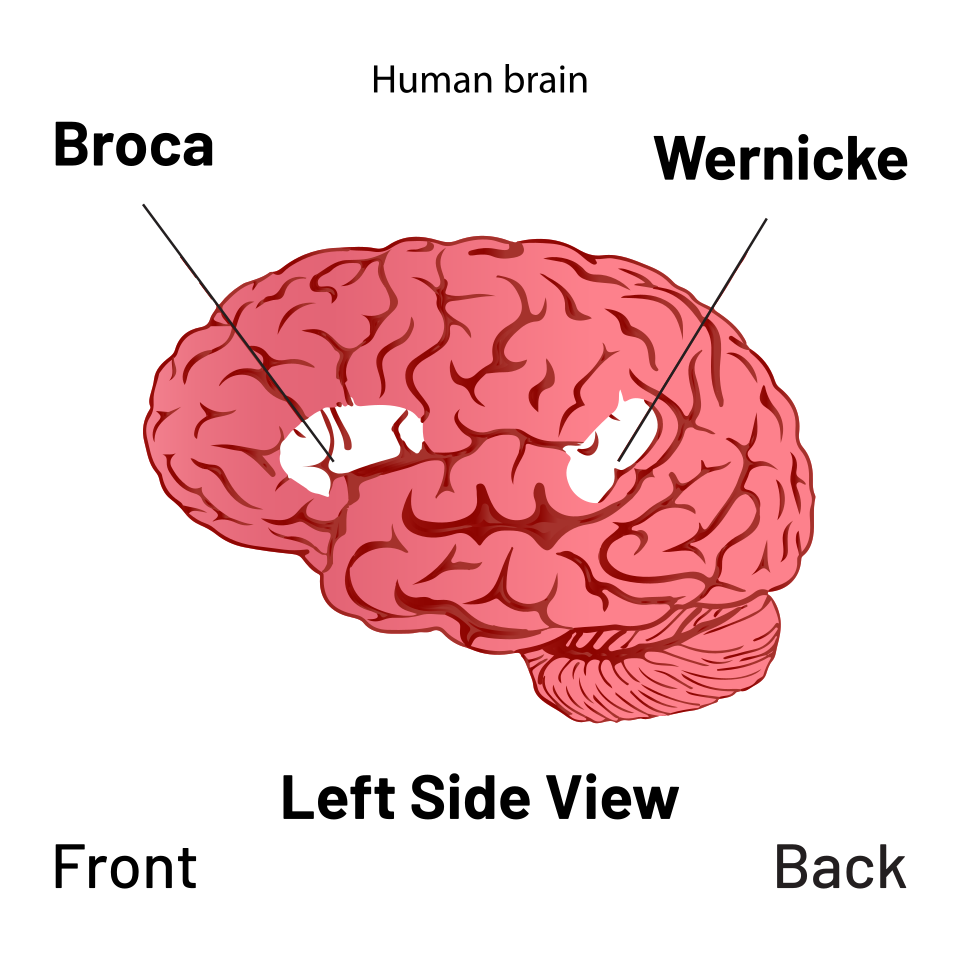
Labeled left-hemisphere diagram showing the locations of Broca’s area (inferior frontal lobe) and Wernicke’s area (posterior temporal region). It visually supports the core localization claim that distinct language functions—production versus comprehension—map onto different cortical regions. Source
This region became known as Broca’s area. Damage to it is associated with slow, effortful, and grammatically reduced speech. The person usually knows what they want to say but has difficulty producing fluent language.
Aphasia is an impairment of language, usually caused by brain damage, that affects speaking, understanding, reading, or writing.
Broca’s findings were important because they showed that one aspect of language could be linked to one specific brain area. This was strong support for localization.
Typical features of Broca’s aphasia include:
reduced fluency
difficulty forming complete sentences
relatively better comprehension than production
awareness of the problem, which can cause frustration
Wernicke’s area
Later, Carl Wernicke studied patients with a different pattern of language impairment. These individuals could speak fluently, but their speech often lacked meaning, and they had serious difficulty understanding spoken language. Wernicke linked this pattern to damage in the left temporal lobe, in a region now called Wernicke’s area.
This was a major development because it showed that language is not controlled by one single “language center.” Instead, different components of language are localized in different places.
Typical features of Wernicke’s aphasia include:
fluent but often meaningless speech
poor comprehension
difficulty monitoring errors in speech
use of inappropriate or invented words
Together, Broca’s and Wernicke’s work demonstrated that speech production and language comprehension are separable functions. This helped establish localization as a major principle in the biological approach.
How localization explains behavior and cognition
Localization of function helps psychologists explain why particular forms of behavior and cognition change after brain damage. If a function is associated with a specific area, then injury to that area should affect that function more than others.
Research into language led to the broader understanding that the cortex contains specialized regions.
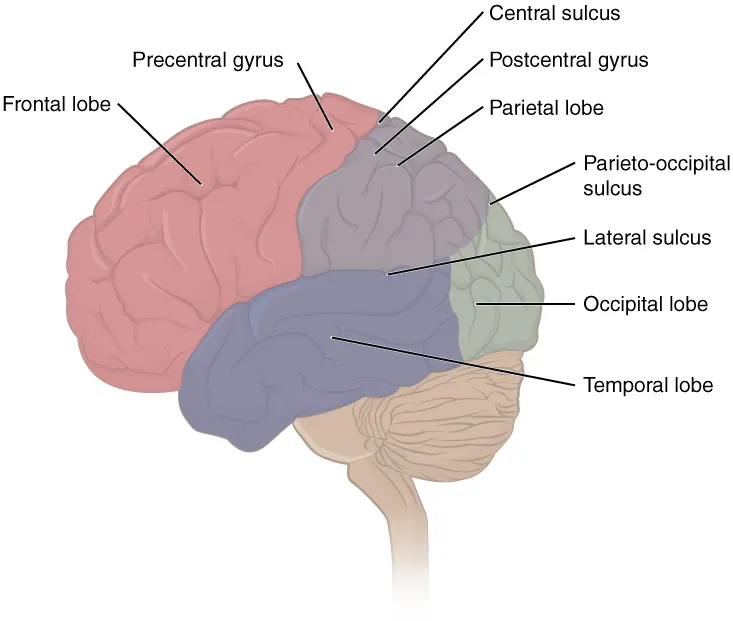
Lateral-view brain diagram labeling the four cortical lobes and key landmarks around the central sulcus (precentral and postcentral gyri). This helps link localization to multiple functions beyond language by situating motor and somatosensory regions within the broader lobe structure. Source
Important examples include:
Broca’s area: speech production
Wernicke’s area: language comprehension
motor cortex: voluntary movement
somatosensory cortex: touch and body sensation
occipital lobe: visual processing
temporal lobe structures: aspects of memory and auditory processing
Localization also links to lateralization, the idea that some functions are more strongly associated with one hemisphere than the other. Language is usually more strongly localized in the left hemisphere, especially in right-handed people, although this is not true in exactly the same way for everyone.
This matters for psychology because cognition can be studied in a more precise way. Instead of asking only whether the brain affects behavior, psychologists can ask which part of the brain is involved in which process.
Evidence and evaluation
Much early evidence for localization came from lesion studies, where researchers examined the effects of brain damage.
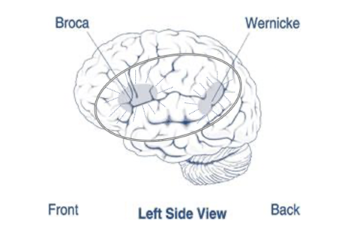
NIH/NIDCD educational figure illustrating language-related brain regions in the context of aphasia. It reinforces how lesion location is used clinically and in research to infer which brain areas are most critical for different aspects of language. Source
These studies were valuable because naturally occurring injuries revealed links between damaged tissue and lost abilities. Later, techniques such as electrical stimulation during surgery supported the same basic idea by showing that activating certain areas could trigger specific responses.
Key strengths of localization research include:
it is supported by clear clinical observations
it has practical value in diagnosis and treatment
it helps explain specific deficits in behavior and cognition
However, localization should not be treated too rigidly:
complex behaviors usually involve networks of brain regions, not just one spot
lesion studies are not perfect because damage may spread beyond one precise area
individual differences mean localization is not identical in every person
language itself depends on communication between several regions, not only Broca’s and Wernicke’s areas
Modern psychology therefore treats localization as a powerful but qualified explanation: some functions are strongly associated with particular brain areas, while more complex cognitive abilities depend on coordinated activity across multiple regions.
Practice Questions
Define localization of function and identify one brain area involved in language. [2]
1 mark for defining localization of function as the idea that specific brain areas are associated with specific functions.
1 mark for correctly identifying a language area and its role, for example:
Broca’s area: speech production
Wernicke’s area: language comprehension
Explain how research into language contributed to the development of localization of function. [6]
Award up to 6 marks for a clear explanation. Credit may include:
1–2 marks: accurate description of Broca’s research, including damage to the left frontal lobe and impaired speech production
1–2 marks: accurate description of Wernicke’s research, including damage to the left temporal lobe and impaired comprehension
1–2 marks: explanation that different language deficits were linked to different brain areas, supporting the idea that function is localized rather than evenly distributed across the brain
FAQ
Left-handed people are more likely than right-handed people to show language functions in the right hemisphere or across both hemispheres.
This does not mean left-handed people lack localization. It means the pattern of localization can vary between individuals. Researchers think genetics and early brain development both contribute to these differences.
The arcuate fasciculus is a bundle of nerve fibers connecting Broca’s area and Wernicke’s area.
Its importance is that language depends not only on specialized regions but also on communication between them. Damage to this pathway can disrupt repetition and coordination between understanding speech and producing it, showing that localization and connectivity both matter.
Doctors may use several methods to estimate where language functions are located before surgery:
language tasks during scanning
direct cortical stimulation during awake surgery
detailed neuropsychological testing
These methods help reduce the risk of removing or damaging tissue that is essential for speech or comprehension.
Conduction aphasia is a language disorder in which a person can often understand speech and speak fairly fluently but has major difficulty repeating words accurately.
It suggests that localization is not only about isolated brain centers. It also depends on the pathways linking those centers. This supports a more network-based view of language within the broader localization framework.
In bilingual individuals, the brain may use overlapping but not fully identical networks for different languages.
Factors that can affect mapping include:
age of second-language learning
proficiency level
how often each language is used
This means localization of language can be more complex than a single fixed “language area,” especially in multilingual speakers.