IB Syllabus focus: 'Students should understand genetic inheritance, gene-environment interaction and epigenetics in human behaviour.'
Genes influence behavior, but they do not act alone. IB Psychology focuses on how inherited biological factors interact with life experiences and how environmental conditions can alter gene expression across development.
Genetic inheritance
Genetic inheritance matters in psychology because biological information is passed from parents to offspring through DNA, contributing to differences in traits, cognition, temperament, and vulnerability to some disorders.
Genetic inheritance: The passing of genes from biological parents to offspring, influencing traits and potential behavioral tendencies.
Genes are segments of DNA located on chromosomes. Different versions of a gene are called alleles, and each person inherits one allele from each biological parent. Some inherited traits depend strongly on one gene, but most psychologically relevant traits are polygenic, meaning they are influenced by many genes acting together.
This is important because human behavior is rarely explained by a single “gene for” aggression, intelligence, or depression. Instead, many small genetic influences combine with each other and with experience.
What inherited influence means
Genetic influence is usually probabilistic, not deterministic.
Genes can increase or decrease the likelihood of an outcome.
The same inherited pattern can lead to different behaviors in different settings.
Genetic effects may be stronger at some life stages than others.
Psychologists often study inheritance using family, twin, and adoption research.
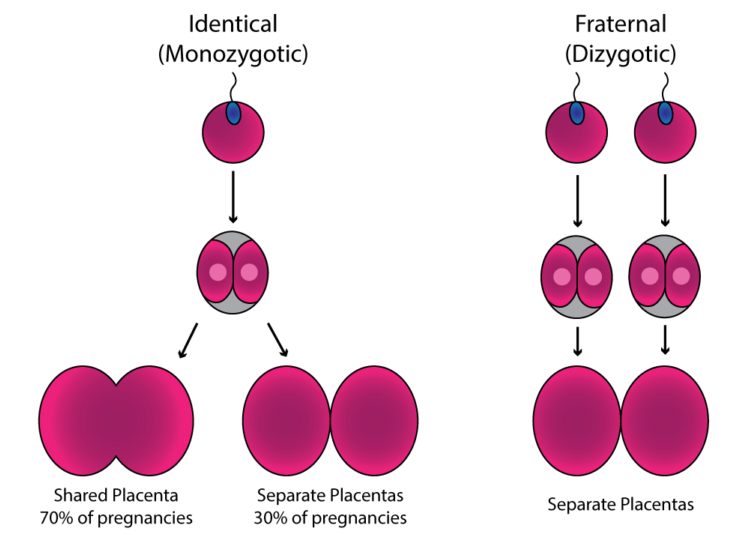
Diagram contrasting monozygotic (identical) twinning—one fertilized egg that later splits—versus dizygotic (fraternal) twinning—two separate eggs fertilized by two separate sperm. This helps explain why identical twins are used as a higher-genetic-similarity comparison group than fraternal twins in behavioral genetics. Source
These methods compare relatives who differ in genetic similarity. If identical twins are more similar than fraternal twins on a trait, this suggests a genetic contribution. However, such findings do not mean the trait is fixed or unavoidable in an individual.
A related idea is heritability, a population estimate of how much variation in a trait is associated with genetic differences. A high heritability estimate does not mean a trait cannot be influenced by education, stress, relationships, or culture. It only describes variation within a particular population at a particular time.
Gene-environment interaction
Psychologists do not treat genes and environment as two separate causes that simply add together. In many cases, genes affect how strongly a person responds to experience, and experiences affect whether inherited tendencies are expressed.
Gene-environment interaction: A process in which the effect of genetic variation on behavior depends on environmental conditions, and environmental effects differ depending on a person's genotype.
A useful way to think about this is that some people may be more biologically sensitive to the same environment than others. For example, exposure to chronic stress may have a stronger effect on mood in some individuals because of their genetic makeup. In contrast, supportive parenting or strong social support may reduce risk, even when a person has a genetic vulnerability.
Why gene-environment interaction matters
It avoids the false idea that genes work independently of experience.
It helps explain why people in the same environment can respond differently.
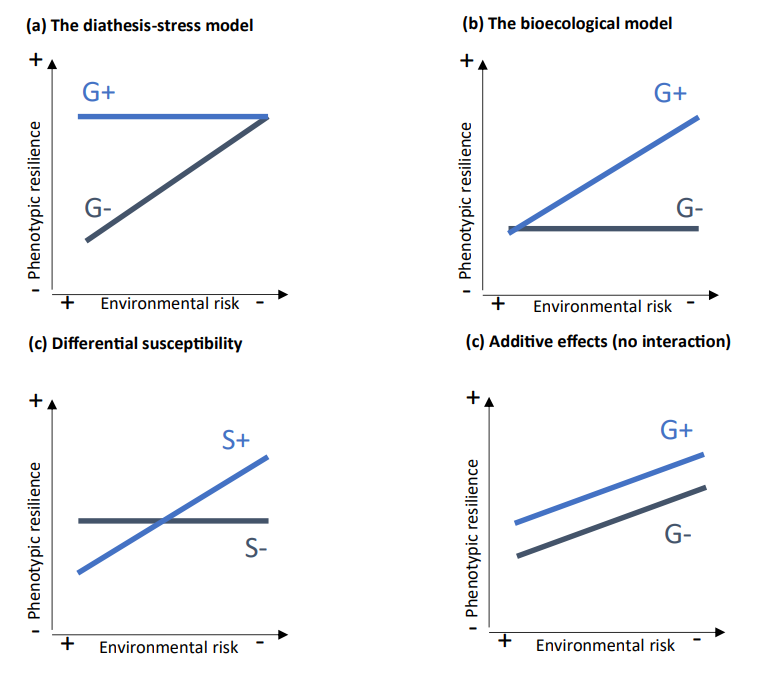
Figure showing several classic ways genes and environments can combine to shape outcomes, including diathesis–stress (genetic vulnerability expressed most strongly under adversity) and differential susceptibility (greater sensitivity to both negative and positive environments). The lines/curves illustrate interaction patterns rather than simple additive effects, matching the idea that genetic influences often depend on environmental context. Source
It also explains why people with similar genes can develop differently over time.
One line of research suggests that certain genetic variants are associated with a higher risk of depression mainly when they are combined with major life stress. Another example concerns antisocial behavior, where genetic differences may matter more when childhood environments involve neglect or maltreatment. These findings do not show that genes directly cause a behavior. Instead, they suggest that genes can shape sensitivity to environmental input.
This idea is especially relevant in psychology because many behaviors of interest, such as emotional regulation, learning, and social functioning, develop over time. As a result, inherited tendencies should always be interpreted in context.
Epigenetics
A further development in biological psychology is epigenetics, which helps explain how environmental factors can influence gene activity without changing the DNA sequence itself.
Epigenetics: The study of changes in gene expression caused by chemical processes that switch genes on or off without altering the DNA sequence itself.
Epigenetics shows how experiences can affect whether genes are active. Factors such as nutrition, chronic stress, caregiving, trauma, toxins, sleep disruption, and social deprivation may influence gene expression.
Two commonly discussed mechanisms are:
DNA methylation: chemical tags reduce the likelihood that a gene will be expressed.
Histone modification: changes to proteins around which DNA is wrapped can make gene expression easier or harder.
These mechanisms matter for behavior because gene expression affects the production of proteins involved in brain development, stress responses, and other biological systems linked to behavior. Through this route, environmental conditions may influence attention, emotional regulation, memory, and vulnerability to psychological disorders.
Epigenetics across development
Epigenetic processes are especially important during development because some periods are more sensitive to environmental input than others. Early childhood, adolescence, and times of prolonged stress may be particularly influential. This helps explain how supportive or adverse environments can have long-term psychological effects.
Epigenetics also challenges the mistaken idea that biological explanations are always fixed explanations. If gene expression can change in response to experience, then biology itself is dynamic. Some epigenetic marks may persist for long periods, while others may change as environments change.
Interpreting genetic evidence carefully
When discussing genetics in IB Psychology, it is important to avoid oversimplified claims.
A genetic contribution does not mean a behavior is inevitable.
An environmental contribution does not mean genes are irrelevant.
Epigenetic change alters gene expression, not the DNA sequence itself.
Findings from groups do not predict an individual’s outcome with certainty.
Most human behaviors are influenced by multiple genes and multiple environmental factors working together.
Practice Questions
State what is meant by gene-environment interaction. [2]
1 mark for stating that genes and environment affect behavior together.
1 mark for explaining that the effect of genes depends on environmental conditions, or that environmental effects differ according to genotype.
Explain one way epigenetics helps psychologists understand human behavior. [6]
1 mark for identifying epigenetics as changes in gene expression without changing DNA sequence.
1 mark for identifying a relevant environmental influence such as stress, trauma, nutrition, or caregiving.
2 marks for explaining how that influence can alter gene activity through epigenetic processes.
1 mark for linking altered gene activity to biological systems relevant to psychology, such as stress response or brain development.
1 mark for clearly linking the explanation to behavior, emotion, cognition, or risk of a psychological disorder.
FAQ
Identical twins share nearly all their DNA, but they do not share every experience.
Differences can grow because of:
different friendships and peer groups
different illnesses, injuries, or stress exposure
different roles within the family
random developmental variation
epigenetic changes over time
These influences are often called nonshared environmental factors because they affect one sibling more than the other.
Some can, and some are more stable.
Epigenetic marks are chemical modifications, not permanent rewrites of DNA. That means they may change with:
development
improved nutrition
reduced stress
medication
psychotherapy or lifestyle change
However, reversal is not guaranteed. Some marks can persist for long periods, especially if they formed during sensitive developmental stages.
This is possible, but the evidence in humans is still debated.
Researchers are interested in whether some epigenetic marks can be transmitted through sperm or egg cells. Animal research gives stronger support than human research.
In humans, it is difficult to separate true biological transmission from shared family environment, parenting, and socioeconomic conditions.
Heritability is not a fixed property of a trait everywhere.
It changes depending on:
how much genetic variation exists in the sample
how similar or different environments are
the age of the group being studied
how the trait is measured
A trait can show high heritability in one population and lower heritability in another if environmental conditions differ.
A genetic marker is a DNA variation associated with a trait. A causal gene directly contributes to the biological process producing that trait.
The two are not always the same.
Sometimes a marker is only located near the actual causal variant, so it appears linked in research without being the true mechanism. This is why replication and biological explanation are both important in genetics research.