IB Syllabus focus: 'Students should evaluate biological reductionism and the diathesis-stress model in explaining human behaviour.'
These notes examine how the biological approach explains behavior through underlying mechanisms and why many psychologists prefer interactionist explanations that combine vulnerability with environmental stress.
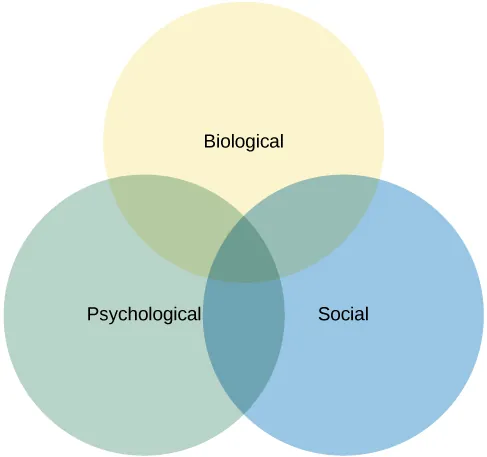
This diagram shows the biopsychosocial model, where biological, psychological, and social factors overlap to shape health and behavior. In evaluation terms, it visually captures why purely biological (reductionist) accounts may miss important psychological processes and social context, supporting a more interactionist explanation. Source
Why this subtopic matters
In IB Psychology, you need to evaluate, not just describe, biological explanations. That means judging how useful they are, what evidence supports them, and whether they explain behavior fully.
Biological reductionism
What it means
Biological reductionism explains complex behavior by breaking it down into simpler biological parts, such as genes, neural activity, hormones, or neurotransmitters.
Biological reductionism: Explaining human behavior by reducing it to underlying biological mechanisms rather than considering the full complexity of the person and situation.
This approach is attractive because biological processes can often be measured directly, making explanations more scientific and easier to test.
Strengths
Reductionism has important strengths.
It can produce precise, testable explanations.
It supports scientific methods, including family studies, drug trials, and brain-based measures.
It can lead to effective treatments when a specific biological mechanism is identified.
For example, if symptoms are linked to neurochemical activity, biological treatments may reduce them. This gives reductionism strong practical value.
Limitations
A major limitation is oversimplification. Human behavior is influenced by cognition, relationships, social context, and experience as well as biology. Explaining depression only in terms of serotonin, for example, ignores loss, beliefs, or coping.
Reductionism may also encourage biological determinism, the idea that behavior is fixed by biology. This can underestimate personal agency and change. People with similar biological characteristics do not always behave in the same way.
Another criticism is that biological findings do not always provide a complete causal explanation. A biological difference linked to a disorder may be one factor in a larger process rather than the sole cause.
For IB evaluation, the strongest judgment is usually balanced: reductionism is useful for isolating mechanisms and developing treatments, but it is often incomplete as a full explanation of behavior.
Diathesis-stress model
Core idea
The diathesis-stress model is less reductionist because it combines biological vulnerability with environmental experience.
Diathesis-stress model: A model proposing that behavior or psychological disorder develops through the interaction between a predisposition, called a diathesis, and environmental stress.
A diathesis may be genetic, neurochemical, or physiological, while stress refers to external pressures or life events that trigger the vulnerability. The key idea is interaction: neither factor always produces the outcome by itself.
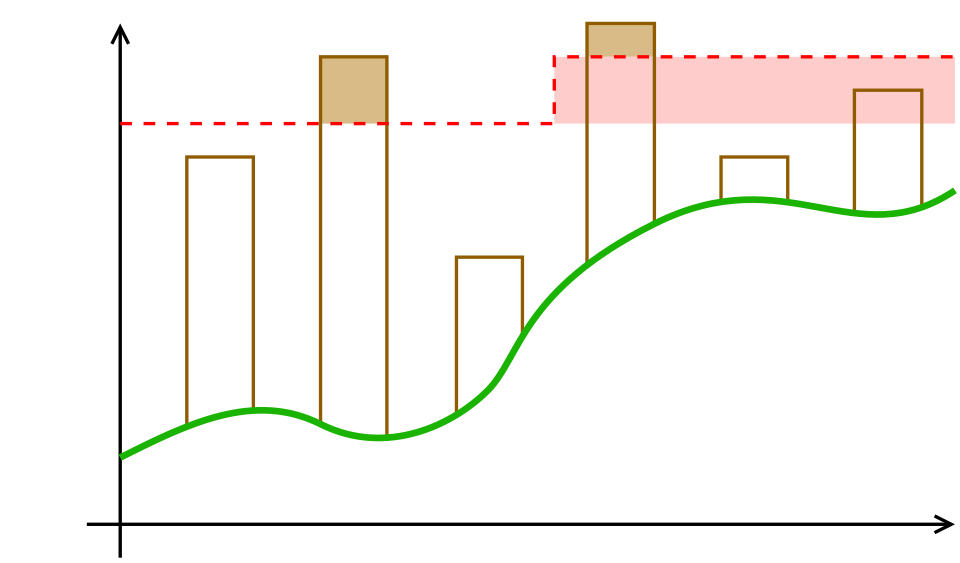
This graph illustrates the diathesis–stress (vulnerability–stress) model as a threshold process: as environmental stress increases, individuals with greater underlying vulnerability show a steeper rise in symptoms and cross the disorder threshold earlier. It helps distinguish “risk” (diathesis) from “triggering conditions” (stress) while showing why the same stressor can produce different outcomes across people. Source
This model helps explain why some people develop disorders after adversity while others do not, and why some people with a vulnerability remain healthy.
How it explains behavior
In this model:
Diathesis creates increased risk.
Stress activates or intensifies that risk.
A disorder or pattern of behavior emerges when the combination becomes strong enough.
The model is often applied to depression and schizophrenia because both show evidence of inherited risk alongside important environmental influences.
A well-known example is Caspi et al. (2003). The researchers found that people with a short version of the 5-HTT gene were more likely to show depressive symptoms, especially after stressful life events. This suggests that genes alone were not enough; the environment changed the outcome.
Research by Tienari et al. on schizophrenia also supports the model. Genetic risk was more strongly associated with schizophrenia when the adoptive family environment was disturbed, showing that vulnerability and stress can interact.
Evaluation
A major strength is that the model is interactionist. It avoids the extreme reductionism of explanations based only on genes or brain chemistry, so it better reflects the complexity of behavior.
It is also supported by studies showing that biological predispositions often predict outcomes more strongly under stressful conditions. This helps explain individual differences.
The model has practical value because it suggests several intervention points:
reduce stress exposure
strengthen coping skills
identify high-risk individuals early
build protective social support
There are limits, however. Stress can be difficult to define and measure accurately. Researchers may rely on self-report or broad categories of life events, which can reduce validity.
The model can also still be too simple. Many behaviors involve multiple vulnerabilities, multiple stressors, and protective factors operating over time. Because of this, the model often explains probability rather than giving precise predictions about individuals.
Using these ideas in evaluation
In essays, direct comparison is useful.
Biological reductionism focuses mainly on internal biological mechanisms.
The diathesis-stress model includes biology but also recognizes environmental influence.
Reductionism is often better for isolating causes.
Diathesis-stress is often better for explaining variation between people.
A strong IB response should argue that biological explanations are most convincing when they are placed in context rather than treated as the only cause of behavior.
Practice Questions
Define biological reductionism.
1 mark for stating that behavior is explained through biological factors or mechanisms.
1 mark for indicating that complex behavior is reduced to simpler processes such as genes, brain activity, hormones, or neurotransmitters.
Explain one strength and one limitation of the diathesis-stress model in explaining human behavior.
1 mark for identifying that the model involves an interaction between predisposition and environmental stress.
1 mark for clarifying that a diathesis is a vulnerability or predisposition.
1 mark for identifying one valid strength, such as being interactionist or supported by research.
1 mark for explaining that strength with a clear link to explaining behavior.
1 mark for identifying one valid limitation, such as difficulty measuring stress or oversimplification.
1 mark for explaining that limitation with a clear link to explaining behavior.
FAQ
Reductionism is about the level of explanation. It asks whether behavior is being explained only through small biological parts, such as genes or neurotransmitters.
Determinism is about control and causation. It suggests behavior is fixed or caused by factors outside conscious choice.
A theory can be reductionist without being completely deterministic if it allows for probability, change, or environmental influence.
Yes. In many cases, vulnerability is probably polygenic, meaning it reflects the combined effect of many genes, each with a small influence.
This is often more realistic than assuming one “disorder gene.”
A polygenic view fits the diathesis-stress model well because:
genetic risk can vary by degree
environmental stress may affect people differently even with similar genetic profiles
prediction becomes probabilistic rather than certain
The same event may not be psychologically identical for both people.
Differences can come from:
different biological sensitivity to stress
different previous experiences
different interpretations of the event
different levels of social support
different timing, such as adolescence versus adulthood
In a diathesis-stress framework, siblings may share some risk but still have different thresholds for developing symptoms.
Yes. Although it is often used for psychopathology, the logic can be applied more broadly.
For example, researchers may use it to think about:
substance misuse after chronic stress
aggressive reactions under provocation
stress-related performance breakdowns
burnout in people with high physiological reactivity
The key requirement is the same: a pre-existing vulnerability combines with environmental pressure to increase the likelihood of a behavior.
Labeling a person as “high risk” can create problems if the information is misunderstood or misused.
Possible concerns include:
stigma from others
self-fulfilling expectations
privacy issues around biological data
anxiety caused by learning about risk
unfair treatment by schools, employers, or insurers
Ethically, psychologists should present vulnerability as risk, not destiny, and protect confidentiality carefully.