IB Syllabus focus: 'The biological approach has evolved from early neurosurgery and phrenology toward scientific explanations of brain and behaviour.'
The biological approach explains behavior by linking it to the brain, nervous system, hormones, and genes. Its development shows how psychology moved from speculation and crude intervention toward evidence-based scientific investigation.
What the biological approach studies
The biological approach starts from the assumption that human thoughts, emotions, and actions have physical causes. Rather than treating the mind as separate from the body, it argues that behavior can be understood through the structure and function of biological systems.
Biological approach: A perspective in psychology that explains behavior and mental processes through biological factors such as the brain, nervous system, genetics, and physiology.
This approach became important because it pushed psychology toward observable evidence. If behavior has biological causes, then researchers can investigate those causes by studying injuries, anatomy, and measurable bodily processes. However, this idea developed slowly and was shaped by both useful discoveries and serious mistakes.
Early origins in neurosurgery
One of the earliest roots of the biological approach can be seen in neurosurgery, especially very early procedures such as trepanation, in which a hole was made in the skull.
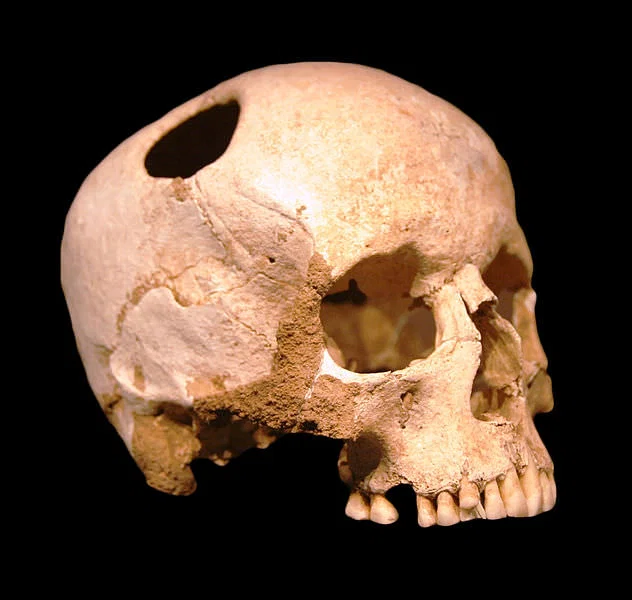
This specimen photograph shows a skull with a trepanation opening—evidence of early surgical intervention on the head. It helps contextualize the biological approach’s earliest roots: people acted on the idea that the head was linked to abnormal experiences or behavior, even without modern anatomy or infection control. Pairing this with later brain-localization diagrams highlights the historical move from crude intervention to evidence-based explanation. Source
These practices existed long before modern psychology and medicine, and they were often based on religious or supernatural beliefs rather than science.
Even so, early neurosurgery is historically important because it suggests that people recognized some connection between the head and mental or behavioral disturbance. This was a significant step away from the belief that all abnormal behavior came only from spirits or moral weakness.
Early neurosurgery had major limitations:
there was little understanding of infection, anesthesia, or brain function
treatments were not based on controlled evidence
outcomes were inconsistent and often dangerous
Despite these problems, early procedures helped establish a basic idea that became central to the biological approach: changes to the brain may alter behavior. That idea later became much more precise and scientific.
Phrenology and the search for brain-behavior links
A major stage in the evolution of the biological approach was phrenology, associated especially with Franz Joseph Gall in the late eighteenth and early nineteenth centuries.
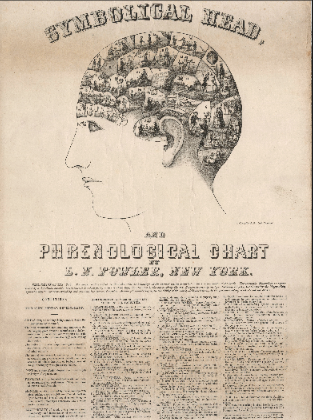
This 19th-century phrenological chart shows a head divided into numbered regions, each claimed to correspond to a specific mental faculty. It is a clear example of early (but scientifically unsupported) attempts to localize psychological traits to particular brain/skull areas. In IB terms, it helps you see why phrenology was persuasive historically, even though its method was not empirical. Source
Phrenology: An early theory claiming that different mental traits are located in specific parts of the brain and that these traits can be identified by the shape of the skull.
Phrenology is now considered pseudoscientific because its methods and conclusions were not supported by reliable evidence. Researchers could not validly infer personality, intelligence, or morality from bumps on the skull. Its claims were often subjective, oversimplified, and vulnerable to bias.
However, phrenology still mattered in the history of psychology for two reasons.
It proposed that different parts of the brain might have different functions.
It encouraged the idea that mental processes should be explained through the brain, not through abstract philosophy alone.
So, phrenology was largely wrong in method and conclusion, but it asked a question that became scientifically productive: Are specific psychological functions related to specific brain areas?
This shows an important pattern in the origins of the biological approach. Not all early theories were correct, but some helped redirect thinking toward the body and the brain.
From speculation to scientific explanation
The biological approach became more scientific when researchers began relying on systematic observation, clinical evidence, and later experimental methods. Instead of guessing from skull shape, scientists studied what happened when particular brain areas were damaged.
For example, physicians noticed that some patients with brain injuries showed specific changes in language, movement, or memory, while other abilities remained intact.
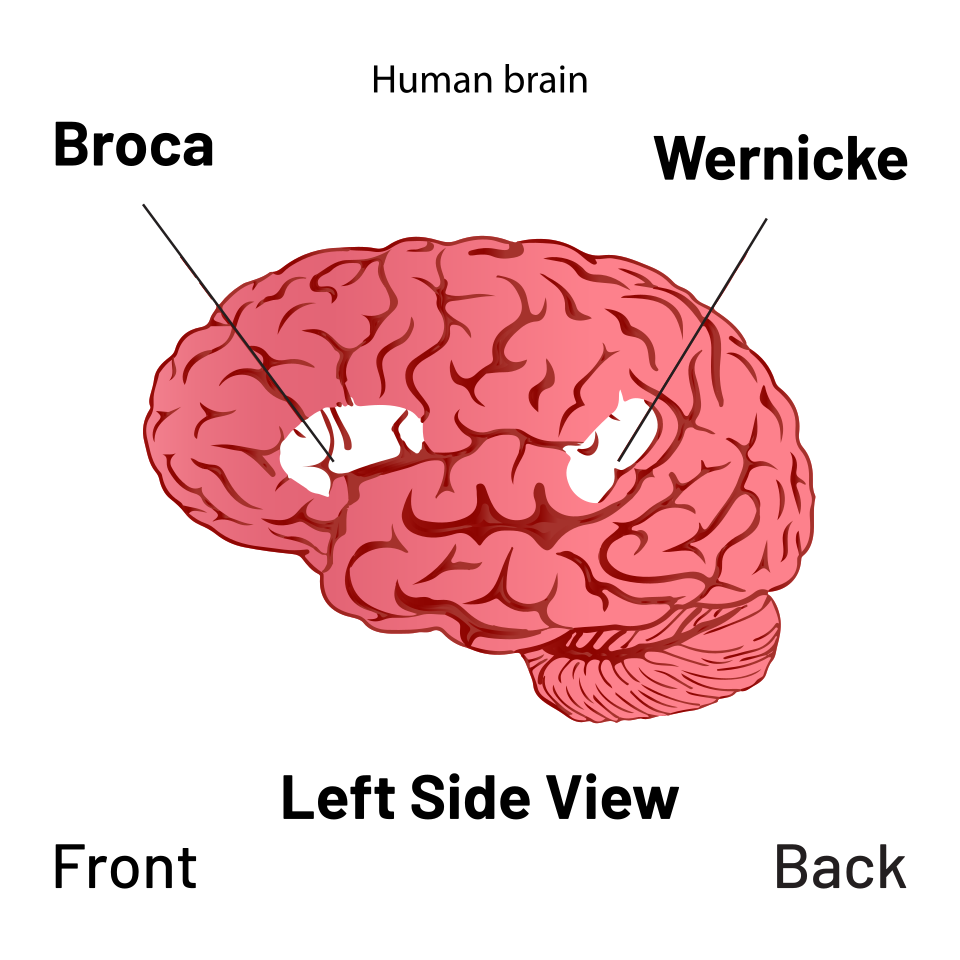
This labeled brain diagram highlights Broca’s area and Wernicke’s area, two classic regions associated with language production and language comprehension. It exemplifies how biological psychology uses brain localization to connect observable neural damage with specific behavioral changes. Use it as a visual anchor for lesion-based reasoning: specific deficits can point to specific cortical networks. Source
This was much stronger evidence than phrenology because it linked observable brain damage with observable behavioral change.
Several developments pushed the field forward:
clinical case studies of patients with localized brain injury
postmortem examination comparing symptoms during life with brain damage found after death
better anatomical knowledge of the nervous system
more careful measurement and recording of behavior
As these methods improved, explanations of behavior became more empirical.
Empirical: Based on observation, measurement, and evidence rather than belief, intuition, or tradition.
This shift was crucial. A scientific biological approach does not just claim that the brain matters; it requires that claims about the brain can be tested, supported by evidence, and revised if evidence changes.
How the biological approach evolved
The evolution of the biological approach can be understood as a movement across three broad stages.
Stage 1: Crude physical intervention
Early neurosurgery showed a rough awareness that the head was related to behavior, but knowledge was limited and explanations were often non-scientific.
Stage 2: Speculative theory
Phrenology moved closer to a brain-based explanation of behavior, but it relied on invalid assumptions and poor methods.
Stage 3: Evidence-based science
Later research used lesion evidence, observation, anatomy, and increasingly rigorous methodology to explain behavior through the brain in a more credible way.
This evolution matters because it shows that the biological approach was not simply “discovered.” It was built gradually, through correction of earlier errors. Modern biological psychology rests on principles that early versions often lacked:
objective measurement
careful observation
testable explanations
willingness to reject unsupported claims
The history of this approach also reminds students to evaluate theories critically. An idea may seem biological and still be weak science. What makes the modern biological approach valuable is not just its focus on the body, but its commitment to scientific explanations of brain and behavior.
Practice Questions
(2 marks)
Identify one reason why phrenology is not considered a scientific explanation of behavior.
1 mark for identifying a valid reason, such as phrenology relied on skull shape to infer mental traits.
1 mark for explaining why this was scientifically weak, such as lack of reliable evidence, poor validity, or subjective interpretation.
(6 marks)
Explain how the biological approach evolved from early neurosurgery and phrenology toward scientific explanations of behavior.
Award 1 mark for each relevant explained point, up to 6 marks. Possible points include:
Early neurosurgery suggested a link between the head/brain and behavior.
Early neurosurgery was not scientific because it lacked controlled evidence and medical knowledge.
Phrenology proposed that mental functions might be linked to specific brain areas.
Phrenology was flawed because skull shape is not a valid measure of brain function or personality.
Later researchers used observation of brain injury and behavior to produce stronger evidence.
The biological approach became more scientific through empirical methods, anatomy, clinical evidence, and testable explanations.
FAQ
Phrenology became popular because it offered a simple, physical explanation for personality and mental ability at a time when many people wanted science-like answers about human nature.
It also fit wider social interests in classification and measurement. Even though its conclusions were false, it attracted attention because it seemed more concrete than philosophical ideas about the mind.
Progress in medicine made biological explanations more credible. As knowledge of anatomy, disease, and surgery improved, researchers could study the body with greater precision.
This mattered because psychology could begin borrowing methods from medicine, especially careful observation of symptoms, diagnosis, and comparison between physical damage and behavioral change.
Yes, indirectly. Its main lasting contribution was not its findings but the type of question it asked.
It encouraged later scientists to investigate whether different brain regions might support different functions. The theory was wrong, but the broader search for brain-behavior relationships continued in more scientific ways.
Postmortem studies allowed early researchers to compare a person’s symptoms during life with the condition of the brain after death.
This gave stronger evidence than speculation alone because it connected observed behavior to actual physical damage. Although limited, this method helped move the field toward evidence-based claims.
Absolutely. A theory is not scientific just because it talks about the brain or body.
For a biological explanation to be good science, it should:
be based on evidence
use valid methods
allow testing and replication
be open to revision if new findings disagree with it
Phrenology is a useful historical example of a biological theory that failed these standards.